

On this page
You solve a three-step physics numerical, apply the right formula, calculate accurately, and still get marked wrong. Checking the answer key reveals the problem: your number differs from the solution by a factor of 1000, 10⁵, or 10⁻¹⁹. In exams like JEE Main, JEE Advanced, and NEET, this mistake is frequent: the physics reasoning was correct, but an uncorrected unit conversion spoiled the result.
As we discuss in our guide on why you understand physics theory but still fail numericals, execution errors often masquerade as conceptual gaps. Targeted conversion drills make unit transitions automatic before exam day.
Why do unit conversion errors happen in physics and chemistry?
Unit conversions require multi-step proportional reasoning under timed pressure. In a 2015 study in Investigations in Mathematics Learning, researchers Allison Dorko and Natasha Speer found that 73% of undergraduate calculus students gave incorrect units for at least one area or volume task. Students understood the algebra, but treated units as superficial labels rather than dimensional quantities, failing to square or cube scaling factors.
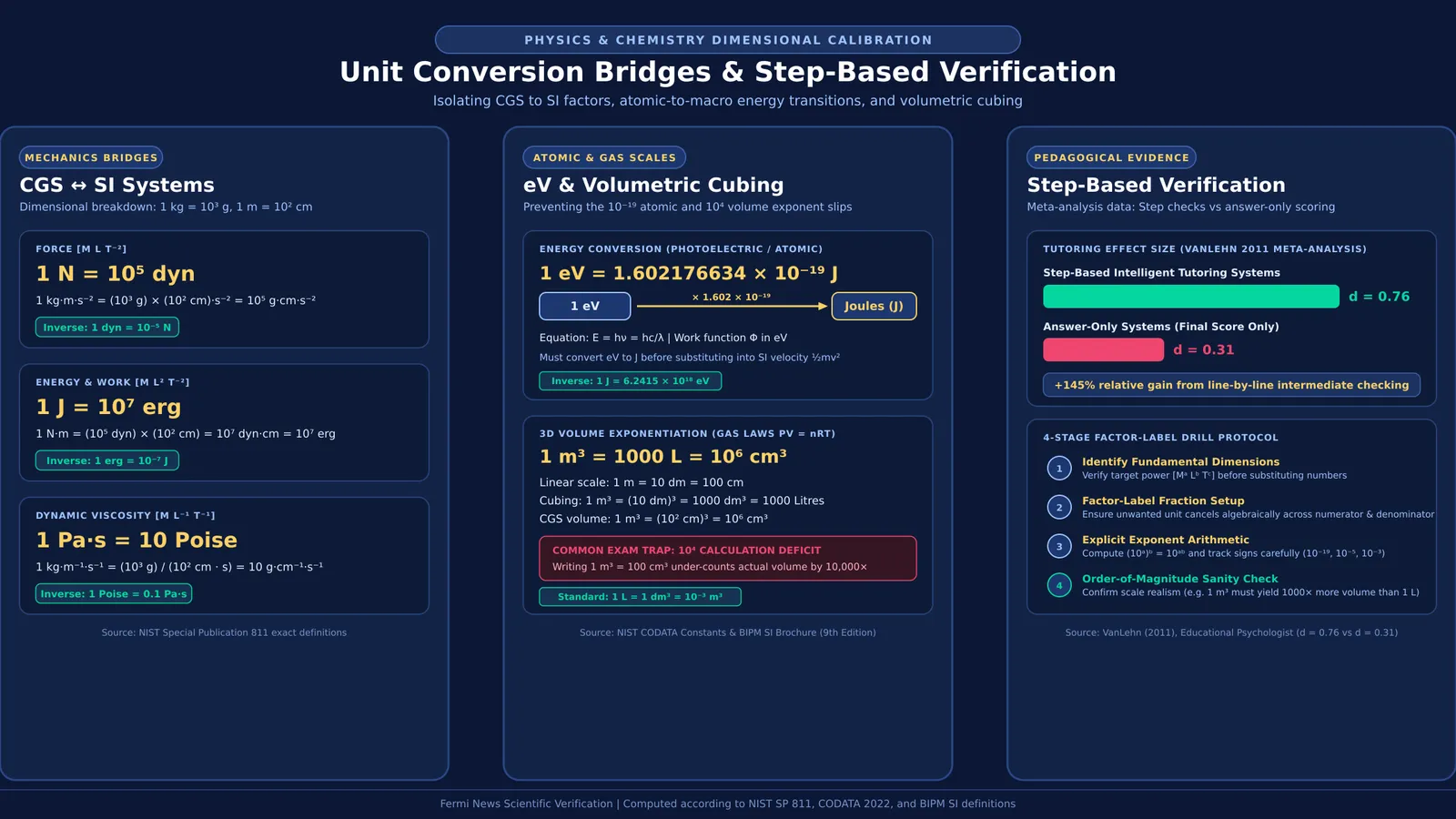
When moving to higher dimensions, linear intuition fails. Students know 1 m = 100 cm, but writing 1 m³ as 100 cm³ instead of (100 cm)³ = 10⁶ cm³ introduces a 10⁴ error. Mixing CGS and SI units in mechanics or confusing atomic and macroscopic energy scales causes similar calculation slips.
How do you drill CGS, electron-volt, and volume conversions?
Focus your drills on three conversion families that recur across physics and chemistry:
Mechanical transitions between CGS and SI. In mechanics and fluids, problems often state force in dynes, work in ergs, or viscosity in poise. According to NIST Special Publication 811, 1 dyne equals 10⁻⁵ N, 1 erg equals 10⁻⁷ J, and 1 poise equals 0.1 Pa·s. Because 1 N = 1 kg·m·s⁻², converting to grams and centimetres gives (10³ g) × (10² cm)·s⁻² = 10⁵ dynes. See our guide on converting a quantity between unit systems using dimensions.
Energy conversions between electron-volts and joules. Modern physics problems give energies in electron-volts (eV). Under the NIST Reference on Constants, Units, and Uncertainty, 1 eV equals 1.602176634 × 10⁻¹⁹ J. When formulas like kinetic energy (½mv²) require SI units, multiply by 1.602 × 10⁻¹⁹ J/eV first. Working in eV·nm for photon wavelengths also avoids exponent slips.
Volumetric conversions between litres and cubic metres. In gas calculations (PV = nRT), pressure in Pascals requires volume in cubic metres (m³). According to the BIPM SI Brochure, 1 litre equals 1 dm³ or 10⁻³ m³ (1000 cm³). Multiplying Pascals by litres without the 10⁻³ factor inflates answers by 1000.
How can an AI tutor check your unit conversions step by step?
Practicing conversions alone leaves blind spots: you only detect an error after checking the final answer key. In a 2011 meta-analysis in Educational Psychologist, Kurt VanLehn showed that step-based intelligent tutoring systems produced an effect size of d = 0.76 over conventional instruction—more than double the d = 0.31 effect size of answer-only systems.
Step-by-step feedback catches mistakes where they happen. When practicing conversions, Fermi's AI tutor can work out what you already know, hold a line of reasoning across the session, and notice where you get stuck between unit systems. Rather than scoring only your final result, the tutor verifies intermediate factor-label steps and exponent signs.
Prompt your tutor directly: "Give me five numerical conversions: two CGS to SI, two eV to joules, and one litre to cubic metre. Check my intermediate factor-label equations step by step and flag missing exponents before showing the final value."
What daily drill routine builds reliable conversion fluency?
Fluency requires distributed practice. In *Psychological Science in the Public Interest*, John Dunlosky and colleagues rated distributed practice and practice testing as having the highest utility for long-term retention. A 10-minute daily routine builds lasting recall:
Step 1: Rapid baseline (3 minutes). Convert five values without context (such as 4.8 × 10⁻¹² ergs to joules, 250 mL to m³, or 3.2 eV to joules).
Step 2: Contextual application (5 minutes). Solve one problem in mixed units, such as computing kinetic energy in joules for an electron accelerated across 500 V, or gas work from 2.5 L to 7.0 L against 1.2 × 10⁵ Pa.
Step 3: Dimensional verification (2 minutes). Use dimensional analysis to check physics answers, confirming unit consistency.
For exam problems where units are interleaved across equations, the Fermi Problem Library offers worked problems with a step-by-step solver that explains the reasoning rather than printing an answer. Daily micro-drills turn unit conversion into an automatic reflex.


