

On this page
Imagine you and a friend agree to meet at a café between 4:00 PM and 5:00 PM. You both arrive at a random time during that hour, and you each agree to wait exactly 15 minutes for the other person before leaving. What is the probability that you cross paths?
What is geometric probability?
This is the two friends meeting problem, a classic example of geometric probability. Much like converting odds in favour and odds against into probabilities, it requires mapping the problem into a space we can measure. Instead of counting discrete outcomes—such as drawing balls with and without replacement—we use areas to find the chance of an event happening in continuous time (Wikipedia).
How do you set up the arrival time graph?
Let the arrival time of Friend A be x minutes past 4:00 PM, and the arrival time of Friend B be y minutes past 4:00 PM. Since both arrive between 4:00 PM and 5:00 PM, both x and y can be any value from 0 to 60.
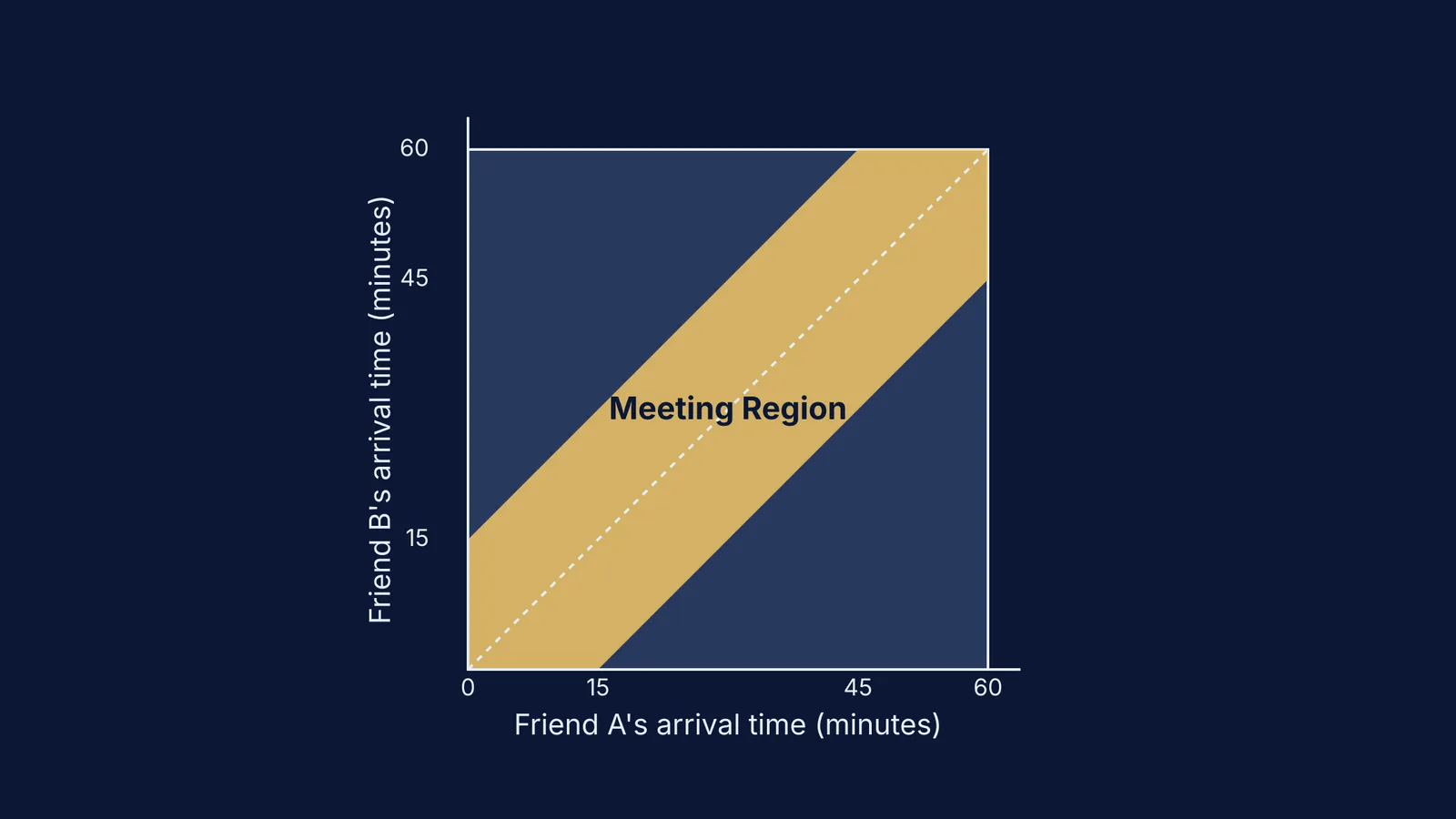
If we plot these times on a graph with x on the horizontal axis and y on the vertical axis, every possible pair of arrival times forms a point (x, y). Because the arrivals are completely independent and random, any point inside a 60 × 60 square is equally likely.
The total area of this sample space is: 60 × 60 = 3600 square units.
What is the window for meeting?
For the two friends to meet, the difference between their arrival times must be 15 minutes or less. We can write this mathematically as: |x − y| ≤ 15
This absolute value inequality breaks down into two conditions:
y ≤ x + 15 (Friend B arrives no more than 15 minutes after Friend A)
y ≥ x − 15 (Friend B arrives no more than 15 minutes before Friend A)
When we draw these two lines on our 60 × 60 square, they create a diagonal band through the centre. This band represents every combination of arrival times where the friends successfully meet.
How do you calculate the probability of meeting?
To find the probability of meeting, we divide the area of this central band by the total area of the square.
The easiest way to find the area of the central band is to subtract the areas of the regions where they do not meet. The areas outside the meeting band form two identical right-angled triangles in the corners of the square:
The top-left triangle represents Friend B arriving too late. Its corners are at (0, 15), (0, 60), and (45, 60).
The bottom-right triangle represents Friend A arriving too late. Its corners are at (15, 0), (60, 0), and (60, 45).
Each triangle has a base of 45 and a height of 45. The area of one triangle is: ½ × 45 × 45 = 1012.5
The combined area of the two triangles (the "missed connection" region) is: 2 × 1012.5 = 2025
Now, we subtract this from the total area to find the "meeting" area: 3600 − 2025 = 1575
The probability of them meeting is the meeting area divided by the total area: 1575 / 3600 = 63 / 144 = 7 / 16
So, the friends have a 7/16 chance of meeting.
What is the formula for the two friends problem?
Notice how the size of the unshaded triangles dictates the overall probability. If the two friends agree to wait 30 minutes instead of 15, the boundaries of the non-meeting regions shift. The unshaded triangles shrink to have a base and height of 30 minutes each. Their combined area drops to 900 (since 2 × ½ × 30 × 30 = 900). Consequently, the meeting area in the centre grows to 2700 square units. This makes the new probability of meeting 2700 / 3600, which simplifies to 3/4. The longer the wait time relative to the total window, the more the meeting band expands, rapidly increasing the likelihood of crossing paths.
Understanding geometric probability is much easier when you can picture the boundaries moving. In the Simulation Lab, you can drag sliders for the total time window and the waiting time, and watch the probability area grow and shrink in real time.
If you struggle to turn word problems like this one into equations or determine the sum of all numbers formed from given digits, the Fermi Problem Library has worked problems with a step-by-step solver that explains the reasoning rather than printing an answer.


