

On this page
Predicting where two objects collide mid-air is a staple of kinematics, just like determining if two projectiles will collide midair or analysing a horizontal projectile from a cliff. A typical problem goes like this: one ball is dropped from a tall tower, and at the exact same moment, another ball is thrown straight up from the ground.
How do you find when two balls meet?
The standard method is to track their positions separately from the ground. If the tower has height H and the second ball is thrown upward with initial speed u, you can write two position equations using the standard kinematic formula y = ut - 1/2 at².
For the dropped ball, the initial velocity is zero and the acceleration is 9.8 m/s² [[1]](https://ncert.nic.in/textbook/pdf/keph103.pdf) downward, so its height at time t is y1 = H - 1/2 gt².
For the thrown ball, the initial velocity is u and the acceleration is also 9.8 m/s² downward, so its height is y2 = ut - 1/2 gt².
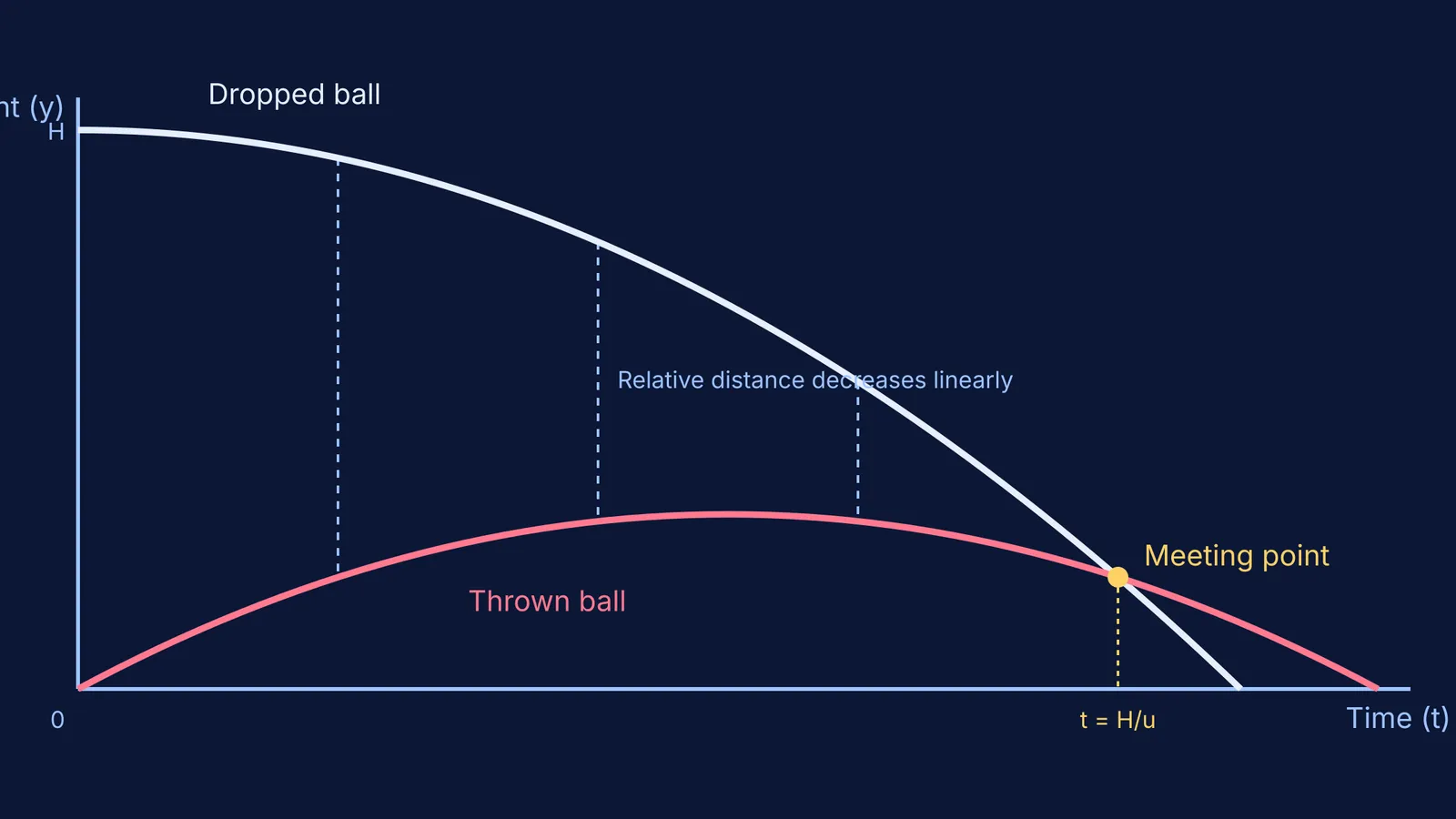
To find when they collide, you set their heights equal (y1 = y2). When you do this, the 1/2 gt² terms perfectly cancel each other out, leaving you with H = ut, or simply t = H/u.
While this mathematical cancellation is neat, writing out the quadratics hides a much simpler physical truth about how the objects interact.
Why does relative motion make it easier?
Rather than measuring everything from the ground, you can shift your frame of reference to one of the balls.
Imagine you are sitting on the dropped ball, looking down at the thrown ball. Both balls are in free fall, which means the acceleration acting on both objects is constant and directed vertically downward at g (9.8 m/s²) [[1]](https://ncert.nic.in/textbook/pdf/keph103.pdf).
When an object and your frame of reference have the exact same acceleration, their relative acceleration is zero, which means their relative velocity remains constant [[2]](https://openstax.org/books/university-physics-volume-1/pages/4-5-relative-motion-in-one-and-two-dimensions).
From your perspective on the dropped ball, you feel no gravity. You simply see the ground and the other ball rushing up towards you. Since the dropped ball started from rest and the thrown ball started with speed u, the thrown ball approaches you at a constant speed of u. The distance to close is the tower's height H.
Because there is no relative acceleration, the time to meet is just distance divided by speed: t = H/u.
Will they meet before hitting the ground?
For the collision to happen mid-air, they must meet before the dropped ball hits the ground, and before the thrown ball falls back down to the ground.
The dropped ball hits the ground when H - 1/2 gt² = 0, which gives t = √(2H/g). For the balls to meet in the air, the meeting time t = H/u must be less than this falling time.
Setting H/u < √(2H/g) and squaring both sides gives H²/u² < 2H/g. This simplifies to the condition H < 2u²/g. If the tower is taller than this, the dropped ball will hit the ground before the thrown ball can reach it.
If you struggle to picture these conditions or want to see what happens when you tweak the height and speed, the Fermi Simulation Lab lets you run the experiment and watch the collision point shift as you change the variables.
Check your understanding
Next time you face a two-body kinematics problem where both objects are in free fall, look for the shortcut. Don't write down the quadratics immediately. Check if relative motion can reduce the problem to constant velocity.
You can practise this approach in the Fermi Problem Library, where the step-by-step solver will guide you through both the standard quadratic method and the faster relative motion technique. And if the relative velocity rules are still confusing, the Fermi Concept Library maps out exactly how to switch reference frames without losing your way.


