

On this page
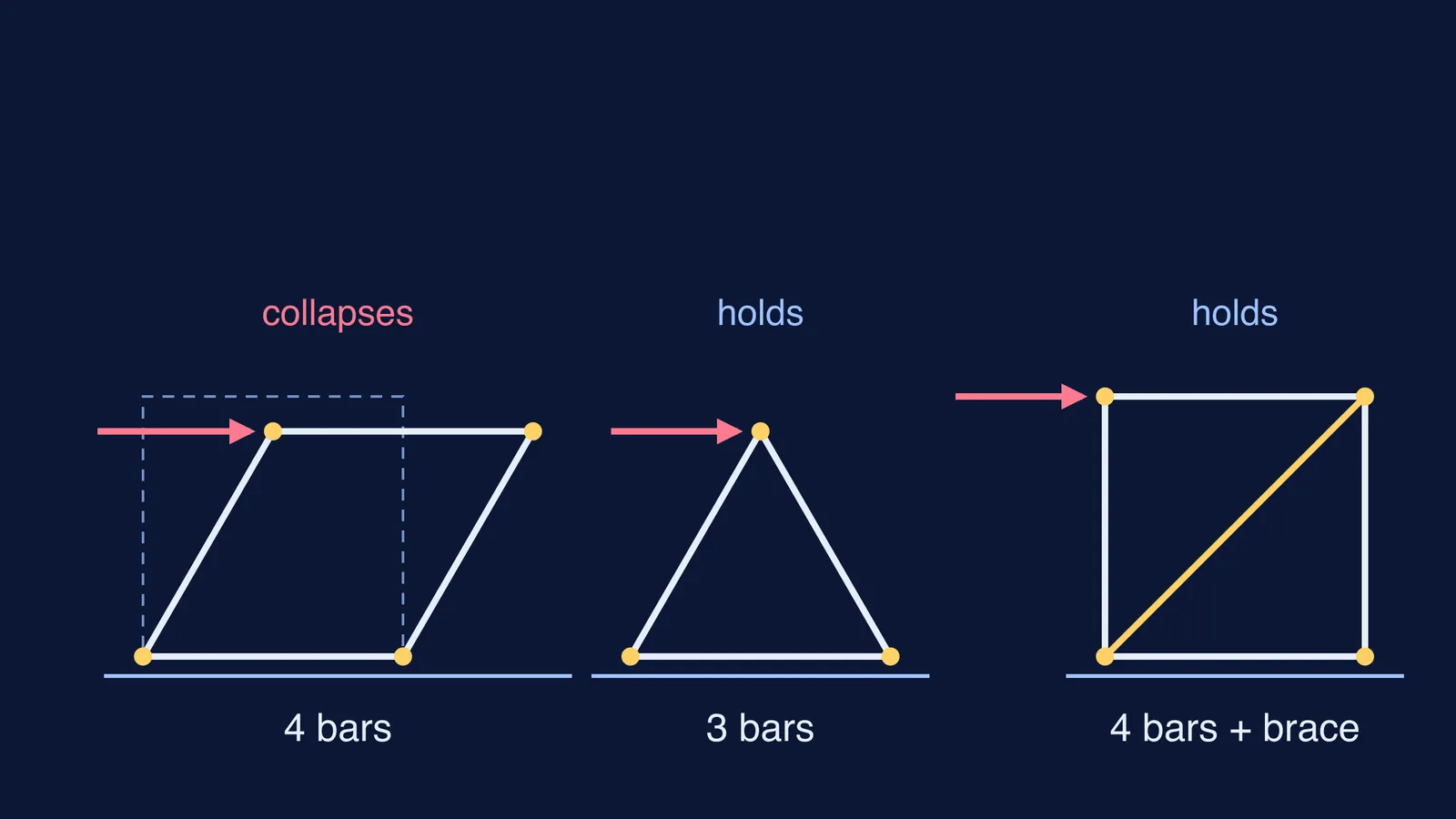
Before you read on, make a prediction. Take a square frame and a triangle frame, each built from identical sticks joined at the corners by pins that let them turn. Push each top corner sideways. Which one keeps its shape? Write down your answer and one sentence explaining why.
If you picked the triangle, you are right. The useful part is the reason, because the same reason tells you how many braces any flat frame needs.
Why is a triangle rigid but a square is not?
A triangle's shape is fixed the moment its three side lengths are fixed. The TeachEngineering lesson "Triangles & Trusses" puts it simply: "The angle between two sides of the triangle is based on the length of the opposite side of the triangle."
You can check this with the cosine rule: c² = a² + b² − 2ab cos C. If a, b and c cannot change, cos C cannot change, so angle C is locked, and so are the other two. To squash a triangle, your push has to stretch or compress one of the sticks, and a stick resists that strongly.
A square has no such lock. Its four sides can stay exactly the same length while its corner angles change. As the same lesson says, "if you push down on top of the square, its 90 degree angles collapse and it becomes a simple rhombus."
How can you test it at home with sticks?
You need eight ice-cream sticks of equal length, a pin or compass point to make holes, and eight split-pin paper fasteners for joints. Keep joints loose: glue hides the effect.
Make a hole near each end of every stick.
Join four sticks into a square and three into a triangle, one fastener per corner, loose enough to turn.
For each frame, write a prediction: holds, bends a little, or folds flat.
Stand each frame on a table, hold the bottom stick down, and push the top corner sideways with one finger. Note what happened beside your prediction.
Fasten the eighth stick across the square from one corner to the opposite corner, and push again.
The square should lean over into a rhombus with almost no effort. The triangle should not move unless the sticks bend. The braced square now behaves like two triangles sharing an edge.
How many braces does a frame need?
On a flat table each joint can move two ways, left-right and up-down, so a frame with j joints has 2j possible movements. Three of those slide or turn the whole frame without changing its shape. That leaves 2j − 3 shape-changing movements, and each bar can block one.
The study of stiff frames goes back to James Clerk Maxwell's 1864 paper on the equilibrium and stiffness of frames. In 1970, G. Laman proved the exact condition for flat frames. As rigidity theory lecture slides by James Cruickshank of NUI Galway state it, a flat frame in general position with just enough bars has exactly 2j − 3 of them, and no part of it with k joints has more than 2k − 3. The second rule stops bars crowding into one corner.
Triangle: 3 joints, needs 2 × 3 − 3 = 3 bars. It has 3, so it is rigid.
Square: 4 joints, needs 2 × 4 − 3 = 5 bars. It has 4, so one movement is free: the lean you saw. One diagonal makes 5.
Pentagon: 5 joints, needs 7 bars. It has 5, so it needs 2 diagonals.
Hexagon: 6 joints, needs 9 bars. It has 6, so it needs 3 diagonals.
The pattern: a frame shaped like a polygon with n sides has n bars and needs 2n − 3, so it needs n − 3 braces. That is exactly the number of diagonals that cut the polygon into triangles.
Where do triangles hold real structures up?
The TeachEngineering lesson defines a truss as "a structure comprised of one or more triangular elements with straight individual members." Look at a railway footbridge, a mobile phone tower or the steel roof over a bus stand near you, and you will often see diagonals turning rectangles into triangles. To see how the force in each bar of a bridge truss can be worked out, read how Squire Whipple calculated truss bridge forces. For a bigger build, try our engineering challenges at home: bridge, tower and egg drop.
What should you try next?
Keep the habit of a written prediction before every test. The Fermi Simulation Lab has interactive simulations for ideas that are easier to see than to read; write down your guess before you press play. For when a simulation helps and when a drawing is enough, see what studies found about simulations versus static diagrams.


