

On this page
When you touch a charged conducting sphere to a neutral one, or connect two charged spheres with a wire, the charge spreads out. But it rarely splits equally. Instead of sharing the charge down the middle, the spheres share until their electric potentials balance out.
This simple rule—that potentials equalise—is the key to solving charge-sharing problems in JEE Main and NEET-UG physics. Whether you are dealing with two small metal balls in a school laboratory or large conductive domes, the underlying principle remains exactly the same.
Why do the potentials become equal?
In a conductor, charge is free to move. If there is a potential difference between two connected spheres, a force pushes the free electrons from the region of lower potential to the region of higher potential.
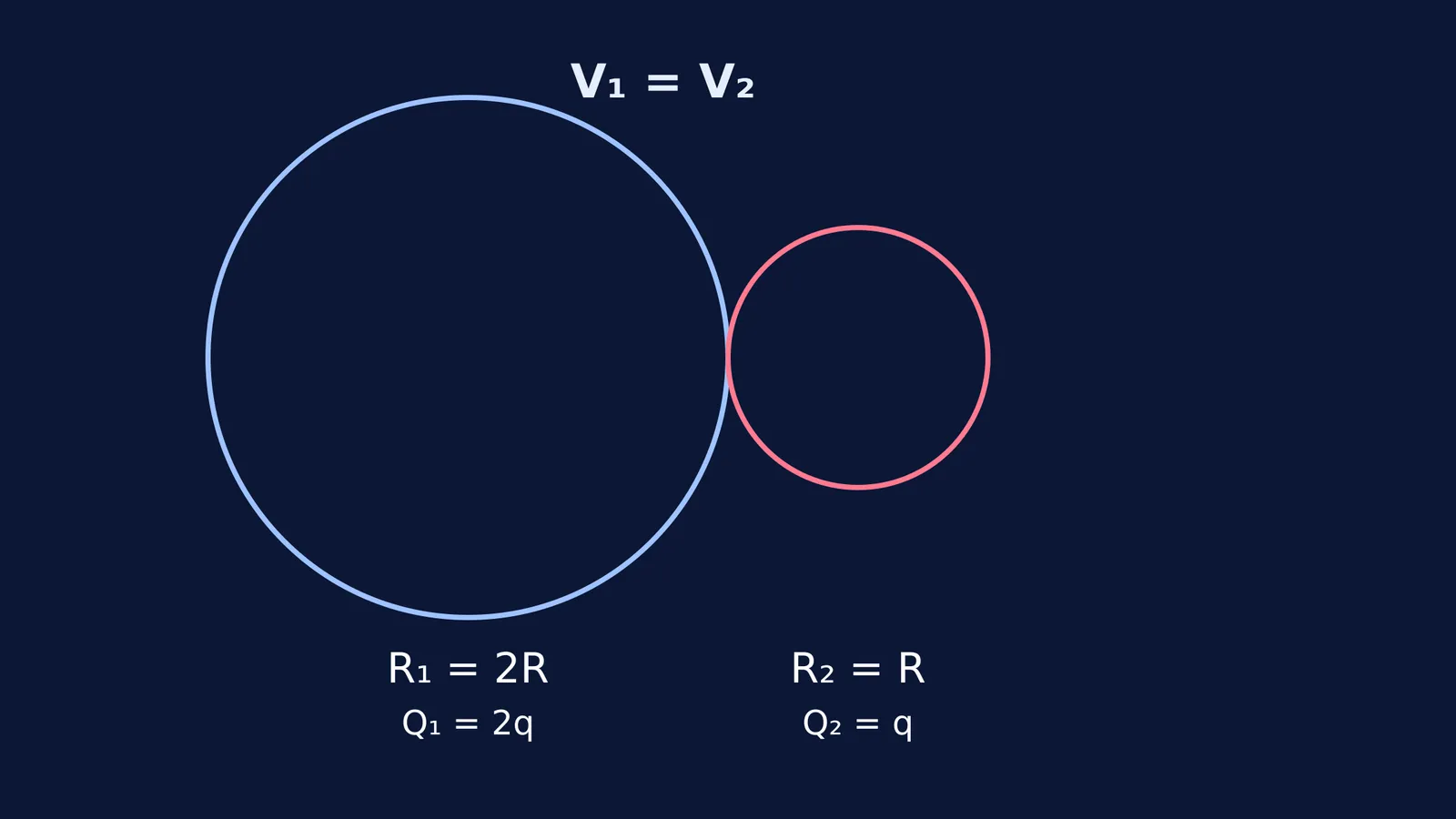
This flow continues until there is no longer any difference to drive it. At that point, the entire connected system reaches electrostatic equilibrium. According to OpenStax University Physics, the two spheres now form a single equipotential surface. This means their final potentials are identical (V₁ = V₂).
How does the charge divide?
For an isolated conducting sphere of radius R holding charge Q, the potential at its surface is V = kQ/R, where k is Coulomb's constant.
Since the two touching spheres share the same final potential, we can equate their individual surface potentials: kQ₁ / R₁ = kQ₂ / R₂
Cancel out Coulomb's constant (k), and you get the sharing rule: Q₁ / R₁ = Q₂ / R₂
This tells us that the charge distributes in direct proportion to the radii of the spheres. According to OpenStax University Physics, a sphere that is twice as large will end up holding twice as much charge.
A worked example
Suppose a small sphere of radius r has an initial charge of +6q, and it touches a larger, neutral sphere of radius 2r.
Total charge: The system has 6q in total. Because charge is conserved, the final charges must add up to this amount (Q₁ + Q₂ = 6q).
The sharing rule: Since the larger sphere has twice the radius, it must carry twice the charge of the smaller one (Q₂ = 2Q₁).
The final split: Dividing 6q into three parts, the smaller sphere keeps 2q, and the larger sphere takes 4q.
If you find it hard to picture the transient state where charges move, the Fermi Simulation Lab offers interactive simulations for the ideas that are easier to see than to read.
How does capacitance explain this?
You can also think about charge sharing in terms of capacitance. The capacitance of an isolated spherical conductor in a vacuum is given by the formula C = 4πε₀R. This shows that the capacitance of a sphere is directly proportional to its radius.
When you connect two spheres with a conducting wire, you are essentially wiring two capacitors in parallel. In a parallel circuit, the voltage across all components is the same, which aligns perfectly with our rule that V₁ = V₂.
Using the standard capacitor equation Q = CV, we know that the charge on each sphere is proportional to its capacitance. Because the larger sphere has a larger capacitance, it can store more charge at the exact same potential. When you substitute the spherical capacitance formula into Q₁/C₁ = Q₂/C₂, the 4πε₀ terms cancel out, leaving you with the exact same radius-sharing rule we derived earlier.
Which sphere has a higher charge density?
Even though the larger sphere holds more total charge, the charge is more crowded on the smaller sphere. Surface charge density (σ) is the total charge divided by the surface area (4πR²).
Because the smaller sphere has a much smaller area relative to the charge it holds, its surface charge density ends up being higher. Specifically, the ratio of their charge densities is inversely proportional to their radii (σ₁ / σ₂ = R₂ / R₁).
This inverse relationship has profound consequences in electromagnetism. It explains why electric fields are strongest at the sharpest points of a conductor, a principle that dictates the design of lightning rods. A very sharp point has a tiny radius of curvature, leading to an immense surface charge density and an electric field strong enough to ionise the surrounding air.
If you are reviewing electrostatics for your exams, you might also need to calculate the work to assemble point charges using the pairwise sum, or find the energy density in an electric field. We also have a dedicated guide on handling concentric spherical shells when one of them is earthed.


