

On this page
When you are stuck on a physics or maths problem, the temptation is strong to copy the entire question, paste it into an AI, and hit enter. The AI spits out a perfectly formatted solution. You read it, nod along, and feel like you understand.
But when the exam comes, that feeling of understanding vanishes.
A 2025 study by researchers at the University of Pennsylvania tested this exact scenario on nearly 1,000 high school mathematics students. They found that students using a standard, unrestricted AI model to practice math scored 17% worse on follow-up tests than a control group that used no AI at all (Bastani et al., 2025). By letting the AI do the heavy lifting from step one, the students had outsourced their thinking and failed to build independent problem-solving skills.
The same study, however, revealed a solution: when students used an AI designed strictly as a tutor—one that gave hints and scaffolding instead of final answers—they scored 127% higher during practice, without the subsequent exam penalty (Bastani et al., 2025).
This is why Fermi's AI tutor teaches rather than answers. It holds a line of reasoning across a session, notices where a student is stuck, and decides whether to explain, ask, or show. But to get the most out of any AI tutor, you have to meet it halfway. You have to tell it exactly where you lost the thread.
Why does pasting the whole question backfire?
When you drop a full question into an AI, you skip the metacognitive work—the process of noticing what you do and do not know.
If you just ask for the answer, the AI cannot tell if you forgot a formula, misread the graph, or made a simple algebra mistake. It assumes you know nothing and lectures you from scratch. Conversely, if you point out the exact line where your reasoning broke down, the AI can fix that specific conceptual gap, leaving the rest of the productive struggle to you.
How do you tell an AI tutor where you got stuck?
Let's look at a classic JEE Main kinematics trap.
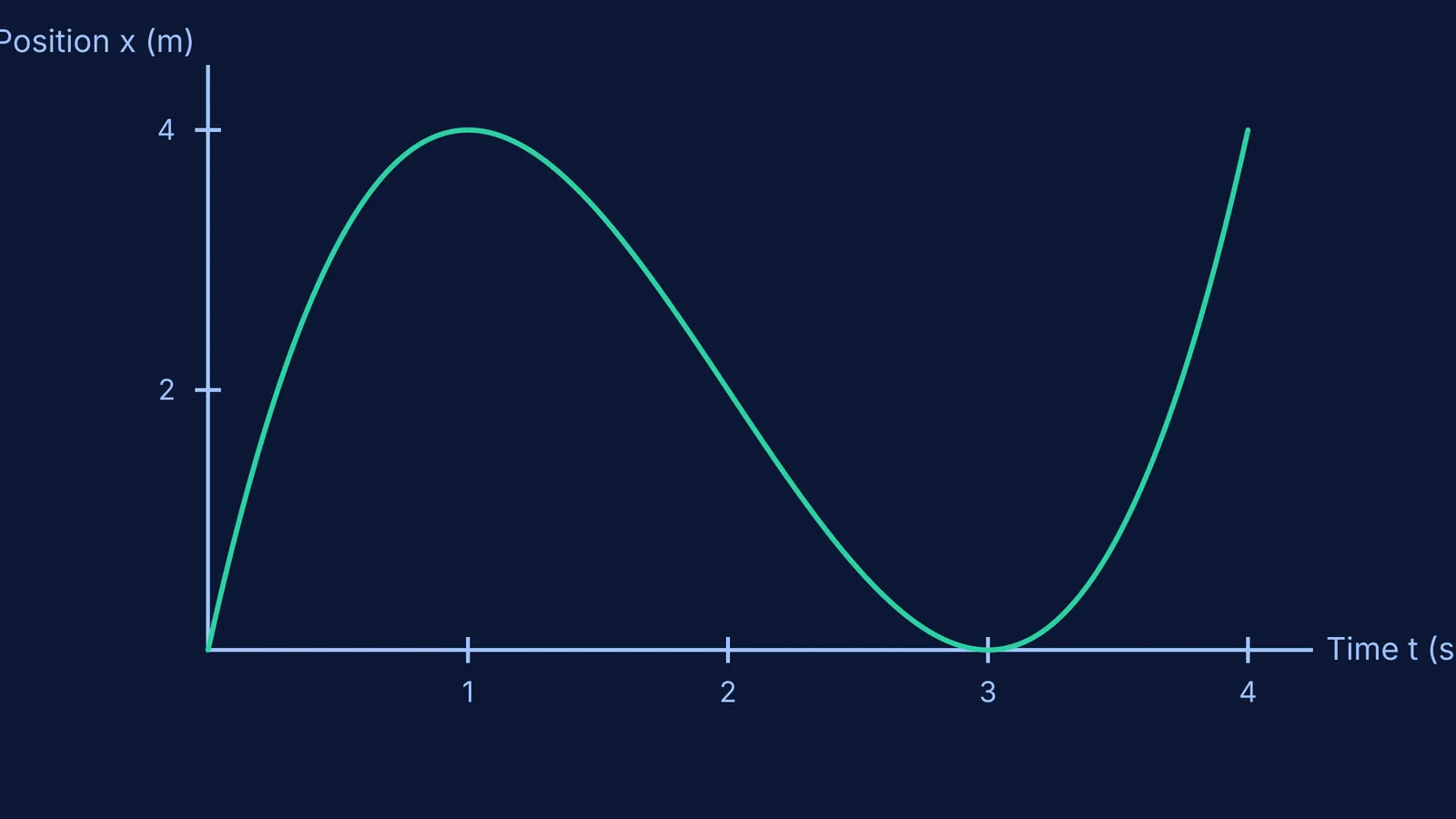
The problem: The position of a particle moving in a straight line is given by x(t) = t³ − 6t² + 9t. Find the total distance covered in the first 4 seconds.
Many students plug in t = 0 to get x = 0, then plug in t = 4 to get x = 4, and confidently declare the distance is 4 m. But the answer key says 12 m.
If you paste the whole question, the AI will just give you the derivative and solve it. Here are three better ways to phrase your prompt, depending on where you are actually stuck.
1. The "I don't know where to start" prompt
Before: "Solve x = t³ − 6t² + 9t for distance in 4s."
After: "I need to find the total distance for x = t³ − 6t² + 9t from t = 0 to 4. I know how to find the velocity equation, but how do I use velocity to get distance?"
2. The "My answer is wrong" prompt
Before: "Why is the distance 12m and not 4m?"
After: "I calculated the position at t = 4 and got 4 m. But the question asks for distance and the answer is 12 m. Does the particle change direction? How do I check?"
3. The "I don't understand the rule" prompt
Sometimes you know the mechanical steps—like finding acceleration given as a function of velocity or taking the derivative to find turning points—but you don't understand why you are doing them.
Before: "Explain distance vs displacement."
After: "I found that the velocity v(t) = 3t² − 12t + 9 is zero at t = 1 and t = 3. I know the particle turns around here. What do I do with these times to calculate the total distance instead of just the displacement?"
What should you write in your next prompt?
To stop the AI from doing the thinking for you, use this three-step framework the next time you open the Fermi Problem Library:
State your goal: Tell the AI what you are trying to find (e.g., "I am trying to find the distance in the nth second").
Show your work: Type out your last mathematical step or logical assumption.
Ask a specific question: Ask "Why does this rule apply here?" or "Where did my algebra go wrong?" instead of "What is the answer?".
By treating the AI as a sounding board rather than an answer key, you ensure that the skills you build during practice will actually stay in your head for exam day.


