

On this page
Making three versions of the same worksheet can take an evening. With an AI chatbot, a first draft takes minutes. The hard part has not changed: keeping all three versions aimed at one learning goal, and making sure every answer in the key is right. Here is a method for both, with a Class 9 physics example you can copy.
How are teachers using AI to make worksheets?
In a Gallup and Walton Family Foundation survey of 2,232 US public-school teachers in spring 2025, six in 10 said they had used an AI tool for their work and three in 10 used one at least weekly. Making worksheets or activities was among the most common uses: Gallup reports 33% used AI for it at least monthly, and 28% used it to modify materials to meet student needs. Teachers using AI at least weekly estimated they saved 5.9 hours a week.
The survey is American, but the job is familiar in any crowded Indian classroom: one chapter, many starting points, one period.
What should stay the same across the three levels?
Differentiation means changing how much support students get, not what they are expected to learn. Keep three things fixed: the learning goal, the idea each question tests, and one final question that everyone attempts. Change only the scaffolding: hints, given formulas, number of steps and how friendly the numbers are.
This matters because the research is mixed. A 2018 review and meta-analysis by Marjolein Deunk and colleagues of 21 studies in primary schools found small to moderate gains from some differentiation practices, but homogeneous ability grouping had a small negative effect on low-ability students. If the easy sheet quietly teaches less, the students who most need the idea never meet it.
How do you prompt AI for three levels of one worksheet?
Write the learning goal first, then give the AI rules. Adapt this prompt:
"Make a Class 9 physics worksheet. Learning goal: use v = u + at to find final velocity, initial velocity or acceleration in uniformly accelerated motion. Make three versions. Level 1 (support): formula given, one step, whole numbers, one worked example first. Level 2 (core): students choose the formula and convert km/h to m/s. Level 3 (stretch): two-step problems and one question on what a negative acceleration means. All three end with the same final question. Give an answer key with full working. Add nothing outside the learning goal."
One sample question from each level, with answers we worked out by hand:
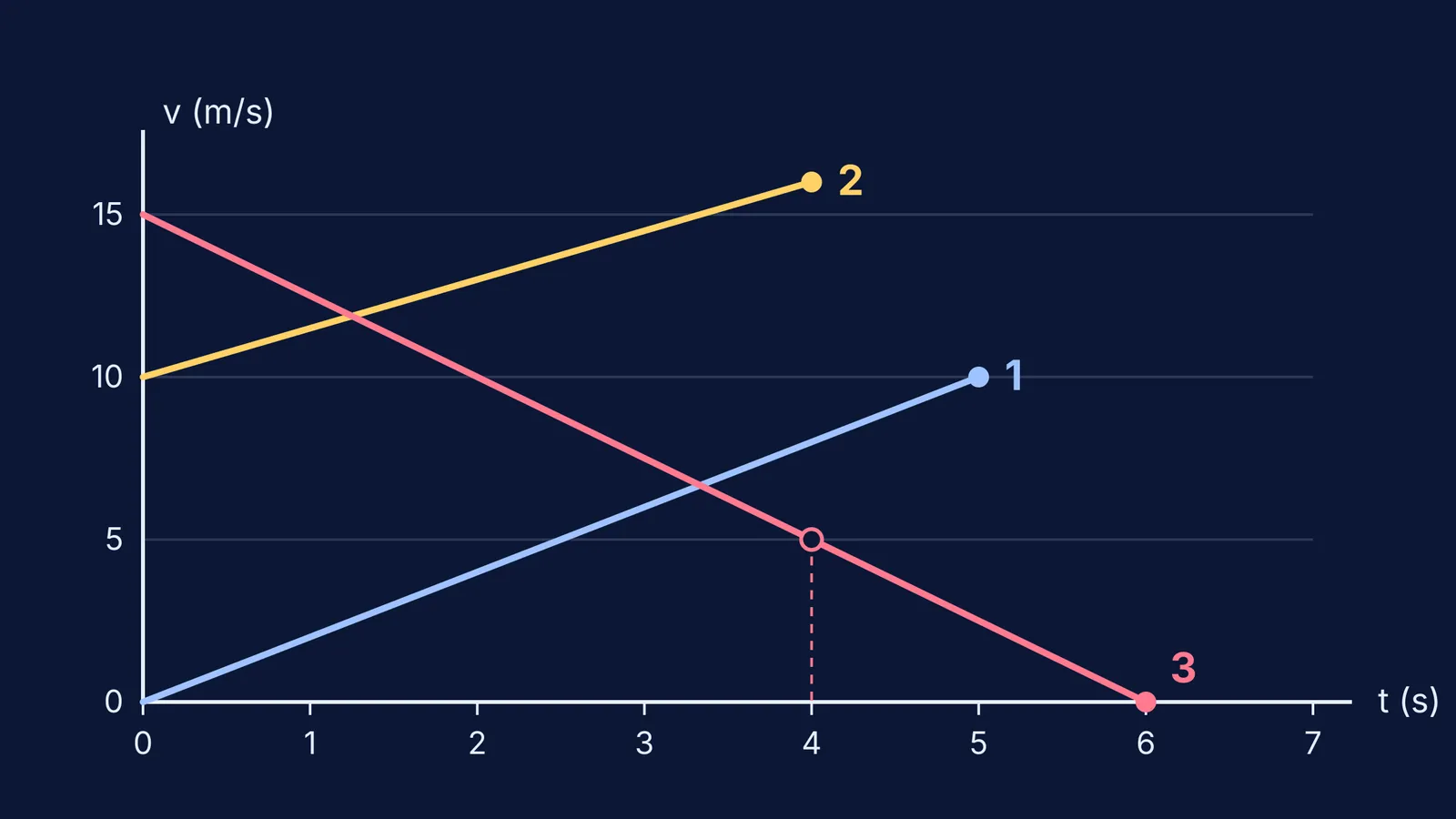
Level 1: A cycle starts from rest and accelerates at 2 m/s² for 5 s. Final speed? v = 0 + 2 × 5 = 10 m/s.
Level 2: A car at 36 km/h speeds up at 1.5 m/s² for 4 s. Final speed? 36 km/h = 10 m/s, so v = 10 + 1.5 × 4 = 16 m/s.
Level 3: A bus at 54 km/h brakes evenly and stops in 6 s. Find its acceleration, then the time to slow to 5 m/s. 54 km/h = 15 m/s, so a = (0 − 15) ÷ 6 = −2.5 m/s², and t = (5 − 15) ÷ (−2.5) = 4 s.
The same equation sits under every question. Only the support changes.
How do you check every answer before printing?
Treat the key as wrong until you have checked it. In a 2024 PLOS ONE study by Zachary Pardos and Shreya Bhandari, ChatGPT-generated help for maths problems failed quality checks on 32% of problems. After the researchers applied self-consistency, a technique for reducing made-up answers that compares several outputs from the model, that fell to nearly 0% for algebra problems but 13% for statistics problems. The study used ChatGPT 3.5, an older model, but the lesson holds: AI can be confidently wrong, and how often depends on the topic.
UNESCO's guidance on generative AI in education makes a similar point for schools: it calls for a human-centred approach, with ethical and teaching checks on the tools.
Before the photocopier:
Solve every question yourself, on paper, without looking at the key.
Redo every unit conversion separately.
Check each question gives all the data it needs.
Read Level 1 and Level 3 side by side: same goal?
Ask whether the numbers are realistic; a bus braking at 25 m/s² is a typo.
When you change a question, change the key too.
If your sheet is multiple choice, our guide to checking the answer keys of AI-made MCQs goes further.
What should students do when they get stuck?
A stuck student needs the reasoning, not just the right number. After the worksheet, students can retry missed questions in the Fermi Problem Library, which has worked problems with a step-by-step solver that explains the reasoning rather than printing an answer. For a student missing the idea itself, Fermi's AI tutor works out what they already know and builds a plan for the session. To build the habit of learning from errors, share our post on using AI to understand mistakes, not get answers.
Pick one worksheet you teach this week, write its learning goal in one line, and try the prompt.


