

On this page
You bring a homework problem to an AI, hoping for a quick hint. Instead, it spits out a solution that looks completely alien to what your teacher did on the whiteboard. The final answer might be the same, but the intermediate steps are entirely different.
This is a common friction point in subjects like mathematics, physics, and chemistry. It leaves students wondering: which method is correct, and more importantly, which one should go on the exam paper? If you have ever wondered why AI chatbots get maths wrong, and a five-step way to check, this difference in algorithms is a big part of the story.
Teacher taught different method than AI: which to use?
For assessed work, you should almost always use the method your teacher taught.
School exams and board papers (such as CBSE or ICSE) do not just test the final answer; they test the specific process you were taught. Marking schemes are rigid and assign points to specific intermediate steps.
For example, when balancing a redox reaction in chemistry, your syllabus might strictly require the "ion-electron half-reaction method." A general AI might default to the "oxidation number method." Both are scientifically valid, and both yield the correct coefficients. However, if the exam question specifically tests your ability to write out half-reactions, using the AI's preferred method will cost you marks.
Your teacher is preparing you for a specific marking scheme. The AI is simply finding the most general, mathematically robust path to the answer.
Why learning multiple methods is an advantage
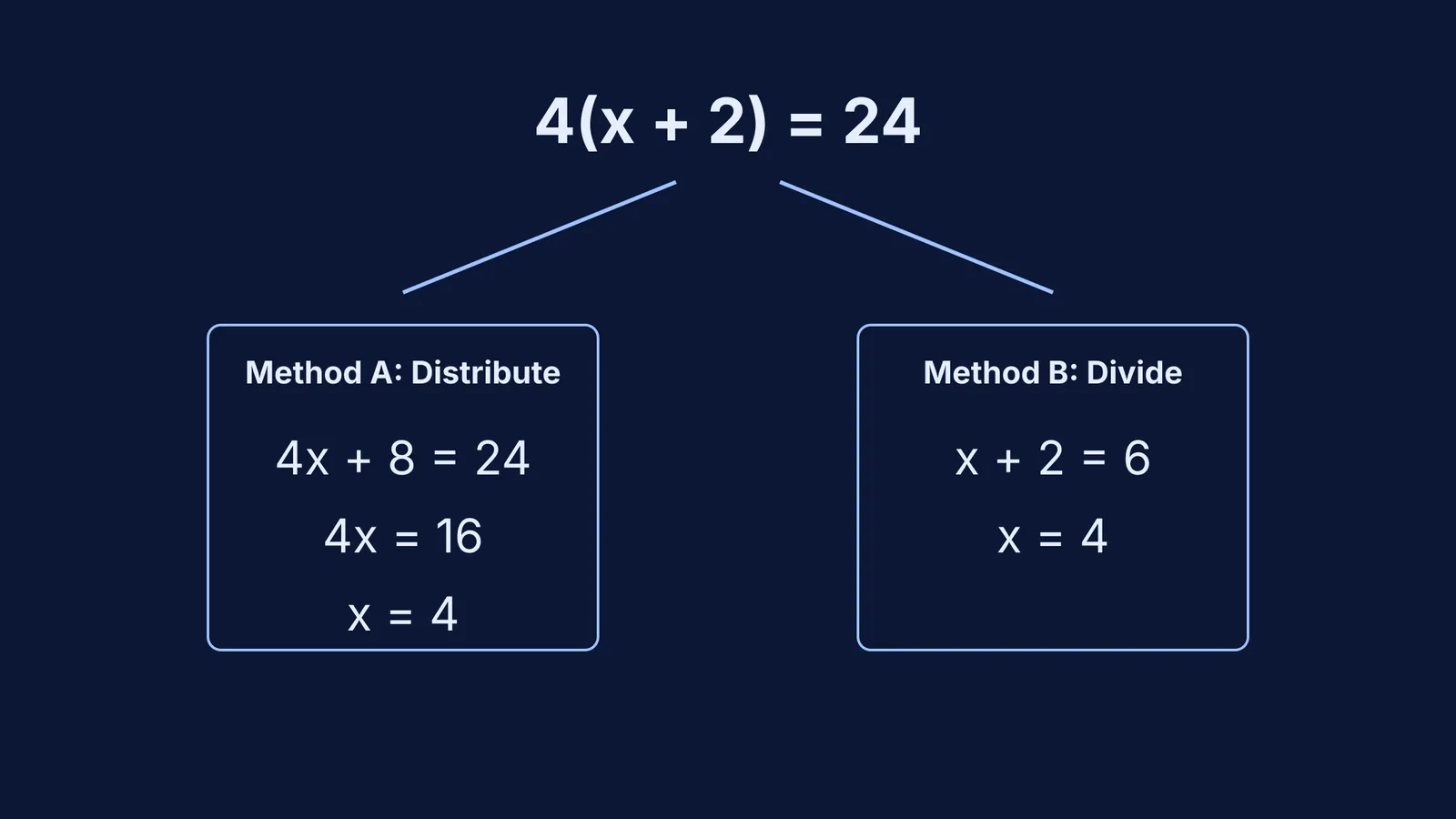
Seeing two different methods can feel confusing, but learning to navigate that confusion is one of the best ways to build lasting math skills.
A 2011 study by Bethany Rittle-Johnson, Jon R. Star and Kelley Durkin (link) tested 198 eighth-grade students learning to solve equations. They found that students who immediately compared two different procedures side by side became more flexible problem-solvers, and they retained that flexibility on tests a month later.
This skill is called "procedural flexibility"—the ability to look at a problem and choose the most efficient strategy, rather than blindly following a memorised set of steps. When you compare an AI's method with your teacher's, you are forced to ask *why* both paths reach the same destination. That question builds deeper conceptual understanding.
How to check if both methods are valid?
If you are faced with two competing methods, do not just assume one is wrong. Instead, run a quick check using this framework:
Ask the AI to explain your teacher's method: Type the first line of your teacher's method into the prompt and ask, "My teacher started the problem this way. Can you finish solving it using this specific method?"
Compare the efficiency: Look at both completed methods. Which one requires fewer steps? Which one is less prone to arithmetic errors? Often, teachers teach shortcuts that are faster for specific exam questions.
Check the edge cases: Try plugging in a simple number, like 0 or 1, to see if both methods still hold up.
How can I get an AI tutor to match my syllabus?
Most standard AI chatbots simply print out an answer using whatever algorithm they learned during training. They do not know what grade you are in or what syllabus you follow. Students often end up asking, can AI tutors teach better than chatbots that give answers?
The answer is yes, if the tutor adapts to you. Fermi's AI tutor teaches rather than answers. It holds a line of reasoning across a whole session, notices where a student is stuck, and decides whether to explain, ask, or show. If you tell Fermi, "I need to solve this using the substitution method, not matrices," it will adapt to your constraint, writing on a board and checking your understanding of that specific syllabus requirement as it goes.
The next time an AI hands you a strange method, do not ignore it. Take five minutes to compare it to your class notes. Use the teacher's method for the exam, but use the AI's method to stretch your brain.


