

On this page
Working out the direction of a magnetic force using the right-hand rule is a famously fragile skill. A 2016 study in *Physical Review Physics Education Research* found that using a guess-and-check method on backwards right-hand rule problems cuts order errors from 15% to 8%. Fermi's AI tutor can act as a sounding board, talking you through the cross product and testing you on cases where the answer flips.
Why do students struggle with the right-hand rule?
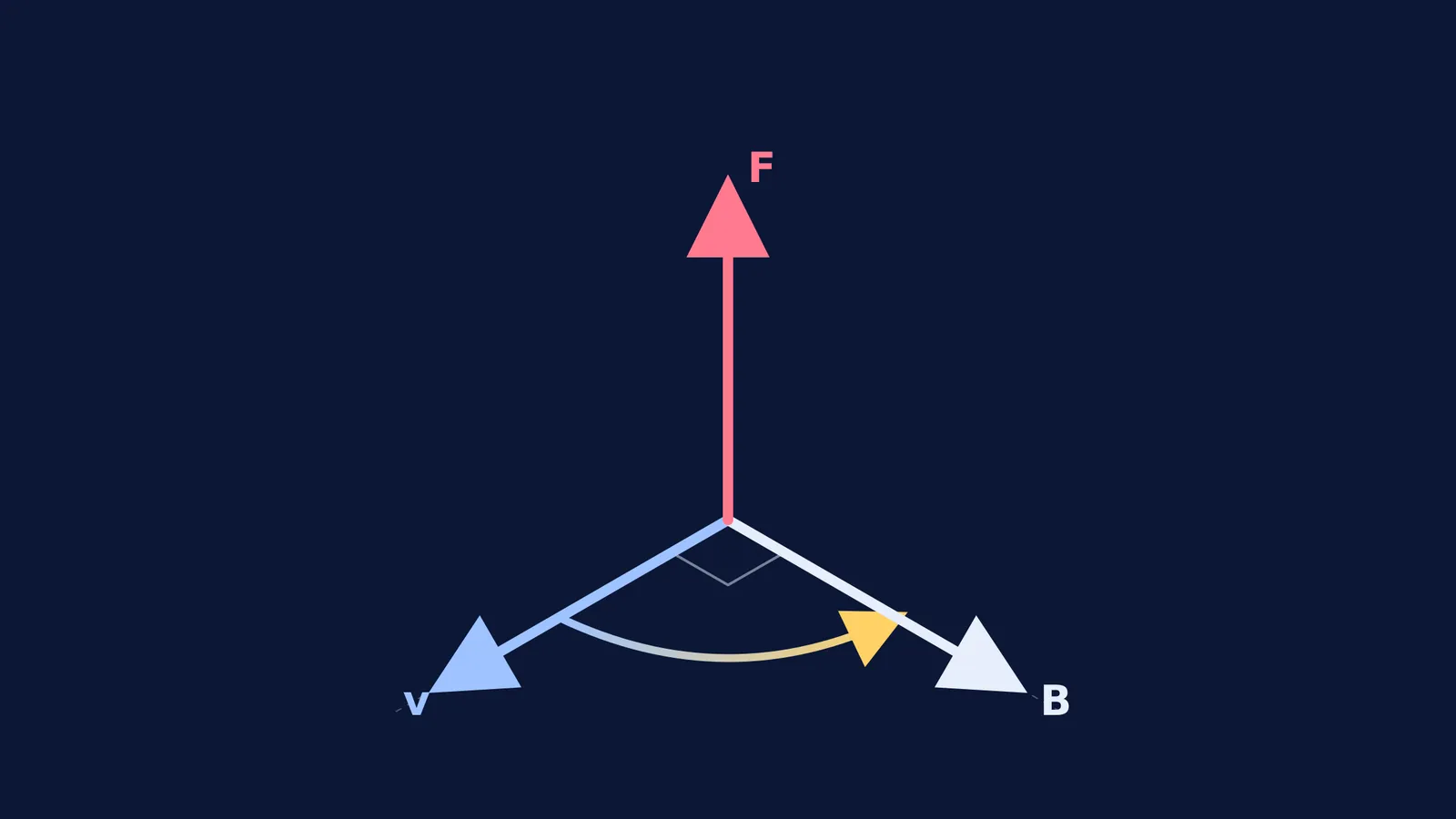
The Lorentz force equation, F = q(v × B), tells us that the magnetic force on a charge is the cross product of its velocity and the magnetic field. But translating that mathematics into physical 3D space trips up nearly everyone at some point. It is not just about memorising a formula; it requires spatial reasoning and mental rotation.
The same 2016 study showed that physical awkwardness is a major factor: when the vectors point in directions that force you to twist your arm uncomfortably, your brain subconsciously "adjusts" your hand into a more relaxed — but incorrect — orientation. Students also frequently reverse the order of vectors (which flips the sign), forget to reverse the result for an electron's negative charge, or struggle when asked to reason backwards from the force to find the initial velocity.
In situations where a particle enters a new region, such as a charge crossing into a B-field region, failing to apply the rule correctly means sending the particle off in completely the wrong direction. The cognitive load of holding the variables in mind while physically contorting your hand often causes the core logic to break down under exam pressure.
How to ask AI to talk through magnetic force direction cross product?
Because the cross product is not commutative (v × B = −(B × v)), getting the steps perfectly in order matters. Rather than just memorising the rule mechanically, you can use an AI tutor to talk you through the logic and check your reasoning in real time.
Instead of asking "What is the force?", tell the AI what you are trying to do and ask it to verify your steps. This forces you to articulate your thought process, exposing the exact moment where your hand or logic slips.
Try a prompt like this: > "I am practising the right-hand rule for the magnetic force cross product F = q(v × B). Please give me a scenario, wait for my answer and my reasoning, and then tell me if I got the direction right. Include cases with negative charges and cases where I have to work backwards to find the velocity."
If you find yourself stuck on the underlying mathematics, the Fermi Concept Library holds a complete map of the vector operations needed for physics, letting you brush up on the theory before returning to the forces.
When does the right-hand rule answer flip?
The best way to solidify your grasp of the cross product is to practise the exceptions. When you talk through problems with an AI tutor, ensure you cover these common "flip" scenarios where rote memorisation usually fails:
Negative charges: The standard rule naturally yields the direction of force for a positive charge. If the particle in question is an electron, the force acts exactly 180° opposite to your thumb.
Current vs electron flow: When looking at the force on a wire (F = Il × B), you must remember that conventional current I flows opposite to the actual physical drift of electrons.
Working backwards: If you know F and B, finding v requires you to align your thumb and palm first, then see where your fingers must have started. This backward reasoning is notoriously difficult. This is where the guess-and-check method shines: guess a direction for v, apply the right-hand rule normally, and see if it produces the given F.
Parallel vectors: Students often mistakenly assume a force exists whenever a charge moves near a magnetic field. An AI tutor can remind you that if v and B are parallel or anti-parallel (angle is 0° or 180°), the cross product is zero and the charge feels no force.
Other cross products: The same right-hand rule logic applies to rotational motion, such as finding torque as r × F. Mixing up the order in these formulas will also leave your vectors pointing the wrong way.
What is a good script for your AI study session?
To build a reliable habit, treat the AI as a spotter while you perform the mental gymnastics. When working through a tricky diagram in the Fermi Problem Library, you can narrate your physical actions to the tutor step by step:
"My fingers start pointing along the velocity v (straight down the page)."
"I curl them towards the magnetic field B (pointing into the page)."
"My thumb naturally points to the right side of the page."
"Because this is an alpha particle (positive charge), the final force is to the right."
By verbalising your physical movements, you give the AI exactly the data it needs to spot where your reasoning slips. If you twist your wrist the wrong way, the tutor can catch the error immediately and offer a different way to visualise the plane. Breaking the problem down into manageable, spoken steps helps you master the cross product for good.


