

On this page
Sunflowers are masters of packing. If you look closely at the disk of a sunflower, you will see a mesmerising pattern of seeds spiralling outward from the centre. This arrangement is not just beautiful; it is a mathematical solution to a biological problem. The plant needs to pack as many seeds as possible into a circular space without leaving gaps or wasting energy.
To do this, sunflowers use a specific rotation between each new seed called the golden angle, which is approximately 137.5° 1. For hard-to-picture ideas like how a single angle creates such a complex pattern, the Fermi Simulation Lab provides interactive simulations for the ideas that are easier to see than to read.
What happens if the angle is 90 or 120 degrees?
When a sunflower grows, it produces new seeds at the centre of the flower head (the meristem). Each new seed pushes the older ones outward. To distribute them evenly, the plant rotates by a fixed angle before placing the next seed.
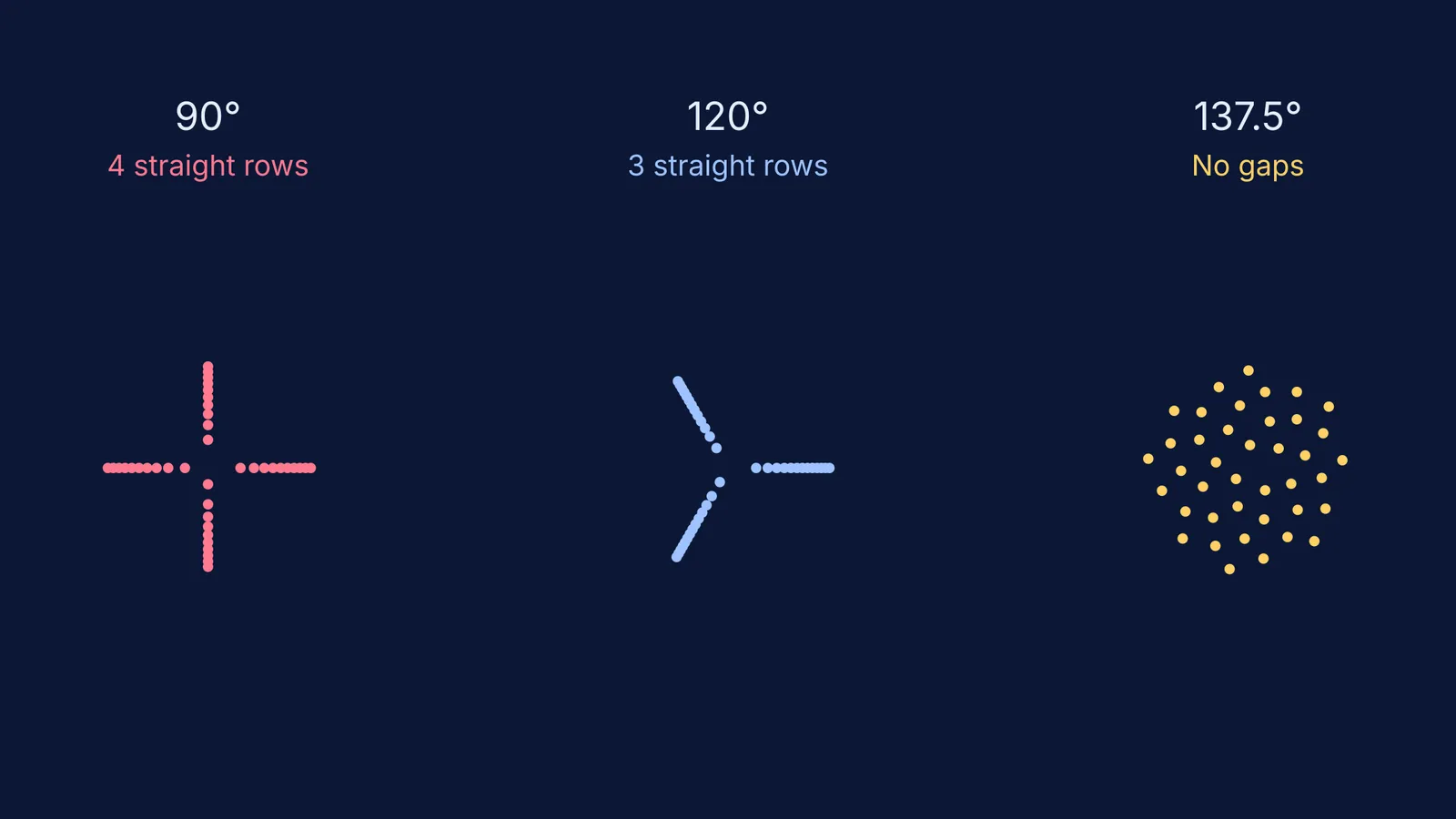
If the sunflower used a simple fraction of a circle, the results would be highly inefficient.
90° (a quarter turn): The seeds would line up perfectly after every four turns. This would create four straight radial spokes projecting from the centre.
120° (a third turn): The seeds would form exactly three straight rows.
As the flower head grows larger, the wedges of empty space between these straight rows would get wider and wider. This wasted surface area means the plant would produce far fewer seeds than it could. To avoid these expanding gaps, the plant needs an angle that never repeats and never allows seeds to line up in straight arms.
Why is the golden angle 137.5 degrees so special?
To prevent seeds from lining up, the sunflower needs an irrational number—a number that cannot be expressed as a simple fraction like 1/3 or 2/5.
The golden angle is derived from the golden ratio (approximately 1.618). Mathematicians consider the golden ratio to be the "most irrational" number because its continued fraction is made entirely of ones, meaning it converges more slowly to a fraction than any other number.
The golden angle is exactly 360° multiplied by (1 - 1/1.618...), giving approximately 137.508° 1. Because it never settles into a neat fraction, the seeds never fall into straight lines. Even a slight deviation, such as an angle of 137.0° or 137.6°, would eventually cause the seeds to form spiral arms with gaps between them. By using the golden angle, each new seed fits perfectly into the largest available gap left by the previous seeds.
How can you plot the seeds yourself?
You can calculate the exact position of any seed using Helmut Vogel's 1979 formula 290080-4). You need the seed number (n), a scaling factor for the size (c), and the golden angle (137.508°).
The Vogel formula:
Angle = n × 137.508°
Radius = c × √n
Worked example for the 10th seed (n=10):
Let the scaling factor c = 5.
Angle: 10 × 137.508° = 1375.08°. To find its position on a circle, subtract 360° three times to get 295.08°.
Radius: 5 × √10 = 5 × 3.16 = 15.8 units from the centre.
If you plot these coordinates for hundreds of seeds, the famous interlocking spirals will emerge on your page. The square root in the radius formula ensures that the area covered grows linearly with the number of seeds, keeping the packing density uniform across the entire flower head.
How does this help the sunflower survive?
The sunflower does not know mathematics, nor does it explicitly calculate the golden ratio. Instead, the physics of plant growth naturally drives the seeds into this optimal pattern.
As the plant's cells divide, hormones like auxin accumulate in spots where there is the most space. A new seed primordium naturally forms in the largest available gap between the older seeds. This simple physical rule of "grow where there is room" automatically forces the plant's rotation toward the golden angle over time.
This optimal packing gives the sunflower a survival advantage. More seeds mean a higher chance of successful sexual reproduction in flowering plants. The interlocking spirals also make the flower head structurally stronger, helping it support the heavy weight of the seeds as they mature and dry.
By naturally landing on the most irrational number, the sunflower achieves the ultimate gap-free design, proving that mathematics is deeply woven into the fabric of life.


