

On this page
The night sky is a time machine. When you look up, you are not seeing the universe in its current state. Instead, you are looking at a mosaic of the past.
Because light takes time to travel across the vast distances of space, the image of a star that reaches your eyes tonight left that star years, centuries, or even millennia ago. This delay is known as lookback time. Understanding this concept completely changes how we think about space and our place within it.
Are we seeing stars as they are now?
We never see anything in the universe exactly as it is right now. Light travels at approximately 300,000 kilometres per second. While this speed is incredibly fast, space is so vast that light still takes a measurable amount of time to reach us.
For nearby objects, the delay is small. Light from the Sun takes roughly 8.3 minutes to reach Earth. If the Sun were to suddenly disappear, we would not know about it for over eight minutes. We would continue to see sunlight and feel its warmth until the last emitted photons crossed the void.
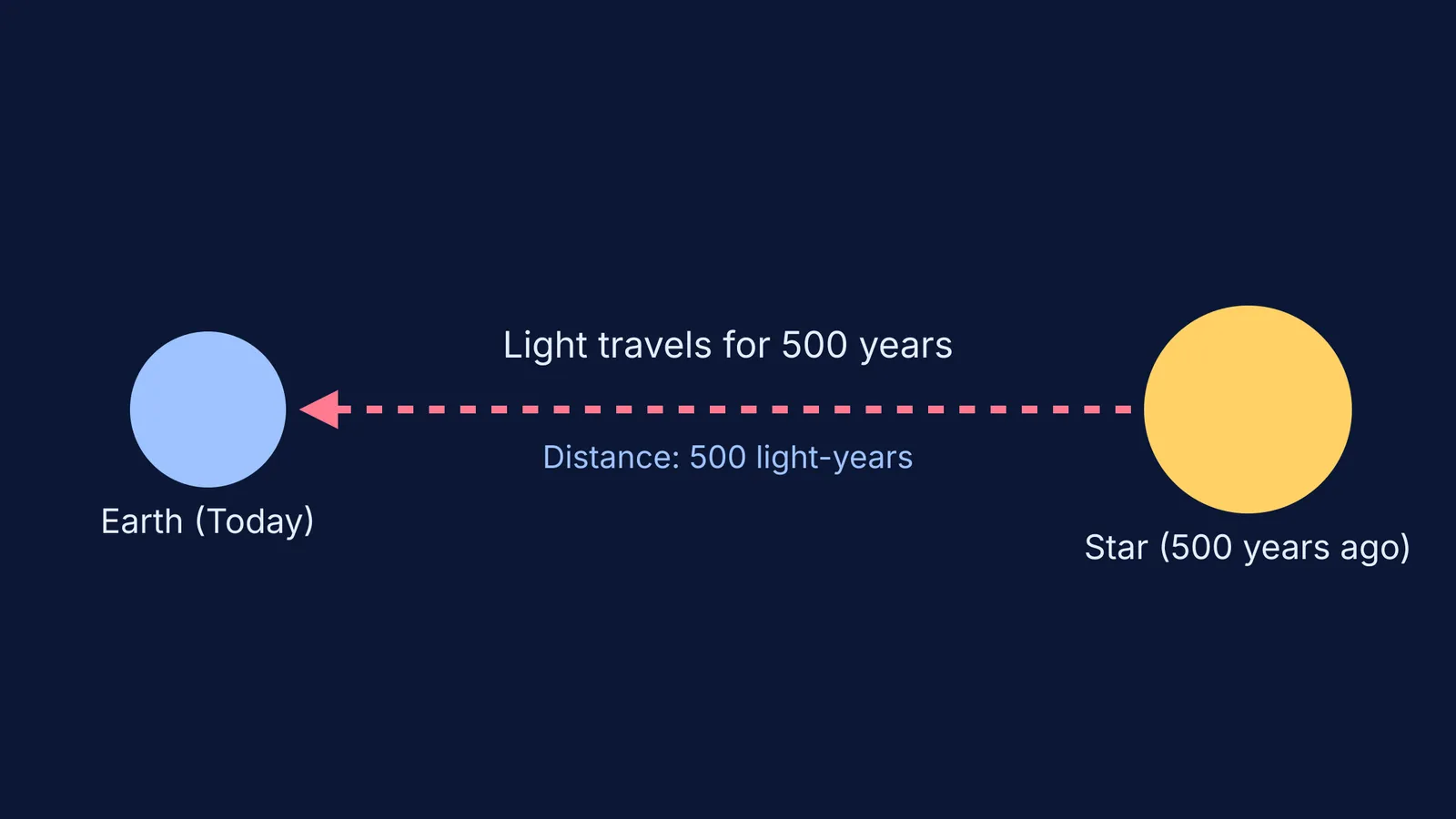
For stars, the distances are much greater. We measure these distances in light-years, which is the distance light travels in one Earth year—about 9 trillion kilometres. Lookback time is the time it takes for this light to travel to us. If a star is 500 light-years away, its lookback time is 500 years. You are seeing the light that left the star five centuries ago. When you observe that star, you are observing an event from human history that is long past.
Could a star 500 light-years away have changed?
Yes, a star can change significantly while its light is travelling towards Earth. The universe is dynamic, and stars are constantly evolving, burning through their fuel, and eventually dying.
Consider Betelgeuse, a famous red supergiant in the constellation Orion. A 2020 scientific model estimates its distance at roughly 548 light-years from Earth. This means the light you see from Betelgeuse tonight actually began its journey during the late Middle Ages, around the year 1478.
Betelgeuse is nearing the end of its life and is expected to explode in a supernova. It is entirely possible that this explosion has already happened. If Betelgeuse exploded 100 years ago, the light from the explosion is still travelling through space. We will not see it for another 448 years. We can only predict its current state based on physics models, rather than direct observation. The star we see shining brightly in Orion's shoulder might already be a collapsed remnant, but the news simply has not reached us yet.
Grasping these distances can be difficult from text alone. For ideas that are easier to see than to read, the Fermi Simulation Lab has interactive simulations that help picture light propagation across different scales. Exploring these models can clarify how distance creates a built-in historical record.
Testing distances and travel times
To work out the lookback time yourself, you only need to know the object's distance in light-years. The calculation is straightforward because the units are designed to align perfectly.
Find the distance in light-years: Astronomers use methods like parallax to measure how far away a star is. As Earth orbits the Sun, nearby stars appear to shift against the background of more distant stars. You can learn more about this in our article on Friedrich Bessel and the first measured distance to a star.
Convert to lookback time: The distance in light-years is numerically equal to the lookback time in years. The Andromeda galaxy is 2.5 million light-years away and has a lookback time of 2.5 million years.
A framework for visualising lookback time
Next time you look at the sky, use this simple checklist to put what you see into perspective. Thinking in terms of travel time turns a flat sky into a deep historical volume.
The Solar System (Minutes to Hours): Planets in our solar system have a lookback time ranging from a few minutes (Venus, Mars) to a few hours (Neptune, Pluto). You are seeing recent, but not instant, reflections of sunlight.
The Local Neighbourhood (Years to Decades): The next closest star to us is about 4.3 light-years away. You are seeing it as it was over four years ago. The light arriving now was emitted when you were a few years younger.
The Deep Sky (Centuries to Millennia): Most stars visible to the naked eye are hundreds or thousands of light-years away. You are seeing them as they were during ancient human history. The photons hitting your retina have been travelling through empty space since before modern civilisations were built.
Understanding lookback time reminds us that astronomy is as much about studying the past as it is about exploring space. Every telescope observation is a glimpse into history, governed by the absolute speed limit of light. We can never know the universe as it is today; we can only ever witness the echoes of what it used to be.


