

On this page
When you press a block against a spring and let it go, the spring pushes the block forward. As the spring decompresses, it transfers its stored energy to the block. If the block slides across a flat table with friction, it will lose speed and eventually skid to a complete stop. This simple setup is a powerful way to understand how energy transforms from one form to another in classical mechanics.
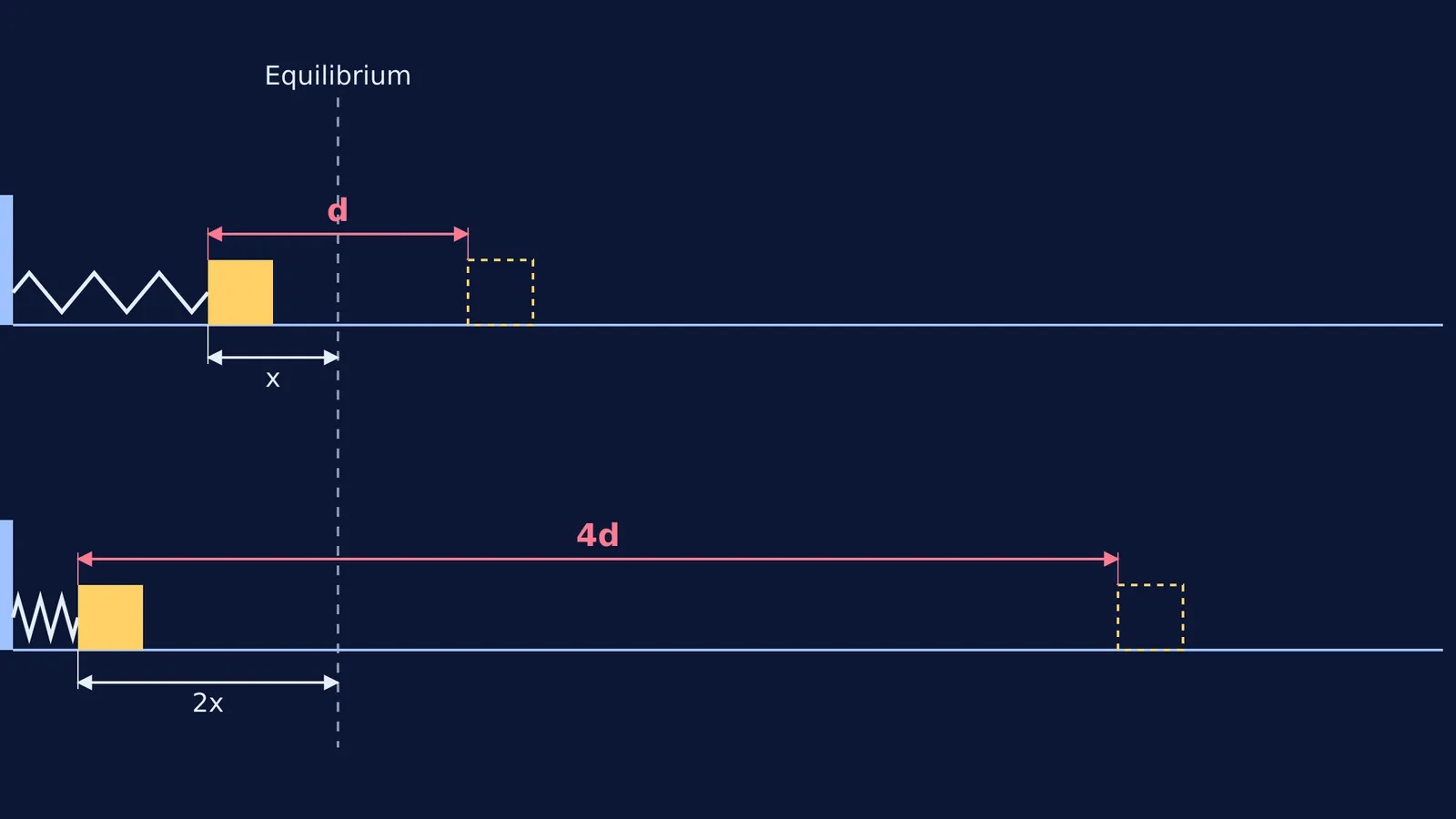
A common exam question asks what happens if you reset the experiment but push the block in twice as far. The intuition for many students is that twice the compression should mean twice the launch distance. But the real answer is four times the distance, because, as HyperPhysics notes, the stored energy grows with the square of the compression (E = ½ kx²).
The reason lies in how a spring stores energy, and how friction takes that energy away.
How does the spring store energy?
A spring does not store energy linearly. As you compress it, the coils push back harder and harder. Pushing it the first centimetre takes a small amount of work, but pushing it the second centimetre requires fighting against a much stiffer resistance.
According to Hooke's Law, the restoring force a spring pushes back with is directly proportional to how far you compress it from its equilibrium position. The total energy stored inside the spring is equal to the mechanical work you must do against this growing force to compress it, a relationship detailed by HyperPhysics.
Because of the x² in the ½ kx² formula, the relationship is quadratic. If you double the compression (x becomes 2x), the energy stored does not double; it increases by a factor of four ((2x)² = 4x²). If you triple the compression, you store nine times the energy.
This quadratic energy growth is the key to predicting how the block will behave, a principle also covered in SHM energy graphs: how KE and PE vary with displacement.
How far does a compressed spring launch a block?
When you release the spring, it decompresses and all that stored potential energy turns into the block's kinetic energy. As the block slides across the table, friction constantly rubs away this energy until the block finally stops.
You can find the stopping distance by equating the energies. The work-energy theorem shows that the negative work done by friction must equal the total energy the block started with. The work done is the friction force multiplied by the sliding distance (W = F_friction × d), as outlined by HyperPhysics.
Since the friction force (F_friction = μmg) is a constant that stays the same no matter how fast the block is going, the sliding distance d is directly proportional to the starting energy.
Original launch: A compression of x gives a starting energy E. The friction force uses up this energy over a sliding distance d.
Doubled launch: A compression of 2x gives a starting energy of 4E. Since the force of friction rubbing against the block is completely unchanged, it takes four times the distance (4d) to rub away this larger amount of energy.
How can you test the prediction?
You can test this relationship mathematically or visually. If you want to see the block slide and watch the energy bars grow in real time, the Fermi Simulation Lab offers interactive simulations for ideas easier to see than read. You can set the spring constant and friction to test the distances exactly. For more on spring energy, you can also explore A mass on a vertical spring: new equilibrium and period of SHM.
For an exam problem, you can set up the conservation equation directly using the energy principles from HyperPhysics: ½ kx² = μmgd
Rearranging for the stopping distance (d) gives: d = (k / 2μmg) x²
All the terms inside the parentheses—the spring constant (k), the friction coefficient (μ), the mass of the block (m) and the acceleration due to gravity (g)—are fixed constants. The only variable that changes from one launch to the next is the compression x.
This quadratic relationship applies to other setups, too. If the block is launched straight up into the air instead of sliding, gravity does the negative work instead of friction. The maximum vertical height it reaches will also scale with x². However, if the block is fired horizontally off the edge of a table, its horizontal range depends on time and velocity. Because velocity only doubles when compression doubles, the horizontal range as a projectile will only double, not quadruple.


