

On this page
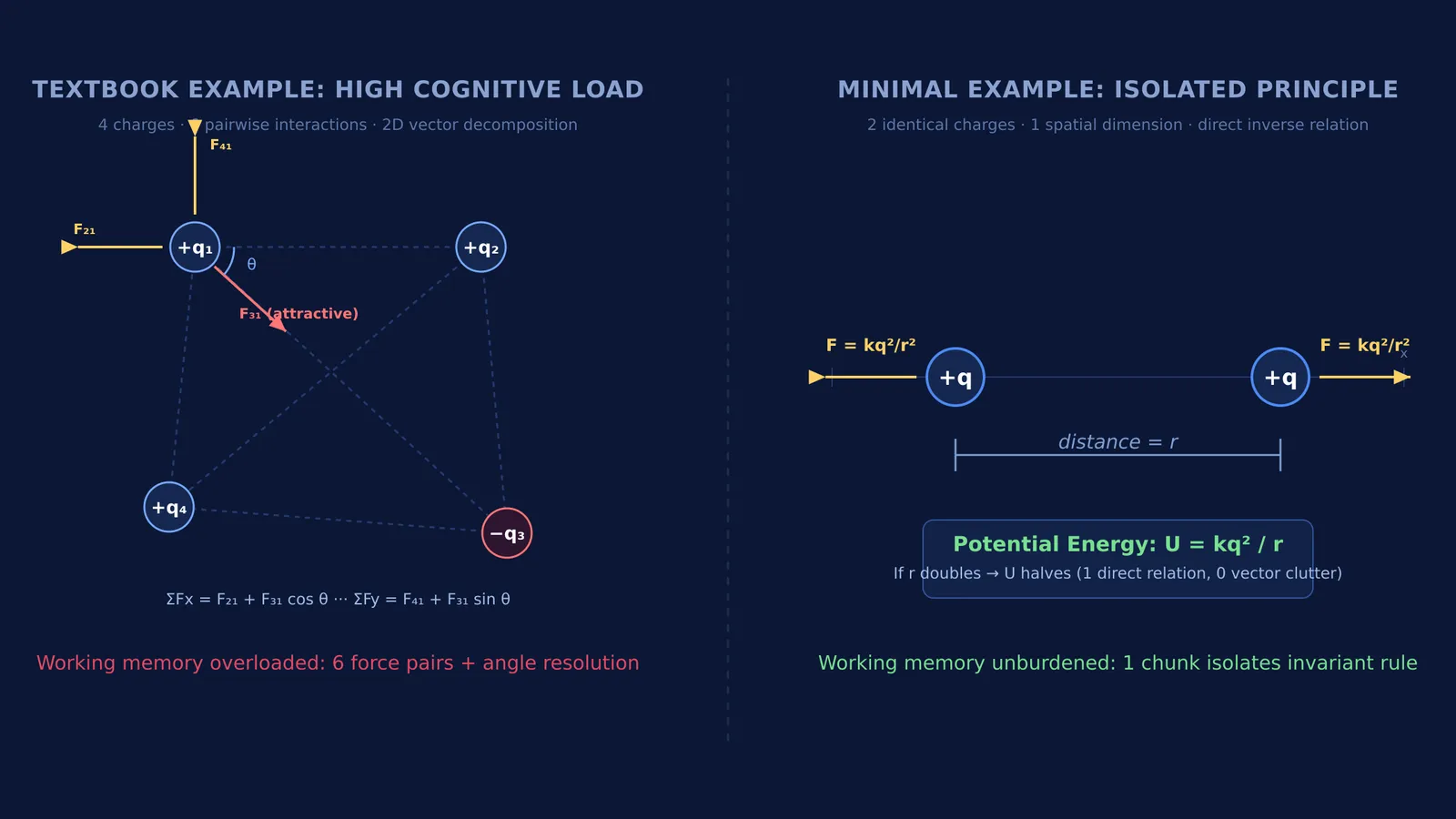
When you open a chapter in a physics or mathematics textbook, introductory worked examples rarely isolate the new concept. Instead of showing how the core relation operates on its own, textbooks routinely embed it inside multi-step geometry, awkward angles, and dense arithmetic.
Most of your mental capacity is consumed by routine housekeeping: tracking decimals, converting units, and rearranging fractions. By the time you reach the final answer, the underlying principle is lost behind calculation clutter. Learning an idea for the first time requires isolating the invariant rule before seeing how it intersects with other concepts under exam pressure.
Why do standard textbook examples make concepts feel so difficult?
Cognitive science explains why oversized examples stall beginners. In a 2001 review published in *Behavioral and Brain Sciences*, psychologist Nelson Cowan demonstrated that human working memory can hold only roughly four independent chunks of novel information at a time when rehearsal and chunking are prevented.
When a worked example introduces multiple interacting components simultaneously, working memory reaches saturation. In educational psychology, this bottleneck is formalised by Cognitive Load Theory, first formulated by John Sweller in Cognitive Science (1988). Sweller showed that conventional problem solving forces novices into means-ends analysis, burning mental energy searching for intermediate steps rather than storing patterns in long-term memory.
In a 2010 analysis in Educational Psychology Review, Sweller established that element interactivity determines this mental burden. When elements cannot be understood without considering several other interacting elements simultaneously, cognitive load spikes. A review by Robert Atkinson, Alexander Renkl, and colleagues in the Review of Educational Research (2000) confirmed that clear, integrated worked examples reduce this extraneous load, giving learners the bandwidth to build stable schemas.
What does a minimal non-trivial example look like in practice?
A minimal non-trivial example is the smallest possible scenario where a law operates without collapsing into a trivial edge case. It strips away calculation clutter while preserving the core mechanism:
In physics: To understand Coulomb's law and potential energy, avoid starting with three charges at the corners of a triangle. Start with two identical charges of magnitude +q separated by distance r on a straight line. The potential energy is simply k × q² / r. You observe how distance inversely scales potential energy without resolving vector components.
In chemistry: To study dipole moments and bond polarity, avoid polyatomic molecules with resonance structures. Start with hydrogen chloride (H-Cl), a diatomic molecule with one polar covalent bond. You see electron density displacement and partial charges without competing bond vectors cancelling out.
In mathematics: To understand matrix transformations, avoid a 3×3 matrix with fractional roots. Start with a 2×2 diagonal matrix containing entries 2 and 3 along the main diagonal. The transformation scales coordinate axes by 2 and 3 without rotation, revealing eigenvalues immediately.
What prompt forces an AI tutor to give you the smallest example?
Standard chatbots default to textbook-style verbosity. If you ask for Gauss's law or eigenvalues, the model typically returns lengthy formal definitions followed by a textbook problem filled with algebraic fractions.
In their 2023 research paper on SSRN, Ethan Mollick and Lilach Mollick demonstrated that structured instructional constraints direct AI models toward genuine tutoring rather than passive text generation.
To extract the atomic core of an idea, use this prompt:
"I am learning [concept] for the first time. Do not give me a generic textbook definition or a multi-step calculation. Give me the smallest non-trivial worked example of this concept:
Use the minimum number of interacting elements (such as two charges, one bond, or a 2×2 matrix).
Use clean integers or simple variables rather than fractions or decimals.
Show the working in three lines or fewer.
State in one sentence what fundamental behavior this example reveals."
How an AI responds reveals whether it functions as a teaching aid or a search engine, an issue explored in our analyses of hints or answers in tutoring and worked examples or solving from scratch. When using Fermi's AI tutor, the platform teaches rather than simply printing answers: it notices where you are stuck, decides whether to explain, ask, or show, and draws figures on a board to keep the core relation visible before adding complexity.
How should you climb from a tiny example to exam-level problems?
A minimal example builds the schema; exam problems require applying that schema under complex conditions. Once the smallest case makes sense, scale up your practice systematically:
Perturb the minimal system: Change one parameter to test your mental model. If distance doubles in the two-charge system, verify that energy halves, following our methods to check you understood an AI explanation.
Add one element at a time: Introduce a third charge on the line before moving to two dimensions, checking whether your schema handles new interactions without overloading working memory.
Introduce exam-style arithmetic: Once structural relationships are clear, replace clean integers with realistic constants, angles, and unit conversions.
Practice composite problems: The Fermi Problem Library provides worked problems with a step-by-step solver that explains the reasoning rather than printing an answer, bridging foundational intuition and multi-concept exam questions. For geometric or spatial phenomena where static equations feel abstract, the Fermi Simulation Lab offers interactive simulations for the ideas that are easier to see than to read.


