

On this page
If you ask a student to list the prime numbers up to 100, the usual method is rote memorisation. But Eratosthenes of Cyrene (c. 276 BC – 194 BC) created a famous algorithm for finding prime numbers by systematically 'sieving' out multiples of primes. He did not test whether individual numbers were prime; instead, he removed the ones he knew were not.
Rather than staring at a list, active learning lets you predict how many primes there are and eliminate the composite numbers yourself. This hands-on approach changes how the mathematics sticks. A landmark analysis by Scott Freeman and colleagues at the University of Washington found that students in traditional lecturing classes are 55% more likely to fail than those in active learning environments. When you construct the knowledge yourself, the rules of mathematics become obvious tools rather than arbitrary facts.
Here is how to run the Sieve of Eratosthenes interactively, step by step, and prove exactly why the counting stops much earlier than you might expect.
What is the Sieve of Eratosthenes?
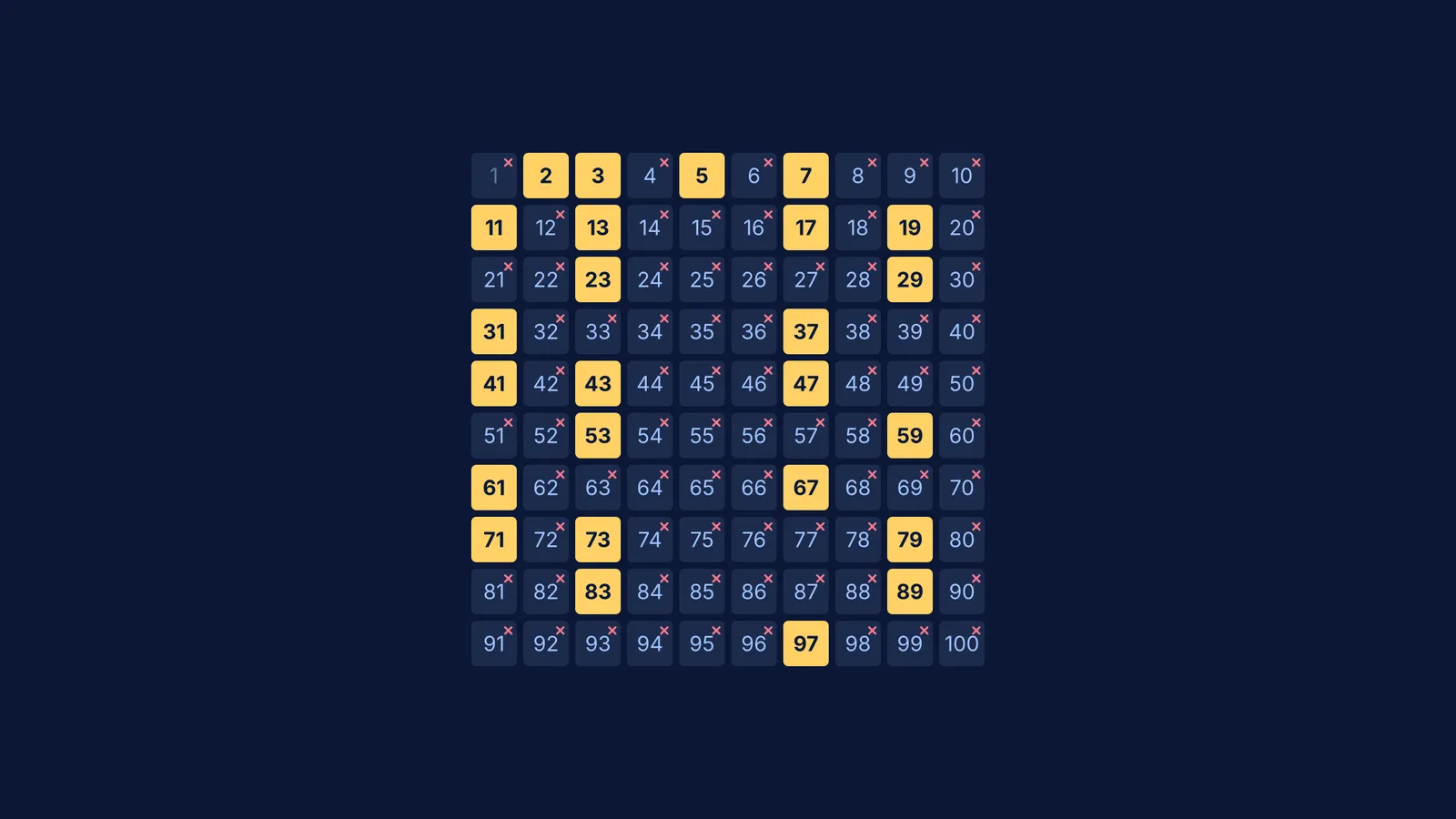
The sieve is a method of elimination. You start with a grid of all numbers from 1 to 100. Because 1 is neither prime nor composite, you cross it out immediately.
Then, you find the first uncrossed number—which is 2, a prime. You leave 2 alone, but you cross out every multiple of 2 (4, 6, 8, 10, and so on). Next, you find the next uncrossed number, which is 3. You circle it as a prime, and cross out all its multiples (6, 9, 12...).
As you continue this process for 5 and 7, the grid empties out. The numbers left standing are the primes. In total, there are exactly 25 prime numbers below 100. You could memorise them like primes, co-primes and divisibility tests, but sieving them out builds a deeper intuition for how numbers are put together. You see, physically on the grid, that prime numbers become rarer as you reach higher numbers, because there are more smaller primes whose multiples overlap.
Why do you stop at the square root of 100?
If you are crossing out multiples on a 100-number grid, you might think you need to keep testing multiples of 11, 13, 17 and beyond. You do not. You can stop after crossing out the multiples of 7.
Why? The square root of 100 is 10 (√100 = 10). If a number less than or equal to 100 is composite, it must have at least two factors. They cannot both be greater than 10, because if they were, their product would be greater than 100 (for example, 11 × 11 = 121).
Therefore, every composite number up to 100 must have at least one prime factor that is 10 or smaller: 2, 3, 5, or 7. By the time you finish crossing out the multiples of 7, every single composite number on your board has already been hit. Anything left uncrossed is guaranteed to be prime. This elegant logic is why the algorithm has survived for over two millennia.
A checklist for sieving primes on paper
You can do this at home with a pencil and paper to prove it to yourself. Follow this simple plan:
Write the numbers 1 to 100 in a 10 × 10 grid.
Cross out 1 (it only has one factor).
Circle 2, then cross out all even numbers (every second number on the grid).
Circle 3, then cross out every third number. Many will already be crossed out by 2.
Circle 5, then cross out every fifth number (any number ending in 0 or 5).
Circle 7, then cross out every seventh number (such as 49, 77, and 91).
Stop. Circle all the numbers that remain uncrossed. You should have exactly 25 circles.
How to try this interactively
Testing primes visually transforms an abstract rule into a mechanical certainty. In the Fermi Simulation Lab, you can run the Sieve of Eratosthenes yourself. You can predict the primes, cross out the multiples one prime at a time, and watch the grid filter down to just the remaining 25 numbers.
If you get stuck on why 91 is crossed out (it is 7 × 13), Fermi's AI tutor can work out what you already know and build a plan for the session, teaching you the reasoning rather than just printing the answer. Whether you are moving on to the AKS test for prime numbers or studying for your next mathematics exam, discovering the pattern yourself is the clearest way to remember it.


