

On this page
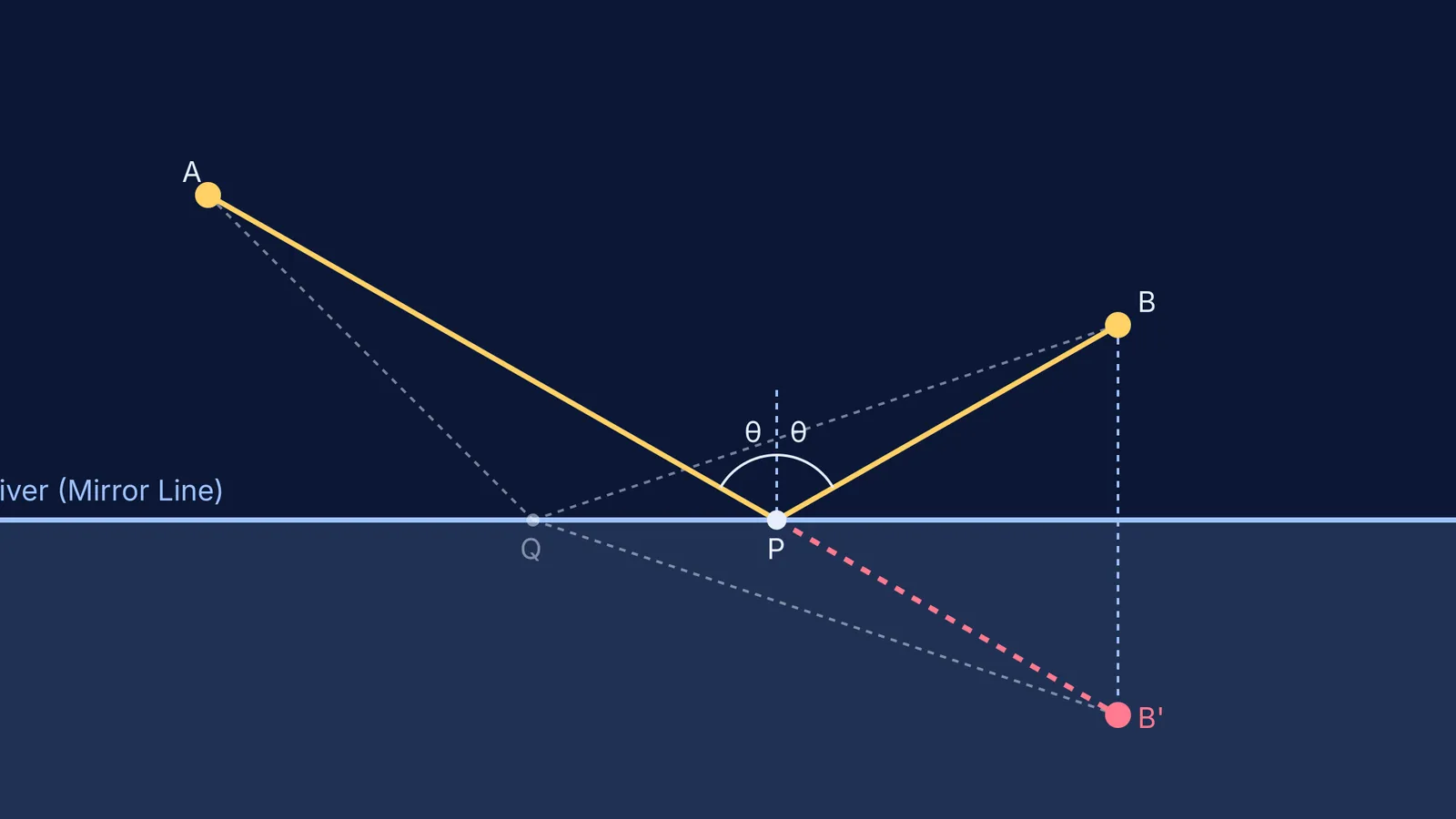
Imagine you are standing at point A on a field, and you want to walk to point B. Between the two points runs a straight river. You need to fetch a bucket of water from the river on your way. Where exactly on the riverbank should you walk to make your total journey as short as possible?
If there were no river, you would just walk in a straight line. But because you have to touch the river, the path bends. The solution lies in a clever geometric idea that also explains how light bounces off a mirror.
How do you find the shortest path to a river and back?
The problem is hard to solve if you try to guess where the bend should be. Instead of guessing, you can use a mirror image to straighten the path out.
Here is the trick: imagine the river is a mirror. Find the exact reflection of point B on the other side of the river, and call it point B'. Now, draw a straight line from your starting point A directly to the reflected point B'.
The spot where this straight line crosses the river is your perfect target. If you walk from A to that exact spot, and then walk to B, you will have taken the shortest possible route.
This elegant solution was recorded by the mathematician Heron of Alexandria (c. 10 CE – 70 CE) in his work *Catoptrica*. He used it to understand how light behaves.
Why does the reflection trick work?
It works because a straight line is always the shortest distance between two points.
By reflecting B across the river to B', you create a symmetry. From any spot on the river, the distance to B is exactly the same as the distance to B'. So, minimizing the walk from A to the river to B is exactly the same problem as minimizing the walk from A to the river to B'.
Since B' is on the opposite side of the river, you can connect A and B' with a single, straight line. Any other path you try will form a triangle with this straight line. The triangle inequality states that the sum of two sides of a triangle is always greater than the third side. Therefore, the straight line to the reflected point is mathematically guaranteed to be the shortest path.
This is the geometric foundation for the law of reflection, and it is why we use similar logic when rotating a plane mirror by θ or calculating the minimum mirror height to see your full image.
How can you test the river problem?
It is one thing to read about the reflection trick, but it is much easier to believe when you can move the points yourself and watch the path change.
If you are exploring this for physics or maths, you can set it up in the Fermi Simulation Lab. You can place the houses and the river, measure the lengths of different paths, and confirm that the straight-line reflection always gives the smallest number.
If you get stuck trying to prove why the two angles are equal, Fermi's AI tutor can help you work through the similar triangles. The AI tutor teaches rather than answers: it holds a line of reasoning across a session, draws the figure with you, and asks questions to check your understanding as you go. It is a great way to turn a classic puzzle into a deep understanding of optics and geometry.


