

On this page
Many students expect every salt solution to test at neutral pH 7.00. Because salts form through neutralization reactions between acids and bases, intuition suggests that the reactants neutralize each other completely. In a study of approximately 7,500 students in the *International Journal of Science Education*, researcher Hans-Jürgen Schmidt (1991) identified the term "neutralization" as a linguistic "hidden persuader." The familiar label persuades learners that the reaction products must be neutral.
In reality, neutralization describes stoichiometric consumption, not final solution pH. When salts dissolve in water, they dissociate into aqueous ions. A secondary process called salt hydrolysis occurs when these ions react with water molecules by exchanging protons.
How do you predict whether NaCl, NH4Cl, and CH3COONa are acidic or basic?
To predict the pH of a salt solution, follow a systematic four-step method:
Separate the salt into its cation and anion.
Trace each ion back to its parent base and acid by pairing the cation with OH⁻ and the anion with H⁺.
Classify parent strengths: strong parents yield spectator ions, while weak parents yield reactive conjugates.
Determine whether the reactive ion donates protons to form H₃O⁺ or abstracts protons to form OH⁻.
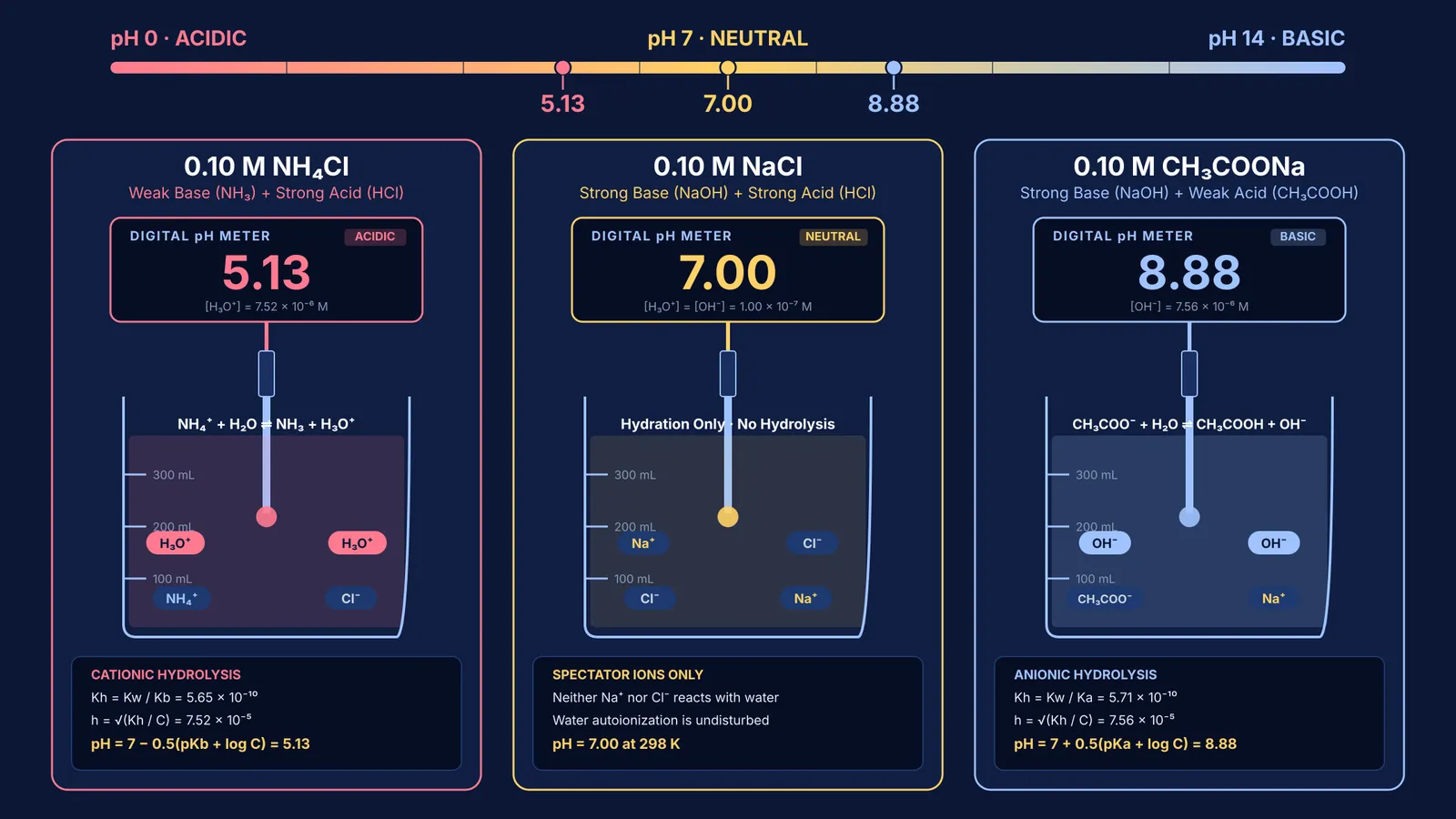
Sodium chloride (NaCl) derives from strong sodium hydroxide (NaOH) and strong hydrochloric acid (HCl). Neither Na⁺ nor Cl⁻ interacts with water. As detailed in OpenStax Chemistry 2e, NaCl undergoes hydration rather than hydrolysis. The water equilibrium remains undisturbed with [H₃O⁺] = [OH⁻] = 1.00 × 10⁻⁷ M, leaving the solution neutral at pH 7.00.
For ammonium chloride (NH₄Cl), the parent acid is strong (HCl) but the parent base is weak ammonia (NH₃). While Cl⁻ is an inert spectator, the ammonium cation (NH₄⁺) is the active conjugate acid of a weak base. In water, NH₄⁺ undergoes cationic hydrolysis:
NH₄⁺(aq) + H₂O(l) ⇌ NH₃(aq) + H₃O⁺(aq)
This proton donation creates excess hydronium ions ([H₃O⁺] > [OH⁻]), producing an acidic solution (pH < 7).
Sodium acetate (CH₃COONa) pairs a strong base (NaOH) with weak acetic acid (CH₃COOH). Sodium acts as an inert spectator, but the acetate anion (CH₃COO⁻) acts as a Brønsted-Lowry base. Acetate undergoes anionic hydrolysis:
CH₃COO⁻(aq) + H₂O(l) ⇌ CH₃COOH(aq) + OH⁻(aq)
Generating hydroxide ions leaves [OH⁻] > [H₃O⁺], making the solution basic (pH > 7). To see how conjugate acid-base strengths mirror each other, read our guide to conjugate acid-base pairs.
What happens during cationic and anionic hydrolysis?
The extent of hydrolysis depends on the dissociation constants of the parent species. In OpenStax Chemistry 2e, the hydrolysis constant Kh connects the ion product of water (Kw = 1.00 × 10⁻¹⁴ at 298 K) to the weak parent's dissociation constant.
For a 0.10 M NH₄Cl solution, ammonia has a dissociation constant Kb = 1.77 × 10⁻⁵ (pKb = 4.75). The hydrolysis constant is Kh = Kw / Kb = 5.65 × 10⁻¹⁰. With h = √(Kh / C) = √(5.65 × 10⁻¹⁰ / 0.10) ≈ 7.52 × 10⁻⁵, the hydronium concentration is [H₃O⁺] = C × h = 7.52 × 10⁻⁶ M:
pH = −log₁₀(7.52 × 10⁻⁶) = 5.13
The standard equilibrium formula confirms this: pH = 7 − 0.5(pKb + log₁₀ C) = 7 − 0.5(4.75 − 1.00) = 5.13.
For a 0.10 M CH₃COONa solution, acetic acid has Ka = 1.75 × 10⁻⁵ (pKa = 4.75), giving Kh = Kw / Ka = 5.71 × 10⁻¹⁰. With h = √(5.71 × 10⁻¹⁰ / 0.10) ≈ 7.56 × 10⁻⁵, hydroxide is [OH⁻] = 7.56 × 10⁻⁶ M and pOH = 5.12:
pH = 14.00 − 5.12 = 8.88
The standard formula gives the same result: pH = 7 + 0.5(pKa + log₁₀ C) = 7 + 0.5(4.75 − 1.00) = 8.88. For step-by-step derivations across salt types, see our tutorial on salt hydrolysis and buffer calculations. When practicing multi-step equilibrium problems, the Fermi Problem Library features worked problems with a step-by-step solver that explains the reasoning rather than printing an answer.
How does testing with a virtual pH meter build lasting intuition?
Formulas alone rarely dislodge misconceptions. In a study on classroom demonstrations, Crouch, Fagen, Callan, and Mazur (2004) showed that passive observation yielded no significant gain in explaining physical concepts (24% correct explanations) compared to no demonstration (22%). Asking students to predict outcomes beforehand increased correct explanations to 30%, rising to 32% with peer discussion.
In chemistry, research by Watson, Dubrovskiy, and Peters (2020) in *Chemistry Education Research and Practice* confirmed that interactive pH simulations significantly improved students' conceptual understanding and confidence over standard instruction.
Interactive tools like the PhET pH Scale simulation let you insert a digital probe into simulated beakers, directly observing how ion ratios shift pH. When you predict that 0.1 M NH₄Cl will register acidic and watch the digital meter settle at 5.13, abstract proton transfers turn into observable evidence. To explore when interactive media outperforms static images, see our review of simulations or static diagrams.
When exploring chemical equilibrium and dynamic processes, the Fermi Simulation Lab provides interactive simulations for the ideas that are easier to see than to read, helping you test hypotheses and build durable intuition.


