

On this page
It's a classic classroom puzzle: if you take two identical sheets of A4 paper and roll them into cylinders—one tall and thin, the other short and wide—which one holds more?
Most people intuitively guess they hold the same amount, or that the tall one holds more because height feels like a proxy for capacity. But the maths tells a different story.
Roll paper into tall or short cylinder: which holds more?
The short, wide cylinder always holds more. If you use a standard A4 sheet, the short cylinder has a volume approximately 41% greater than the tall one.
You can prove this with a simple test. Roll one A4 sheet along its length and tape the edges without overlapping. Roll the second sheet along its width and tape it. Place the tall cylinder flat on a table, inside the short one. Fill the tall cylinder to the brim with popcorn or rice. When you lift the tall cylinder straight up, the contents will fall into the short cylinder—and you will see plenty of room left over. This physical demonstration makes the abstract geometry immediately visible.
Why does the short cylinder have more volume?
The answer lies in the formula for the volume of a cylinder, which is calculated as V = πr²h.
Because the radius (r) is squared while the height (h) is not, changing the radius has a much larger impact on the total volume than changing the height. When you roll the paper into a short cylinder, the longer edge of the paper becomes the circumference. This creates a larger radius, and squaring that larger radius outweighs the loss in height.
Let's run the numbers for an A4 sheet, which measures 21.0 cm by 29.7 cm.
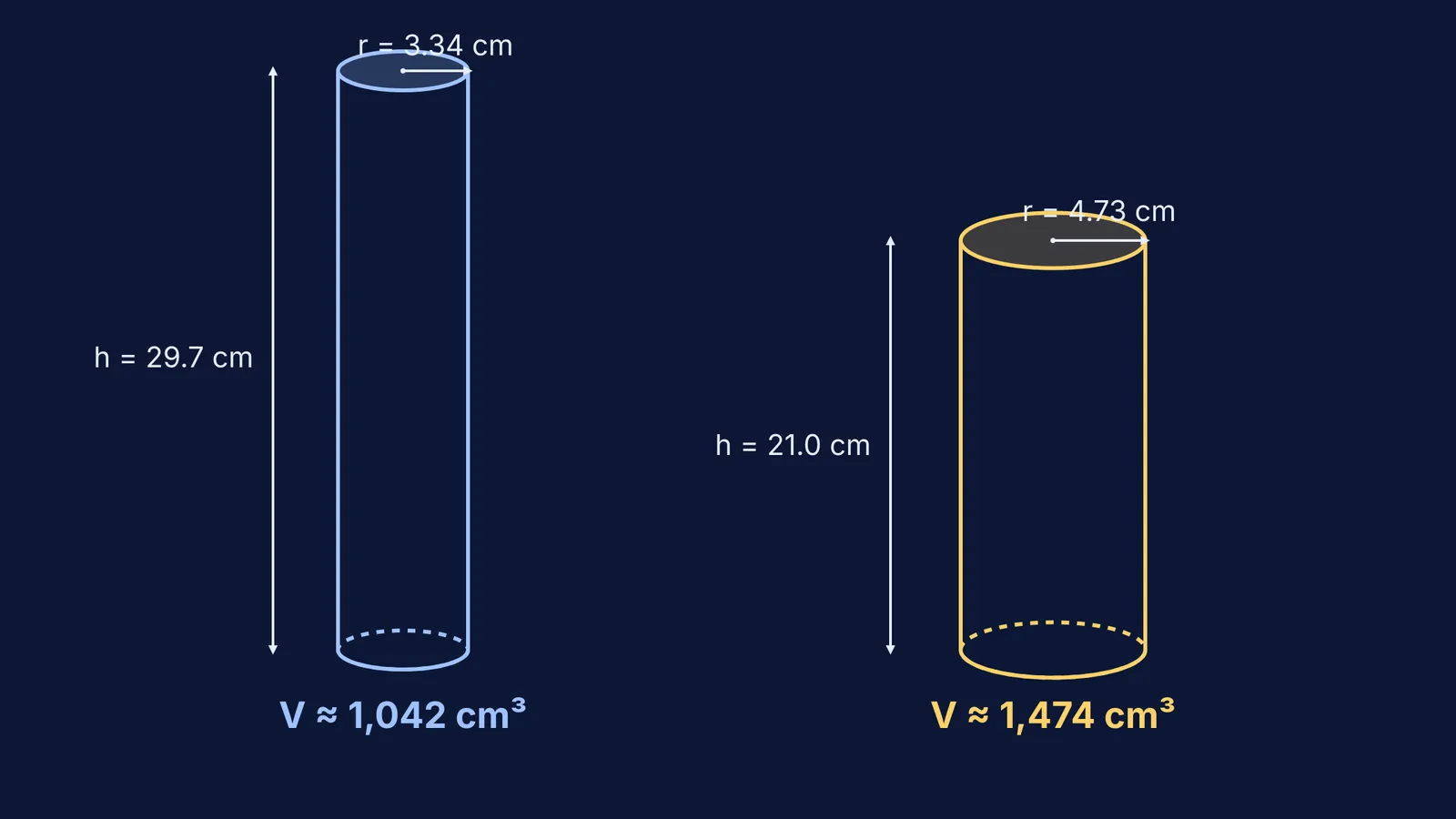
Tall cylinder: The circumference is 21.0 cm and the height is 29.7 cm. The radius is 21.0 / 2π (about 3.34 cm). The volume is π × 3.34² × 29.7, which equals roughly 1,042 cm³.
Short cylinder: The circumference is 29.7 cm and the height is 21.0 cm. The radius is 29.7 / 2π (about 4.73 cm). The volume is π × 4.73² × 21.0, which equals roughly 1,474 cm³.
Because the sides of A4 paper are designed to have a ratio of 1 to √2, the short cylinder holds exactly √2 times as much volume—which works out to 41.4% more space. This ratio is a unique feature of the A-series paper sizes, ensuring that if you cut the paper in half, the two new sheets have the exact same proportions as the original.
Does this rule apply to everyday objects?
This geometric rule applies to any situation where a flat surface is bent into a container. This mathematical relationship is why manufacturers of pipes, silos and storage tanks must carefully calculate their dimensions. While a short, wide shape holds the most volume for the surface area of its sides, closing the cylinder with a top and bottom requires extra material.
For everyday objects like beverage cans or soup tins, the final shape is a compromise between the volume it holds, the cost of the metal for the lids, and how easily a consumer can hold it in one hand. When you only consider the sides—like rolling a single sheet of paper without top or bottom covers—the wider cylinder is the undisputed winner for maximising capacity.
How can you picture the math?
It can be difficult to visualise how a linear change in one dimension causes a squared change in another. The Fermi Simulation Lab lets you adjust the dimensions of geometric shapes and watch how their volumes change in real time. Seeing the base area expand quadratically while the height drops linearly makes the rule intuitive.
If you get stuck on geometry problems where shapes are reformed, stretched or melted down, Fermi's AI tutor can help. It works out what you know and teaches through the steps, drawing the figure and checking your understanding as it goes.
Try the experiment yourself, or bring your trickiest geometry homework to Fermi to see how a small change in radius shifts everything. If you are exploring more geometry and calculus rules, you might also find it helpful to review the latus rectum lengths for conic sections or how to calculate area using horizontal strips.


