

On this page
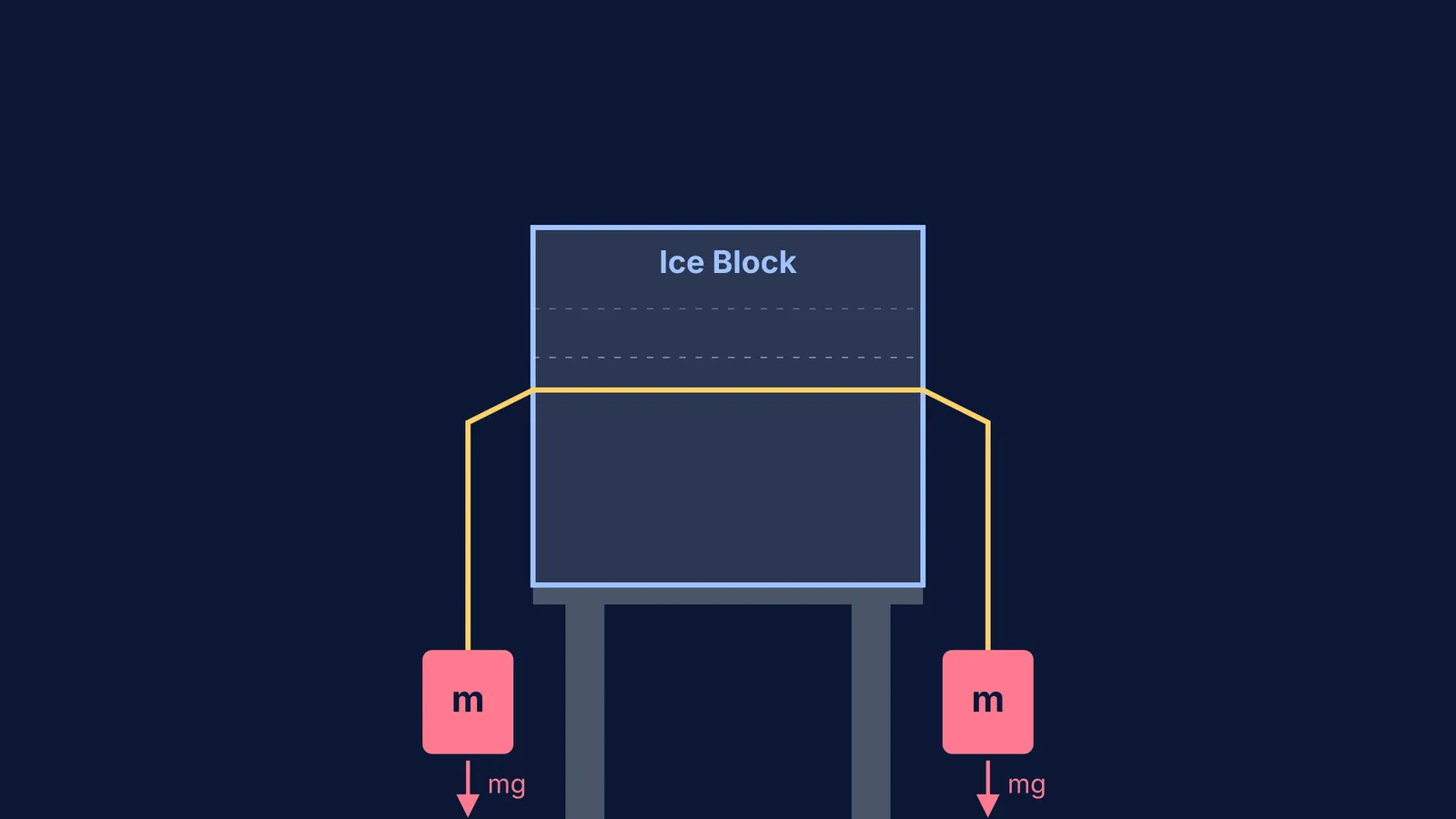
Have you ever seen a thin metal wire, weighted at both ends, slice completely through a solid block of ice without breaking it? This classic physics demonstration looks like a magic trick. The ice block remains whole even after the wire has passed right through it.
This phenomenon is called regelation. It relies on a unique property of water: unlike most substances, its solid form (ice) is less dense than its liquid form.
Why does a wire cut through an ice block?
The secret lies in the relationship between pressure and melting point. When you drape a wire over an ice block and hang weights on it, the wire's tiny surface area concentrates the force, creating enormous pressure on the ice directly beneath it.
According to the Clausius–Clapeyron equation, increasing the pressure on ice lowers its melting temperature. If the ice is resting at its freezing point, the added pressure drops the local melting point below freezing. The ice right under the wire melts into a thin film of water, allowing the wire to sink into the ice.
Predicting the outcome of physical systems like this can be counterintuitive. Students often build a better understanding of forces and pressure when they can manipulate the variables themselves in the Fermi Simulation Lab, where interactive simulations make ideas easier to see than to read.
How much pressure lowers the melting point of ice?
The pressure required to melt ice is substantial. According to the American Meteorological Society, the melting point of ice falls by 0.0072 °C for each additional atmosphere of pressure applied (source).
To lower the melting point to −4 °C, a pressure of 500 atmospheres is needed. Because a thin wire has a very small contact area, even a small weight can generate enough pressure to lower the melting point just enough to melt the ice, provided the ambient temperature is close to freezing.
Does the ice block break in half?
No, the block remains completely intact. As the wire sinks into the meltwater, the water is pushed above the wire. Once above the wire, the water is no longer under high pressure.
Without the pressure, the water's melting point returns to its normal freezing point. Because the surrounding ice is still at its freezing point (and absorbs the latent heat released by the freezing water), the water instantly refreezes. This refreezing process is what we call regelation. The ice essentially heals itself as the wire moves down, leaving a solid block behind.
Why does heat conduction matter?
Pressure alone does not explain how fast the wire moves. Heat transfer is the rate-limiting step.
When ice melts beneath the wire, it absorbs latent heat. When water refreezes above the wire, it releases latent heat. A copper wire acts as a thermal bridge, conducting the heat released at the top down to the ice at the bottom. If you repeat the experiment with a nylon fishing line — which is a poor conductor of heat — it will barely cut the ice at all, even if it applies the same pressure.
When studying thermodynamics, reading a textbook explanation is one thing, but stepping through the reasoning is another. The Fermi Problem Library provides worked problems with a step-by-step solver that explains the reasoning rather than printing an answer.
If you are preparing for exams like JEE Main or NEET-UG, understanding why a material's conductivity matters as much as the pressure it exerts is the key to solving complex numericals. You can read more about what PhET research says interactive physics simulations are good for, or learn when to use simulations or static diagrams in your study routine.


