

On this page
If you ask a student how they study for physics or chemistry exams, many will describe making a massive list of equations to memorise. While having a "cheat sheet" feels safe in the moment, relying on rote memory is a dangerous trap for competitive exams like JEE and NEET. When you forget a minus sign or mix up a denominator under pressure, you are completely stuck.
Expert problem-solvers do not rely on vast mental libraries of equations. Instead, they memorise a handful of fundamental principles and derive the rest on the fly.
Why is the "plug-and-chug" method a trap?
A foundational 1981 study on problem-solving by Michelene Chi and colleagues found that novices sort physics problems by surface objects, while experts categorise them by deep principles 1. The study revealed that beginners view physics as a collection of equations, scanning the question for variables and then hunting for a formula to plug them into.
Experts, by contrast, categorise problems based on underlying truths like the conservation of energy or Newton's second law. Because they understand the core physics, they do not need to blindly plug numbers into a memorised equation; they construct the right mathematical tool for the specific problem at hand.
What is mathematical sensemaking?
Relying on derivations rather than rote memory builds what researchers call "mathematical sensemaking". A 2020 paper by Eric Kuo and co-authors found that mathematical sensemaking allows students to use calculations to solve qualitative physics problems 2. It is the ability to treat an equation as a story about physical quantities, rather than a mindless calculation.
For instance, when students understand that the mass cancels out in the equation for a block sliding with friction, they grasp the physical balance between the friction force and inertia. Instead of just memorising F = Gm₁m₂/r², sensemaking involves understanding that doubling the distance cuts the force to a quarter. This conceptual feel for the math is much more robust than remembering letters on a page, and it is a key reason why students understand theory but fail numericals.
The limits of textbook solutions
When students try to practice derivations on their own, their primary feedback loop is usually the textbook's solution manual. However, standard solutions present a polished, unbroken chain of logic. They show you the correct path from start to finish, but they offer no insight into why your specific alternative path failed.
If you make a mistaken assumption—for example, assuming that a variable is constant when it actually changes with time—a textbook solution will not point that out. You might spend hours staring at the page, trying to reverse-engineer where your thought process diverged from the author's. This frustration often drives students back to rote memorisation, as memorising a final formula feels safer than risking an unguided derivation.
How to practice deriving formulas from memory with AI?
To break the habit of rote memorisation, build this exercise into your study routine: take a blank sheet of paper, pick a target formula you struggle to remember, and try to derive it from one basic definition.
When you get stuck or finish your derivation, do not just look up the textbook answer. That only tells you if you got the right result, not *where* your logic broke down. Instead, bring your working to Fermi's AI tutor.
Upload a photo of your sheet and ask: "Check my logic, not just the answer. Where did I make a wrong assumption?"
Most tools just print a final answer, but Fermi teaches. Fermi's AI tutor holds a line of reasoning across a whole session, notices where a student is stuck, and decides whether to explain, ask, or show. It will pinpoint the exact step where your algebra or physics reasoning drifted, helping you fix the flaw in your conceptual understanding. This is a crucial difference when evaluating AI tutors vs answer chatbots.
A worked example: the kinematics equations
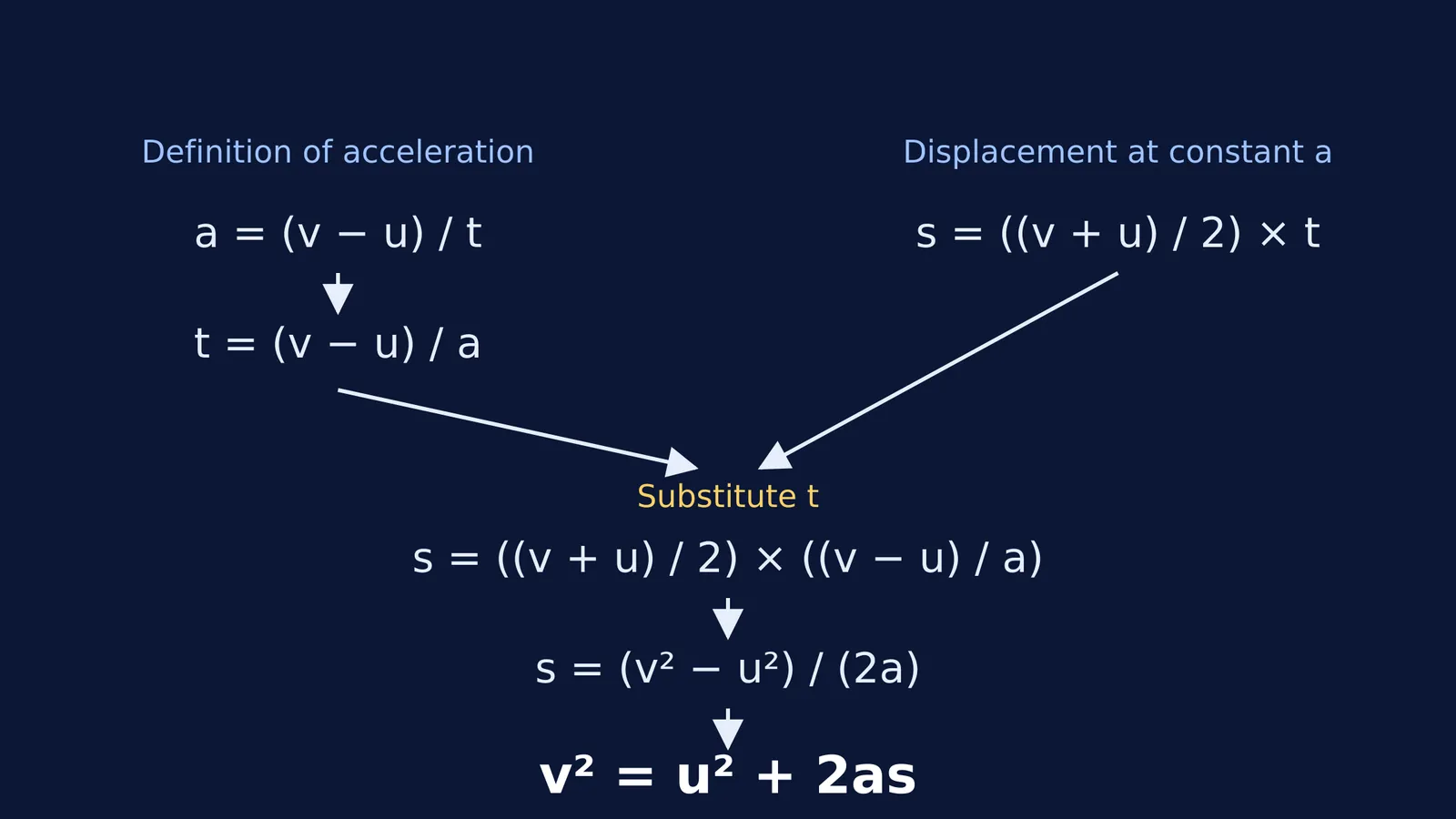
Let us say you always forget the kinematics equation v² = u² + 2as. Instead of staring at a formula sheet, start with the basic definition of acceleration (a = (v − u) / t) and the formula for displacement at constant acceleration (s = ((v + u) / 2) × t).
Write down the steps to eliminate the time variable, t. Substitute your rearranged acceleration equation into the displacement equation and multiply it out. If you make a mistake expanding the brackets, asking the AI to review your logic will catch it. By deriving equations yourself, you transform burdensome facts into meaningful tools that will not fail you on exam day.


