

On this page
When a block slides down a frictionless incline, it does not fall straight down. The ramp pushes back with a normal force, cancelling out some of the pull of gravity. The only force left is the component of gravity pointing directly down the slope.
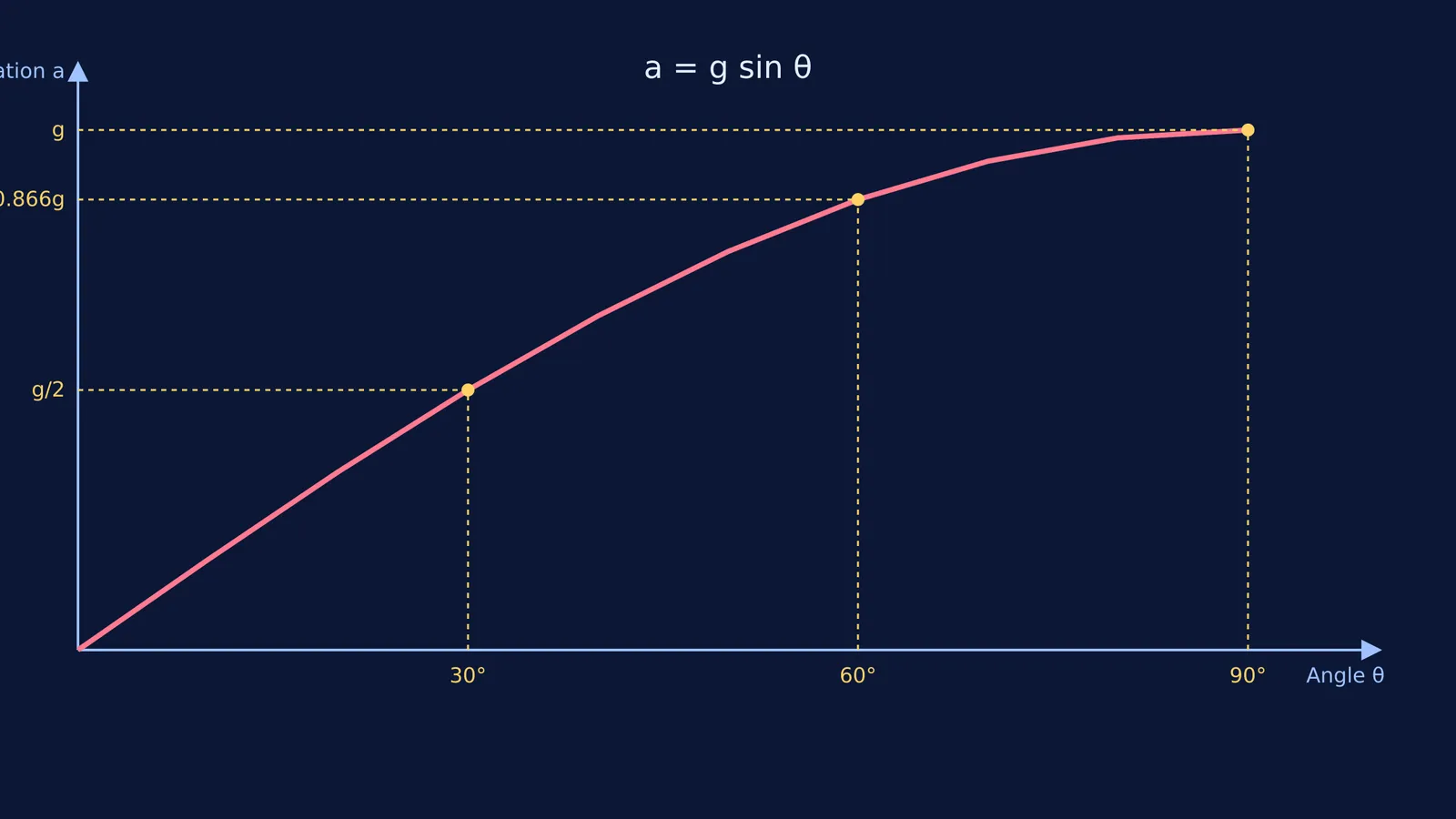
This leftover force gives us the classic acceleration formula: a = g sin θ, where g is the acceleration due to gravity (about 9.8 m/s²) and θ is the angle of the ramp.
How does acceleration down a ramp change with angle?
Because the acceleration depends on the sine of the angle, it does not increase in a straight line. It traces out a curve. If you tilt a board from flat (0°) to straight up (90°), the acceleration starts at zero, climbs quickly, and then increases more slowly before levelling off at standard gravity, 9.8 m/s².
We can see this clearly by predicting the acceleration at three different angles:
At 10 degrees: The ramp is quite shallow. The sine of 10° is roughly 0.1736. The acceleration is 9.8 × 0.1736 = 1.70 m/s². The block speeds up, but you could easily catch it.
At 30 degrees: The sine of 30° is exactly 0.5. The acceleration is 9.8 × 0.5 = 4.90 m/s². The block is now gaining speed at exactly half the rate of a falling object.
At 60 degrees: The ramp is steep. The sine of 60° is roughly 0.866. The acceleration jumps to 9.8 × 0.866 = 8.49 m/s². Even though the board is still 30 degrees away from being perfectly vertical, the acceleration is already 86% of free fall.
Does sliding friction change with angle?
The g sin θ curve assumes a perfectly smooth, frictionless surface. In the real world, friction slows the block down. The standard textbook model treats the kinetic friction coefficient as a constant number that depends only on the materials.
However, real physical systems are messier. A 2024 study in Physics Education found that in typical classroom inclined-plane experiments, the kinetic friction coefficient actually changes at different inclinations and cannot be treated as a strict constant.
How can you visualise the forces?
It is one thing to plug numbers into a = g sin θ, but it is another to see why the formula works. As the ramp gets steeper, the weight vector stays pointed straight down, but its component along the slope grows longer. If you find it hard to picture how these vectors shift, the Fermi Simulation Lab lets you drag the angle of a ramp and watch the forces and acceleration change in real time.
For more on how things move on inclines, see our worked example on the time for a block to slide down a rough incline or learn about the angle of repose and angle of friction.


