

On this page
When you read that the principal quantum number (n) determines the shell, and the azimuthal quantum number (l) goes from 0 to n−1, it feels straightforward. It is easy to nod along while reading the textbook chapter on atomic structure. But on an exam like JEE Main or NEET, spotting why a set like n = 2, l = 2, m = 0 is impossible can suddenly feel confusing when the clock is ticking.
Reading the textbook creates an illusion of competence because the rules make sense on the page. To truly master the allowed values of quantum numbers, you need to put the book away and test yourself.
Why does testing yourself beat re-reading?
Research on learning shows that testing is not just a way to measure knowledge, but a powerful mechanism to build it. A 2006 study by Roediger and Karpicke found that students who used testing to study retained 61% of the material a week later. In contrast, those who only re-read the material retained just 40%. The effort of pulling a fact from memory strengthens the neural pathways you will rely on during an exam.
An AI chatbot is a perfect tool for active testing. Instead of hunting for practice problems in your workbook, you can ask the AI to generate an endless supply of orbital sets and evaluate your answers instantly.
What is the prompt for an AI quantum numbers quiz?
To get the most out of an AI, give it a specific role and clear constraints so it does not give away the answer too early. Paste this exact script into your favourite AI chat:
"Act as my chemistry tutor. List 5 random sets of quantum numbers (n, l, m) for the first three shells. Make some of them allowed, and some impossible. Ask me to identify which are allowed and which are impossible. Do not give me the answers until I reply. When I reply, explain my mistakes."
How do you spot impossible n, l, m sets?
When the AI gives you a set to evaluate, check it methodically against the three core rules:
The shell: The principal quantum number (n) must be a positive integer (1, 2, 3...).
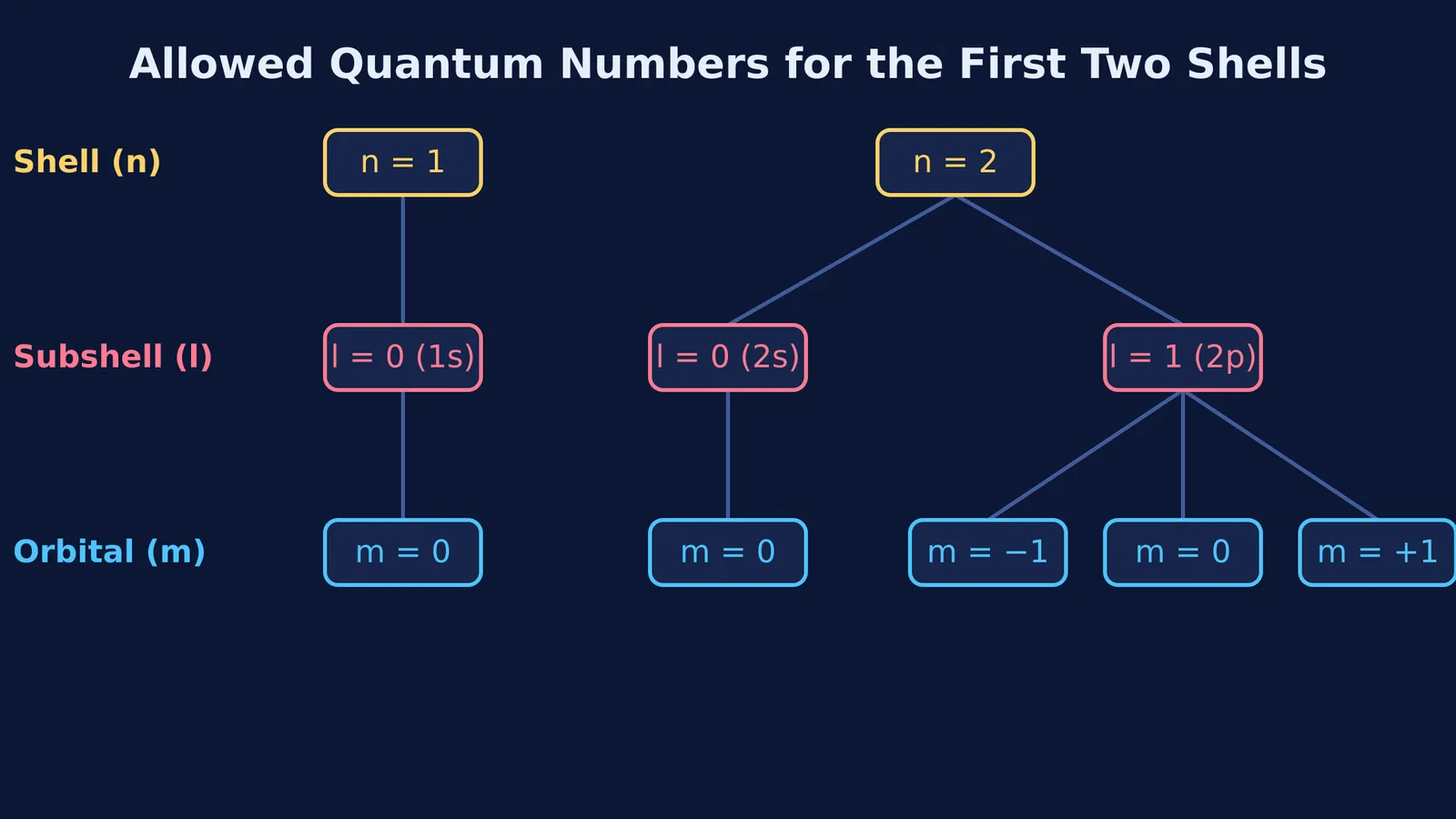
The subshell: The azimuthal quantum number (l) must be an integer from 0 up to n−1. For example, if n = 2, the only allowed values for l are 0 (the s orbital) and 1 (the p orbital). If the AI suggests l = 2 (a d orbital) for the second shell, it is an impossible set.
The orbital: The magnetic quantum number (m) must be an integer between −l and +l. If l = 1, then m can only be −1, 0, or +1. An m value of −2 would be impossible here.
If you struggle to remember the shapes these numbers represent, review how to find quantum numbers and electron configurations. Or, if the underlying physics feels too abstract, look at how Erwin Schrodinger formulated the wave equation that gives us these numbers in the first place.
How do you take the quiz to the next level?
Once you can easily spot impossible sets of n, l, and m, you can modify the AI prompt to test deeper concepts. Ask the AI to give you an orbital name, like 3p or 4d, and challenge you to list all the possible m values for it.
Alternatively, you can test your knowledge of electron capacity and orbital structure. Tell the AI: "Now give me an allowed set of quantum numbers, and ask me to calculate the total number of electrons that can share those exact values, as well as the number of radial and angular nodes." This forces you to connect the rules back to the physical atom. If you need a refresher before doing this, read up on counting radial and angular nodes.
What if you keep getting them wrong?
If you are missing the same type of question repeatedly, a standard text chatbot can sometimes get stuck in a loop of explaining the rule without helping you see why it works.
This is where Fermi's AI tutor steps in. Instead of just printing text, it works out what you know and builds a plan for the session, checking your understanding as it goes. It holds a line of reasoning across a session and can draw the figure on a whiteboard, breaking down the subshells until the rules finally click.
Testing yourself with an AI takes the passive reading out of your study routine, turning abstract quantum rules into second nature.


