

On this page
If you are studying for the CBSE Class 12 physics board exam, you already know that derivations make up a large portion of the theory paper. Students spend hours copying the lens maker's formula or Gauss's law over and over, hoping the steps will stick.
But when exam day arrives, many hit a wall halfway through a derivation. They remember the starting diagram and the final equation, but the algebraic steps in the middle vanish. This happens because most students treat derivations as a memory test, when they are actually a chain of logical arguments.
Why do derivations feel so hard to learn?
When you read a textbook chapter on the electric field of a dipole or the lens maker's formula, the logic flows perfectly. Each step seems like an obvious algebraic substitution. This fluency tricks your brain into an "illusion of competence." You feel you understand it because the author did the hard work of connecting the steps and defining the physical constraints.
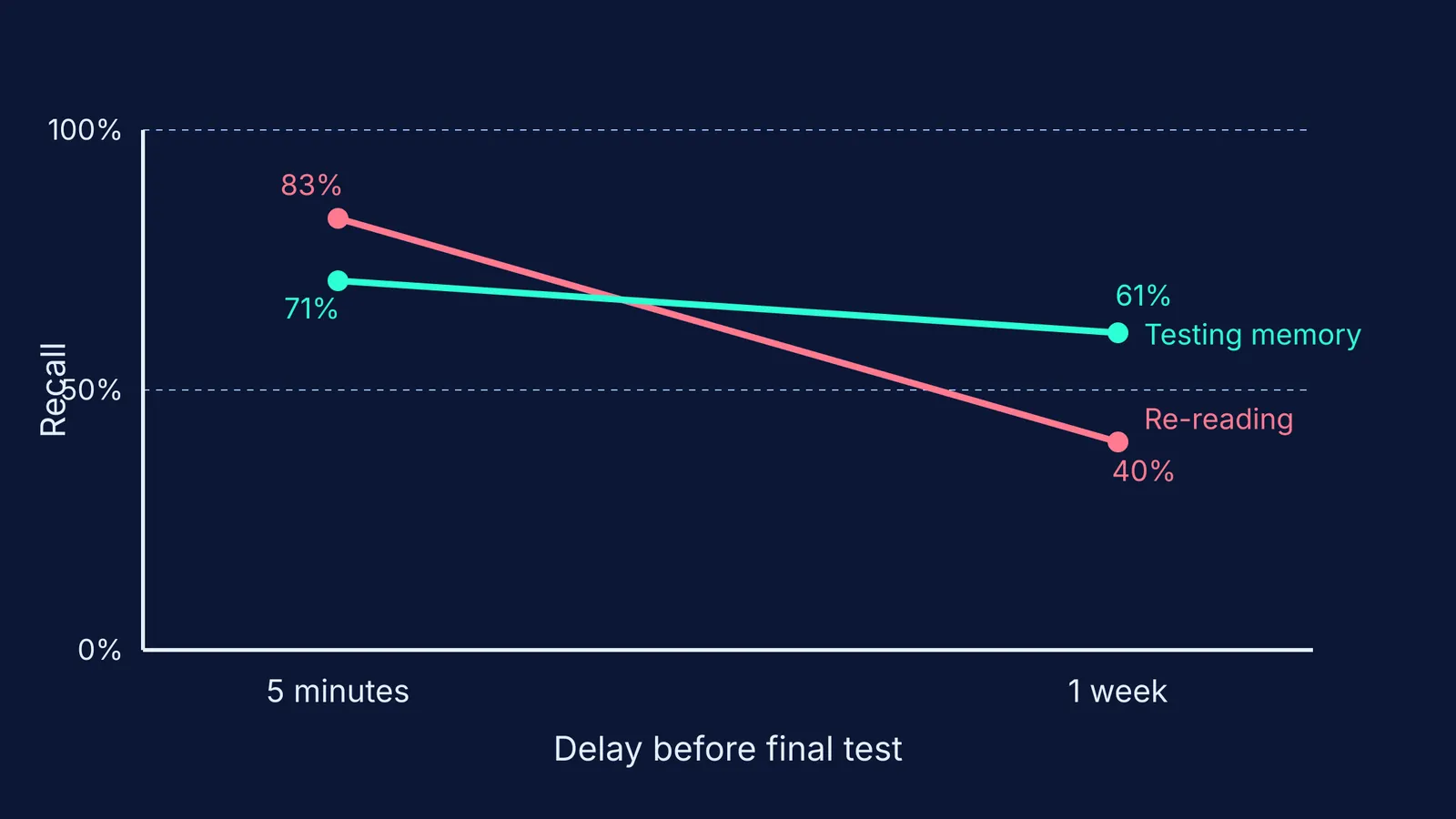
In reality, true learning does not happen when information enters your eyes; it happens when you force your brain to retrieve it. A landmark 2006 study in the journal *Psychological Science* tested this exact idea. Researchers Henry Roediger and Jeffrey Karpicke asked students to study scientific passages. One group re-read the material four times, while another group read it once and was tested on it three times.
After five minutes, the re-reading group did slightly better. But after one week, the results flipped dramatically. The students who repeatedly tested their memory retained 61% of the material, compared to just 40% for those who only re-read it. The act of retrieving the information stopped the forgetting process in its tracks. Staring at notes simply does not build the long-term memory traces you need to master physics derivations in CBSE boards.
How can an AI tutor help with physics derivations?
The best way to apply this active testing method is not to just stare at a blank piece of paper until you get frustrated. It is to work with an AI tutor that acts like a mentor, using the Socratic method to guide you through the physics without just handing you the answer.
Instead of typing "derive the formula for a parallel plate capacitor" and copying the output, you can ask an AI to test your understanding step by step. Fermi's AI tutor can work out what you already know and build a plan for the session. Rather than printing the final answer, it teaches you through it — writing on a board, drawing the figure, and asking you why you need to integrate over the volume before letting you move on.
This interaction forces you to vocalise the physical meaning behind the mathematics. If you are struggling with a core idea, such as why the electric field inside a conductor is zero, you can review it in the Fermi Concept Library to patch the gap before continuing the problem. By the end of the session, you will know exactly *why* step three follows step two, making the entire derivation a logical sequence rather than a memorised list.
What is a reliable framework for exam prep?
To master the high-weightage topics in the CBSE Class 12 physics paper — particularly Optics, Electrostatics, and Magnetic Effects of Current — try this three-step loop for every major derivation:
Understand the physics first. Do not touch the algebra until you can explain the physical setup. If you are deriving the magnetic field of a current loop using the Biot-Savart law, draw the diagram and state the direction of the magnetic field vectors. Every CBSE marking scheme allocates specific marks just for an accurate, labelled diagram.
Write it from memory. Put your textbook away. Take a fresh sheet of paper and attempt the entire derivation from memory. When you get stuck, do not look at the book. Instead, write down exactly *why* you are stuck (e.g., "I know I need to substitute for drift velocity, but I forget the formula").
Ask for targeted feedback. Upload your handwritten attempt to an AI tutor. Ask it to point out your logical error without revealing the next line. Getting useful AI feedback on your step-by-step physics solutions trains you to spot your own mistakes on exam day.
Practising this way is mentally taxing, and it will slow you down initially. But the effort you spend pulling the next step from memory is exactly what guarantees the derivation will still be there when you open your board exam paper.


