

On this page
A typical parallel plate capacitor simulation lets you change three things (plate area, plate gap, dielectric) and connect or remove the battery. Moving the controls at random shows you what happens but not why; predicting each reading first turns every click into a check. Here are the three rules, one question to ask before every change, and a fully worked example you can repeat on screen.
What does a parallel plate capacitor simulation let you change?
Capacitance is the charge stored per volt, C = Q/V, and for two parallel plates it is C = ε₀A/d, where A is the plate area and d is the gap (OpenStax University Physics, 8.1). The same textbook stresses that capacitance depends only on the geometry and on the material between the plates, not on the charge or voltage you apply.
The constant ε₀, the permittivity of free space, is 8.854 187 8188 × 10⁻¹² F/m in the 2022 CODATA values (NIST).
The dielectric slider sets κ, the dielectric constant. Typical values listed by OpenStax, 8.5: dry air 1.00059, Teflon 2.1, paper 3.7, mica 6.0 and water 80.
How do plate area, separation and dielectric change capacitance?
Read the formula as three rules:
Double the plate area and C doubles, because C is proportional to A.
Double the gap and C halves, because d is in the denominator.
Fill the gap with a dielectric and C becomes κ times larger, C = κC₀ (OpenStax, 8.4).
These rules hold whether or not the battery is connected. Charge, voltage and energy are a different story.
What changes when the battery stays connected or is removed?
The stored energy can be written three ways: U = ½CV² = Q²/2C = ½QV (OpenStax, 8.3). Which form to use depends on what stays fixed.
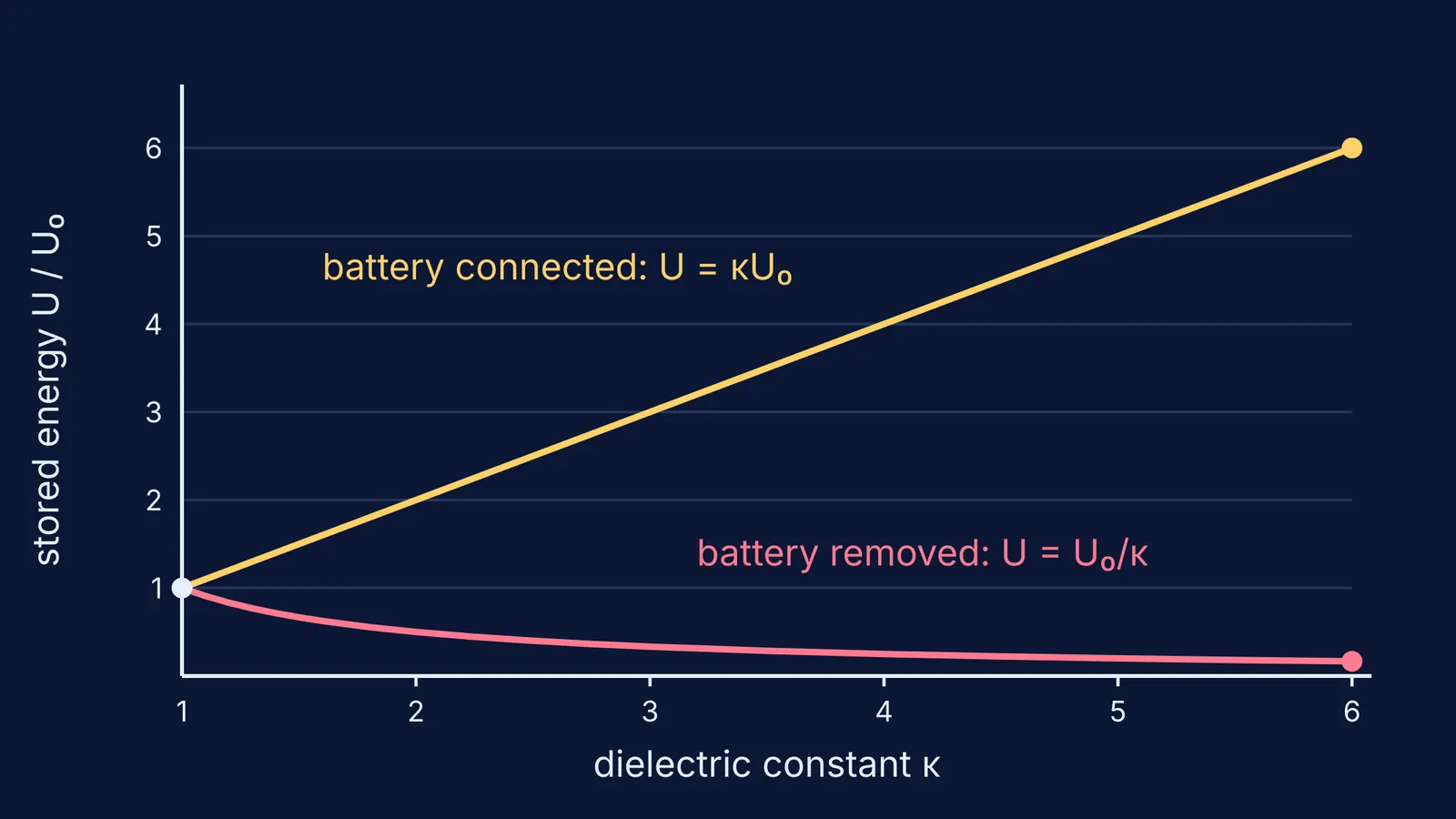
Battery connected: the battery holds V constant. Use Q = CV and U = ½CV², so charge and energy follow C. Inserting a dielectric gives Q = κQ₀ and U = κU₀ (OpenStax, 8.5).
Battery removed: the charge has nowhere to go, so Q is constant. Use V = Q/C and U = Q²/2C, so voltage and energy move opposite to C. Inserting a dielectric gives V = V₀/κ and U = U₀/κ (OpenStax, 8.4).
We go through the slab-insertion case step by step in inserting a dielectric slab with the battery connected or disconnected.
Worked example: predict, then check in the simulation
Set up plates of area 100 cm² (0.01 m²), a gap of 1.0 mm, air between them, and a 12 V battery. Using ε₀ ≈ 8.85 × 10⁻¹² F/m (NIST):
Starting point: C₀ = 8.85 × 10⁻¹² × 0.01 / 0.001 = 88.5 pF, Q₀ = C₀V = 1.06 nC, and U₀ = ½C₀V² = 6.4 nJ.
Slide in mica (κ = 6.0) with the battery connected: C = 531 pF, V stays 12 V, Q = 6.4 nC, U = 38 nJ.
Reset, remove the battery, then slide in mica: C = 531 pF, Q stays 1.06 nC, V falls to 2.0 V, U falls to 1.06 nJ.
Reset, keep the battery connected, double the gap to 2.0 mm: C = 44.3 pF, V stays 12 V, Q = 0.53 nC, U = 3.2 nJ.
Reset, remove the battery, double the gap: C = 44.3 pF, Q stays 1.06 nC, V rises to 24 V, U rises to 12.7 nJ.
Step 5 can look surprising: capacitance falls, yet energy doubles. The extra energy comes from the work you do pulling apart two plates that attract each other. In step 3 the opposite happens: the field pulls the slab in, so the stored energy drops.
A five-minute prediction routine
Write V-fixed or Q-fixed at the top of your page.
For the change you are about to make, write the factor for C first.
Pick the energy formula that uses the fixed quantity, then write the factors for Q, V and U.
Move the slider and compare. If a meter disagrees, check step 1 before you check your arithmetic.
Repeat with a different slider until you can predict all four meters without writing.
Predicting before you check is one reason a simulation can help more than a printed diagram for ideas like this one; simulations versus static diagrams looks at what studies found and when each works better.
For more ideas that are easier to see than to read, explore the Fermi Simulation Lab, our interactive simulations for learning. When you are ready for exam-style numericals with series, parallel and energy questions, work through capacitors and dielectrics problems, or check your method step by step in the Fermi Problem Library.


