

On this page
Asking an AI tool to draft a one-page formula sheet for a physics chapter feels like an effortless shortcut. In seconds, you get a clean list of equations from kinematics to electromagnetism. Yet in exams like JEE Main, JEE Advanced, and NEET-UG, students who rely on unverified summary sheets frequently drop marks on straightforward numericals. The error is rarely arithmetic. It is misapplying a formula to a physical system where its core assumptions do not hold.
Why do AI formula sheets miss crucial physics conditions?
Large language models generate text by predicting statistically probable sequences of symbols from their training data. They output equations that resemble textbook summaries, but they do not reason through physical constraints. In a 2023 study published in *Physical Review Physics Education Research*, physicist Gerd Kortemeyer found that while AI agents produce fluent physics explanations, they routinely stumble over spatial representations, limiting cases, and underlying physical constraints.
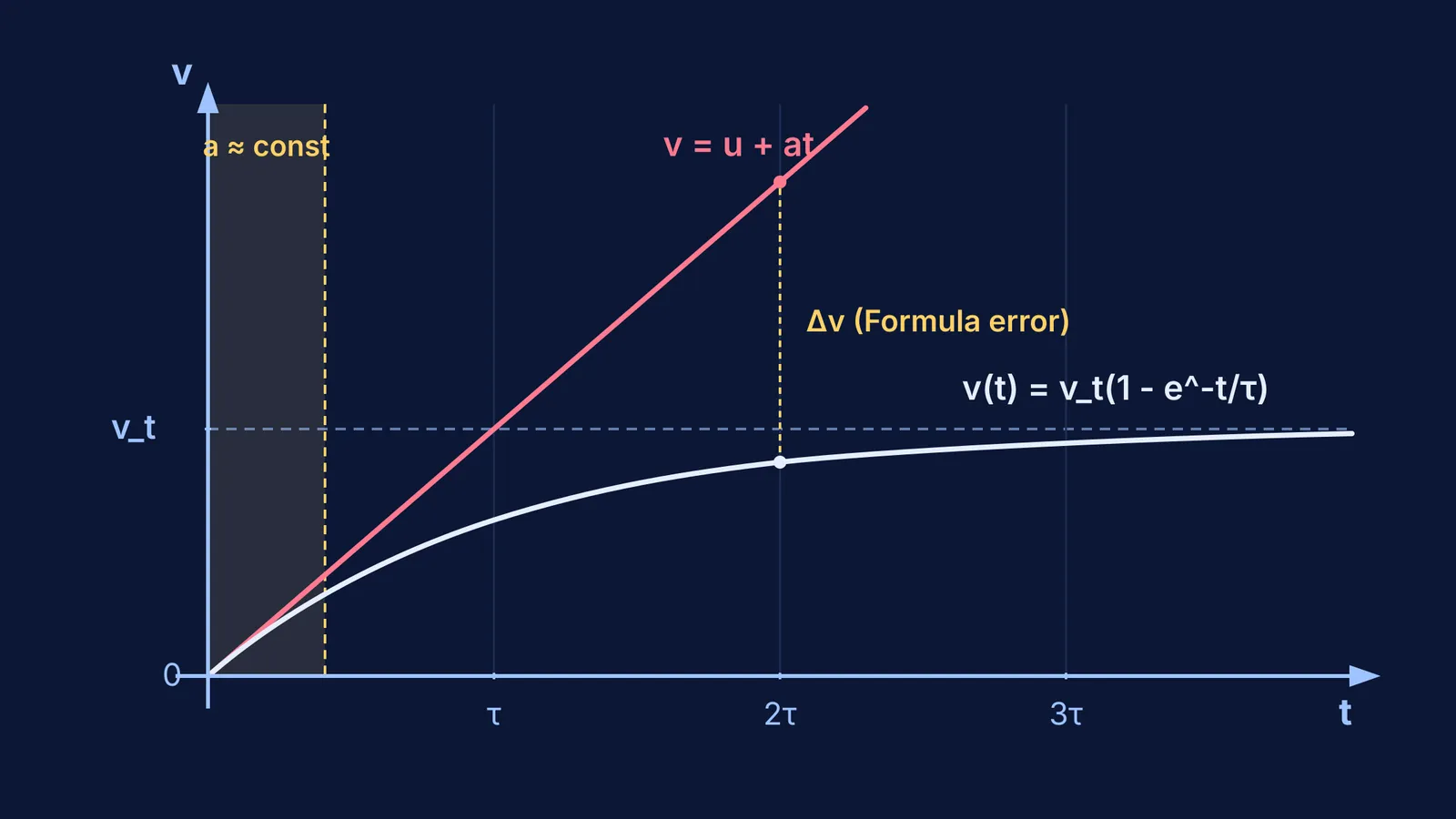
When a chatbot outputs kinematics equations like v = u + at or s = ut + ½at², it presents them as general laws of motion. It rarely warns you that these relations require acceleration to remain strictly constant. If a problem features time-dependent acceleration a(t) or fluid drag, the formula fails completely.
Beginner physics students already struggle with this trap. In a 1981 study in *Cognitive Science*, Michelene T. H. Chi, Paul J. Feltovich, and Robert Glaser found that physics novices categorize problems by surface features, such as pulleys or literal symbols, jumping into formula hunting without testing validity conditions. Experts instead categorize problems by underlying physical laws and check boundary constraints first. Unchecked AI formula sheets reinforce novice habits by presenting formulas as disconnected plug-and-play recipes. Learning how to spot when AI gets physics wrong starts with recognizing that equations are meaningless without their domain of validity.
How can you audit an AI formula sheet against your textbook?
Instead of treating an AI draft as a finished reference, treat it as a rough inventory that you must cross-examine against your primary textbook, such as NCERT Physics or H. C. Verma's *Concepts of Physics*.
The cognitive payoff comes from the verification process itself. In a three-year study in the *European Journal of Physics*, researchers Wheijen Chang and Ruey-Shiann Shieh found a statistically significant correlation (p < 0.001) between the quality of student-constructed formula sheets and physics exam scores. Organizing and evaluating equations forced students into meaningful conceptual processing rather than rote memorization.
Similarly, a review of learning strategies led by John Dunlosky in *Psychological Science in the Public Interest* found that passive summarization has low educational utility. By contrast, active self-explanation—deliberately checking why an equation applies and when it breaks down—builds durable problem-solving skill.
To convert an AI draft into an active revision tool, test every formula against a three-part audit on paper:
The raw equation: Write the mathematical expression drafted by the AI.
The textbook symbol check: Verify what each variable represents and identify its coordinate reference frame.
The invalidation boundary: State the exact physical conditions under which the formula fails, along with the calculus relation that replaces it.
This process turns making your own formula sheet from passive transcription into active diagnostic study.
Which textbook audits catch common physics formula traps?
Running this audit across three standard formulas reveals common traps in AI-generated notes:
Kinematics (v² = u² + 2as):
Symbol check: u is initial velocity, v is final velocity, a is acceleration, and s is displacement (not distance).
Invalidation boundary: Fails when acceleration varies. For non-uniform acceleration, integrate: ∫ v dv = ∫ a ds.
Gravitation (v = √(GM/r)):
Symbol check: G is Newton's constant, M is the central mass, and r is the distance from the centre of mass.
Invalidation boundary: AI sheets often omit that r = R + h, where R is the planet's radius and h is altitude. Substituting h directly into r causes an immediate error. It also assumes a circular orbit; non-circular trajectories require vis-viva energy equations.
Simple pendulum (T = 2π√(l/g)):
Symbol check: l is length to the centre of oscillation, and g is gravitational acceleration.
Invalidation boundary: Valid only for small angular displacements where sin θ ≈ θ, with a point mass, an inextensible string, and negligible air drag.
These missing conditions explain why AI chatbots get mathematical derivations wrong on multi-step problems.
How to prompt AI for better physics drafts?
You can improve the initial draft by demanding physical constraints in your prompt:
"Generate a revision table for [Chapter Name] in Class 11 Physics. For each formula, provide three columns: the equation, the exact definition and reference frame of every variable, and the physical assumptions under which this formula is invalid."
Once the AI generates this table, audit each line against your textbook. Cross out ambiguous variable names, confirm vector orientations, and highlight boundary conditions in red ink.
If you want to practice identifying boundary conditions across numericals, Fermi's AI tutor works out what you already know and checks understanding as it goes, deciding whether to explain, ask or show rather than printing raw answers. For multi-concept problems where several principles interact, the Fermi Problem Library provides worked problems with a step-by-step solver that explains the reasoning rather than printing an answer.
Drafting a formula sheet with AI takes only a moment, but auditing each formula against your textbook is what builds actual physics intuition.


