

On this page
In June and July 2024, World Bank researchers ran an after-school English programme in nine public schools in Benin City, Nigeria, where students worked with a free AI chatbot while teachers guided the sessions. The results are in the World Bank working paper From Chalkboards to Chatbots by Martín De Simone and colleagues (first published May 2025, updated December 2025). The authors describe it as one of the first programmes to test a large language model for learning in a developing country with a randomised design.
What did the World Bank pilot in Nigeria do?
According to the working paper, the programme targeted first-year senior secondary students, who are typically 15 years old. Students who signed up were picked by lottery, and those selected could attend up to twelve 90-minute sessions in school computer labs, at most two a week over six weeks.
The tool: Microsoft Copilot, powered by GPT-4, which was free and needed only a student account.
The format: students worked in pairs at one computer, on topics from the English curriculum they were already covering in class.
The sample: 657 students were assigned to the programme and 671 to a control group; 422 and 337 of them took the final test.
How big was the effect?
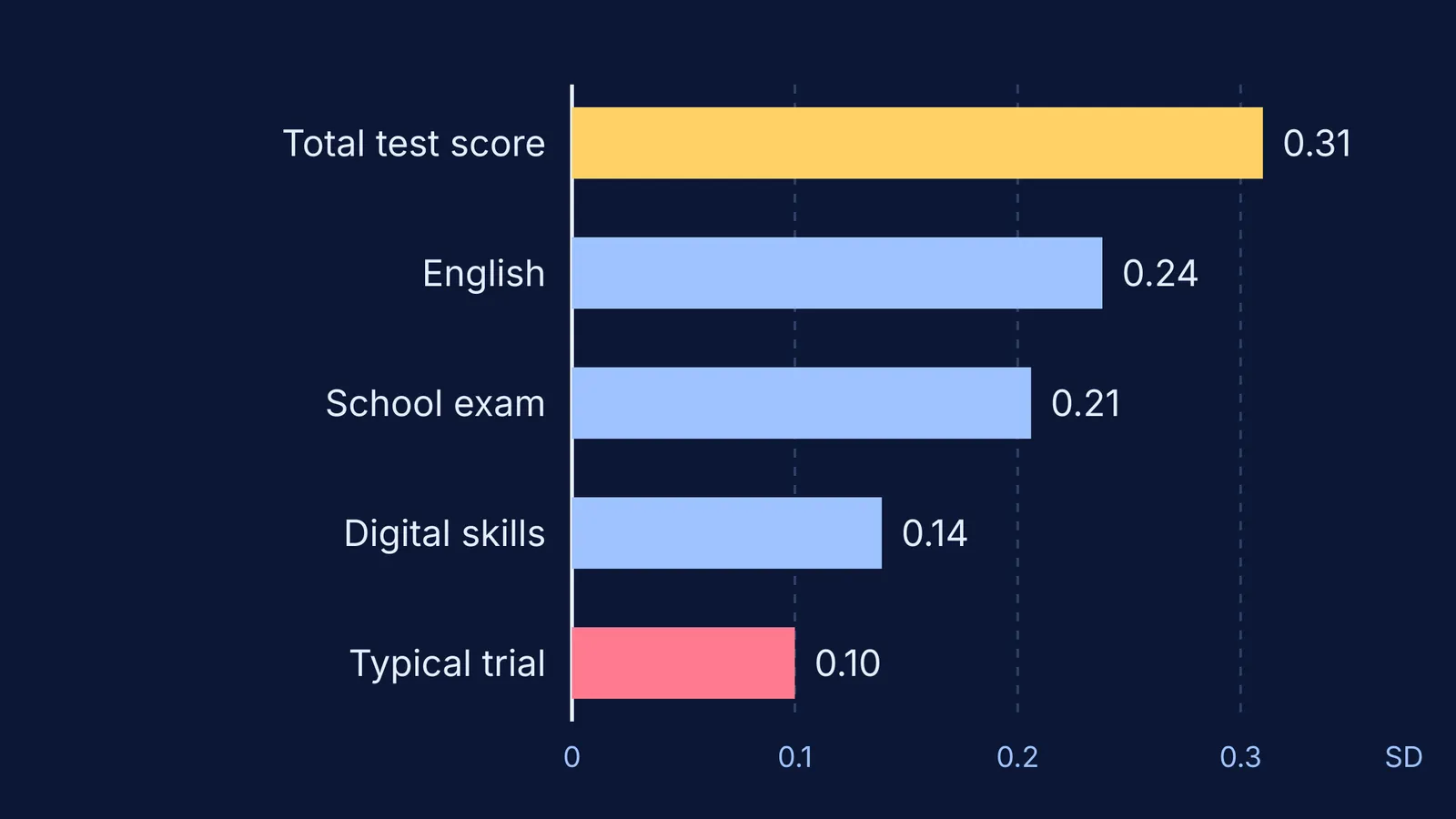
The paper reports that students offered the programme scored 0.31 standard deviations higher on the end-of-programme test. On the English section, the main outcome, the gain was 0.238 standard deviations. The effect on AI knowledge was 0.309 and on digital skills 0.139.
The programme students also did better, by 0.206 standard deviations, on their school's regular third-term English exam, which covered more than the six weeks of sessions.
For scale, the authors cite a review that found a median effect of 0.10 standard deviations across randomised trials in low- and middle-income countries, which places this pilot at or above the 80th percentile (World Bank working paper). Counting language results only, it sits near the 70th percentile. They estimate a cost of about $48 per pupil, and they translate the gains into 1.5 years (English) to 2 years (total score) of typical schooling in Nigeria.
What role did teachers play?
Teachers did not lecture, but the paper describes them as playing a critical role in guiding students. They had a three-day training. In the first session they showed students how Copilot works and warned about over-reliance and made-up or biased answers.
Each later session began with a prompt the teacher gave, written to make the chatbot act as a tutor rather than hand over answers. Students then worked with it freely while teachers kept them on task, and each session ended with a discussion of what they had learned. The authors credit the whole package (chatbot, prompts, teacher guidance and curriculum fit), not the chatbot alone. That fits what research on hints versus answers in tutoring suggests.
What questions are still open?
The authors list several limits themselves in the working paper:
Duration: it ran for six weeks, with no follow-up yet on whether the gains last.
Drop-out: many students missed the final test, and more were missing from the control group; the authors' adjusted estimates still came out positive.
Who gained most: students with higher earlier scores and better-off families gained more, and so did girls, though the authors say the gender result needs caution.
What caused it: extra time, the chatbot and the teachers came as one package, and there was no human-tutor group to compare with.
One school matters: leaving out the largest school cut the estimate to 0.156.
The paper's full-year figures are projections, not results. Read the Rori maths tutor study in Ghana and other AI tutor trials in real classrooms with the same care.
How can you copy what worked at home?
You can borrow the trial's structure. Here is a 60-minute plan, with a parent or older sibling in the teacher's role:
Pick one topic from this week's textbook chapter, for example reported speech in Class 11 English.
Start with a fixed opening prompt: "Be my English tutor for reported speech. Do not give me answers. Ask me one question at a time, wait for my reply, and tell me what I got wrong and why."
Spend 35 minutes answering its questions yourself, in writing.
Check two of its corrections against your textbook, because chatbots can be confidently wrong.
Finish by writing three lines: what you learned, one mistake you made, one question for your teacher.
Keep it regular. The World Bank paper estimates that each extra day of attendance added about 0.031 standard deviations.
If working out the plan is the hard part, Fermi's AI tutor works out what you already know, builds a plan for the session and checks understanding as it goes, so you start with a clear next step.


