

On this page
When you solve a physics problem and end up with a negative answer, it is tempting to just drop the minus sign and move on. After all, you cannot have a negative mass or a negative time. But in physics, a negative sign is rarely just a mathematical artefact. It carries a specific, physical meaning that tells you something real about the system you are studying.
A 2023 study published in the *International Journal of Research in Undergraduate Mathematics Education* found that students often struggled to interpret a negative definite integral when they viewed it simply as a spatial area, assuming it must always be positive (10.1007/s40753-022-00202-y). However, when those same students were asked to apply a physical context, they made much more progress.
Instead of ignoring the sign, a better study habit is to ask what it physically represents. Here are three common areas where the negative sign matters, and how an AI tutor can help you make sense of it.
What does a negative velocity or force mean?
In kinematics and dynamics, physical quantities like displacement, velocity, acceleration, and force are vectors. They have both a magnitude (how much) and a direction (which way). In one-dimensional motion, the negative sign is simply a way of communicating direction along an axis.
If you choose "right" to be the positive x-direction, a car moving to the right at 20 m/s has a velocity of +20 m/s. If the car reverses and moves to the left at the same speed, its velocity is −20 m/s. The negative sign does not mean the car is travelling slower than zero; it simply means the car is moving in the opposite direction to your chosen axis.
If you find this confusing, you can use Fermi's AI tutor to clarify. Instead of just asking for the final numerical answer, you can prompt the tutor with: "I chose upwards as positive, but my final acceleration is negative. Does this mean the object is slowing down, or just moving downwards?"
How does the negative sign work in optics?
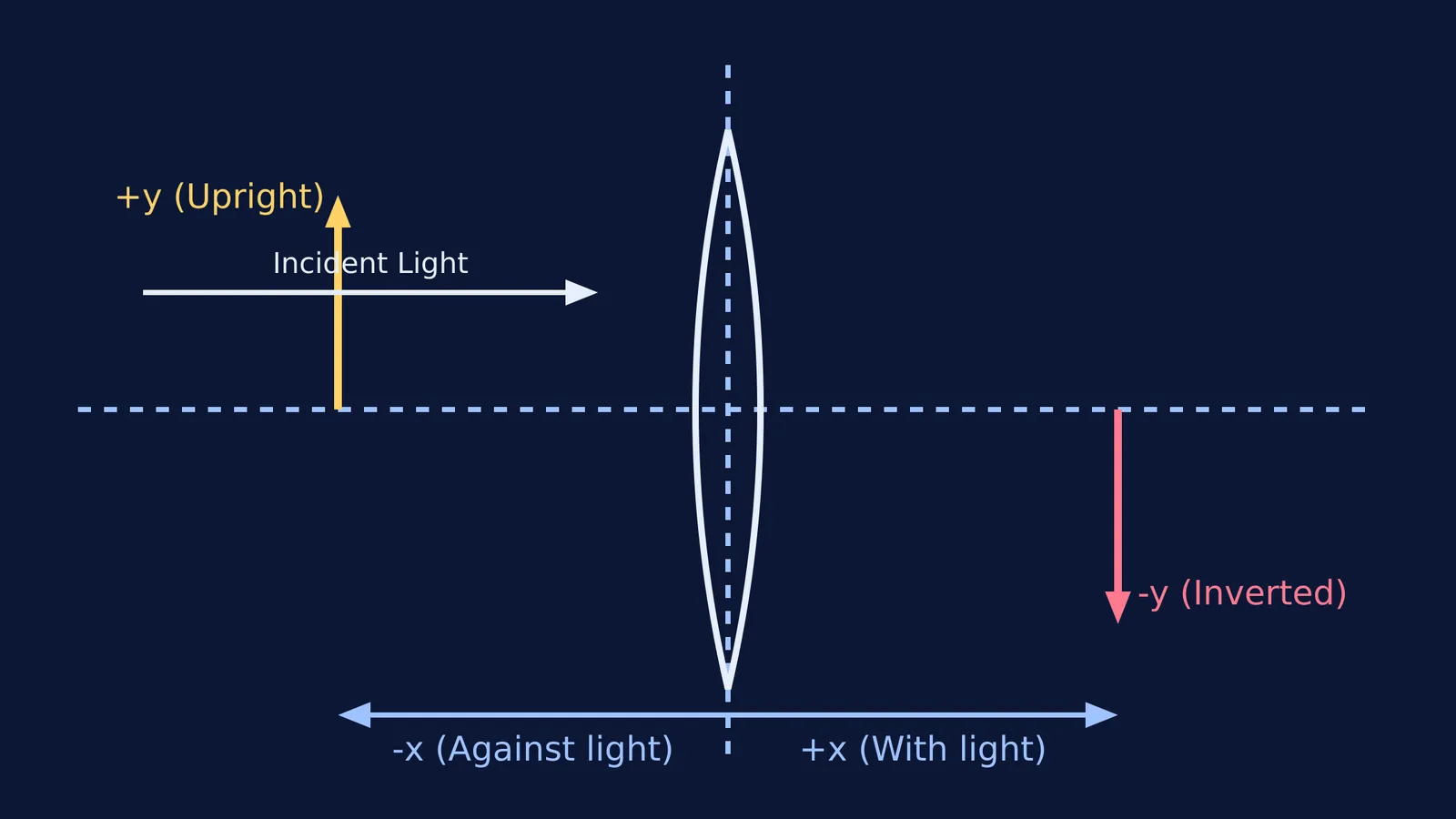
In ray optics, the Cartesian sign convention dictates whether distances and heights are positive or negative. The pole of the mirror or the optical centre of the lens is taken as the origin.
By convention, the direction of incident light is positive. This means:
Distances measured in the same direction as the incident light are positive (+x).
Distances measured against the direction of the incident light are negative (−x).
Heights measured upwards from the principal axis are positive (+y), while those measured downwards are negative (−y).
If you calculate the image distance (v) for a convex lens and get a negative answer, it tells you that the image is formed on the same side as the object. This means the image is virtual and erect. If you compute the magnification (m) and it is negative, it means the image is inverted (and therefore real). If you are practicing ray diagrams and the signs are not matching your sketches, try the Fermi Problem Library to work through the algebra step by step.
What does negative work mean in thermodynamics?
In thermodynamics, the negative sign is used to track the flow of energy into or out of a system. However, the convention you use depends on whether you are studying chemistry or physics.
In chemistry, the IUPAC convention focuses on the system's internal energy. Work done *on* the system by the surroundings increases the system's energy, so it is positive. Work done *by* the system on the surroundings costs the system energy, so it is negative. The formula for pressure-volume work is therefore written as W = −PΔV. If a gas expands, its change in volume (ΔV) is positive, making the work done negative, meaning the gas lost energy to push the piston.
In many physics textbooks, the focus is on what the system achieves. Work done *by* the system is considered positive (W = +PΔV).
This split causes endless confusion. If you are ever in doubt about which convention your current syllabus requires, you can read Hints or answers? What tutoring research says about the right help to understand how to guide your learning, or ask your AI tutor to explain the specific convention used in your textbook.
Why should you ask AI about the sign?
Dropping a minus sign might get you the right number for a multiple-choice question, but it leaves a gap in your conceptual understanding. The next time you find a stray negative in your working, treat it as a clue rather than a mistake.
You can upload your handwritten working to an AI tutor and ask: "I got −15 J for the work done, but the answer key says 15 J. Did I mess up my arithmetic, or is this just a sign convention?" (For a quick guide on testing these platforms, see How to evaluate an AI tutor: 8 tests you can run in 20 minutes).
By asking *why* the sign is there, you shift from just calculating numbers to actually understanding the physics.


