

On this page
When you read a dense science paragraph in your NCERT textbook, it is easy to nod along and feel like you understand it. The words are familiar, the diagrams look clear, and the sentences flow logically from one to the next. But this fluency can trick your brain into a false sense of security.
This phenomenon is known as the "illusion of competence": mistaking the ease of reading for the ability to actually recall and apply the information in an exam setting. A 2006 study by Henry Roediger and Jeffrey Karpicke found that on delayed tests, prior testing produced substantially greater retention than studying. In short, reading feels like learning, but it is not the same as being able to retrieve the facts when you need them.
To break this illusion, you have to stop reading passively. If you cannot answer a conceptual question about a paragraph, the problem usually starts at the most fundamental level: the individual sentence.
Why do students struggle with NCERT paragraphs?
NCERT textbooks are written to be concise. They often pack multiple constraints, conditions, and mechanisms into a single sentence. When you try to swallow the whole paragraph at once, you lose track of the details. If you cannot unpack the individual claims, you cannot synthesize the main idea or solve a numerical problem based on it.
For example, trying to understand stabilising, directional and disruptive selection by reading a whole page at once can be overwhelming. Interestingly, forcing yourself to slow down and process one sentence at a time can help. A 2017 study comparing natural reading to a "sentence-by-sentence" format found that the sentence-by-sentence approach resulted in comparable or even marginally higher immediate comprehension and recall.
This is where artificial intelligence can step in, not to summarize the text for you, but to break it down so you can test your understanding line by line.
How to ask AI to explain an NCERT paragraph line by line?
Instead of pasting a whole page into an AI and asking for a summary—which often just produces another dense wall of text—use a prompting strategy that forces you to engage actively with the textbook.
Copy the dense paragraph: Pick the specific paragraph that is confusing you.
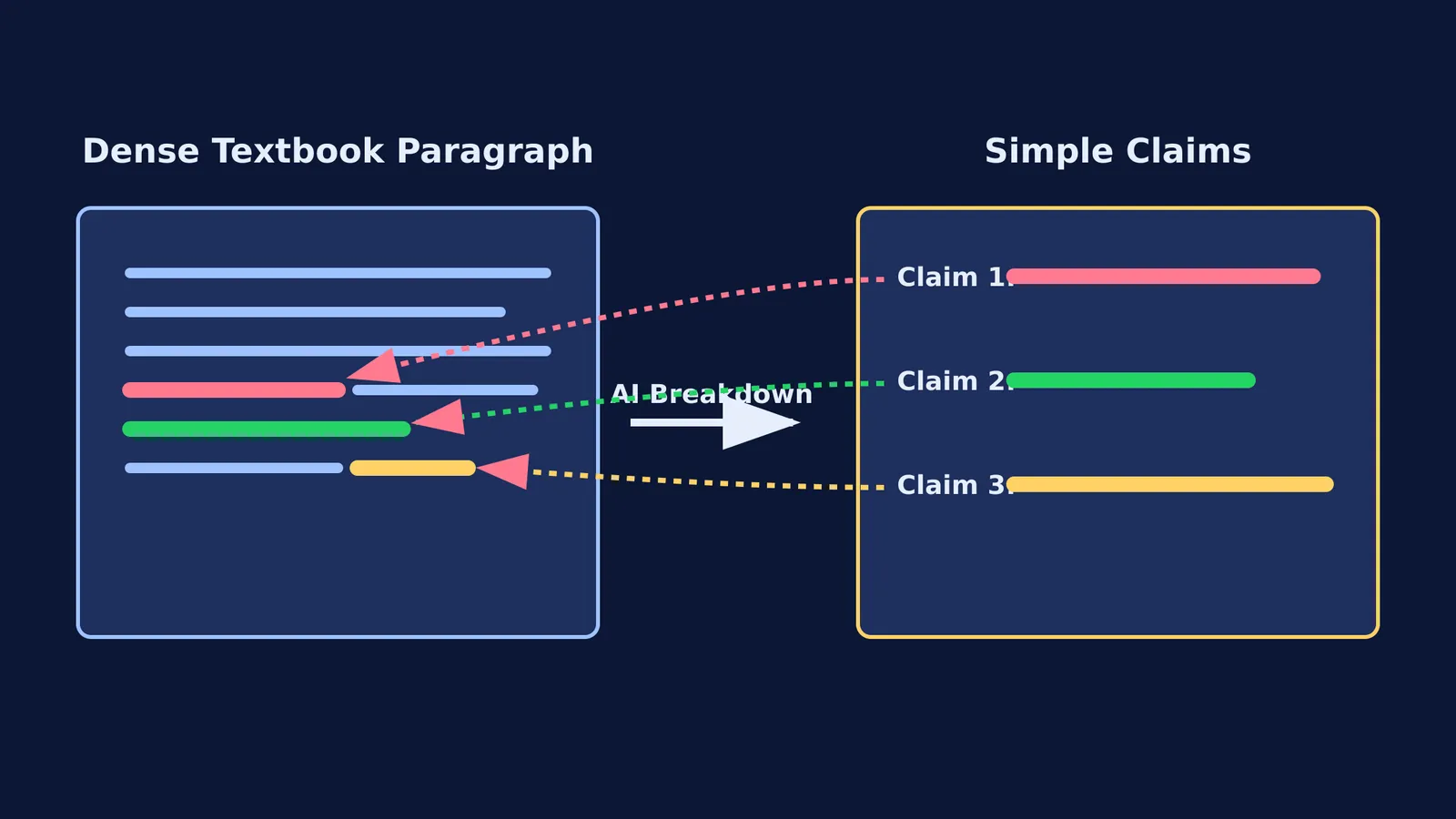
Use the breakdown prompt: Ask the AI: *"Break this paragraph down into 3 to 4 simple claims. Explain each claim in one sentence."*
The mapping step: This is the most crucial part of the process. Do not just read the AI's output and move on. Take the AI's first simplified claim and map it back to the textbook. Ask yourself: *Where exactly does the NCERT text say this? Which specific words mean this?*
This active mapping is a form of self-testing. If you cannot find the AI's simplified claim in the original text, you have found a gap in your understanding. You are forcing your brain to translate between the simple explanation and the formal scientific language.
How does this work in practice?
Imagine you are reading a classic dense NCERT biology sentence on why RuBisCO wastes energy in C3 plants: "In C3 plants some O2 does bind to RuBisCO, and hence CO2 fixation is decreased. Here the RuBP instead of being converted to 2 molecules of PGA binds with O2 to form one molecule of phosphoglycerate and phosphoglycolate in a pathway called photorespiration."
You ask the AI to break it down. It gives you these claims:
Claim 1: The enzyme RuBisCO accidentally grabs oxygen instead of carbon dioxide.
Claim 2: Because it grabbed oxygen, the plant fixes less carbon.
Claim 3: Instead of making two normal 3-carbon molecules (PGA), it makes one 3-carbon molecule and one 2-carbon waste molecule (phosphoglycolate).
Now, you look back at the text. You see that "binds with O2" means the enzyme grabbed oxygen. You see that "instead of being converted to 2 molecules of PGA" matches Claim 3. You have successfully decoded the syntax and connected the simple concept to the formal vocabulary.
If you are still stuck on *why* a specific reaction happens, that is the perfect time to open the Fermi Concept Library to understand the underlying mechanism, or sit down with Fermi's AI tutor. The tutor can hold a line of reasoning across a session, noticing where you are stuck and deciding whether to explain, ask, or show, rather than just printing an answer for you to passively read.


