

On this page
When you finish reading a section in your science or maths textbook, you hit the in-text questions. These boxes are designed to test your understanding before you move on. But when you are stuck, it is easy to type the question into a chatbot, get a neat answer, and copy it down.
This feels productive, but it bypasses the learning process. If you want to clear your doubts while still building long-term memory, you need a method that forces you to do the cognitive work.
Can I use AI for NCERT intext questions doubts?
Yes, but you should use it as a tutor, not an answer key. If you are stuck on a physics or chemistry doubt, do not ask an AI to write the final answer for you.
If you bring your doubt to Fermi's AI tutor, it works out what you already know and builds a plan for the session. It teaches through the concept, checking your understanding as it goes, rather than just handing you the result.
It is helpful to know how to use a step-by-step solver without just copying it. Treating the AI as a sounding board ensures that an in-text question remains a check on your learning.
Why does copying answers feel good but hurt learning?
Copying a smooth, perfectly formatted AI answer gives you an illusion of competence. It feels like learning, but it is just transcription.
A 2019 study at Harvard University tested this "feeling of learning". Researchers found that students who were actively engaged in solving problems scored significantly higher on actual learning assessments than those in passive lectures. However, those same students consistently reported a lower feeling of learning, because the mental struggle of active learning felt difficult. The struggle of retrieving information and forming sentences is exactly what builds the memory. When an AI does that work for you, it feels easy, but the knowledge does not stick.
Similarly, a 2014 study published in Psychological Science compared students who took notes verbatim on laptops with those who wrote them out by hand. The researchers found that processing and reframing information in your own words leads to better performance on conceptual questions than verbatim transcription.
When you copy an AI answer word-for-word, you are transcribing verbatim. Your brain acts as a simple pass-through filter. When you rewrite the answer in your own words, you are reframing the information. You have to select the most important points, organise them logically, and connect them to what you already know.
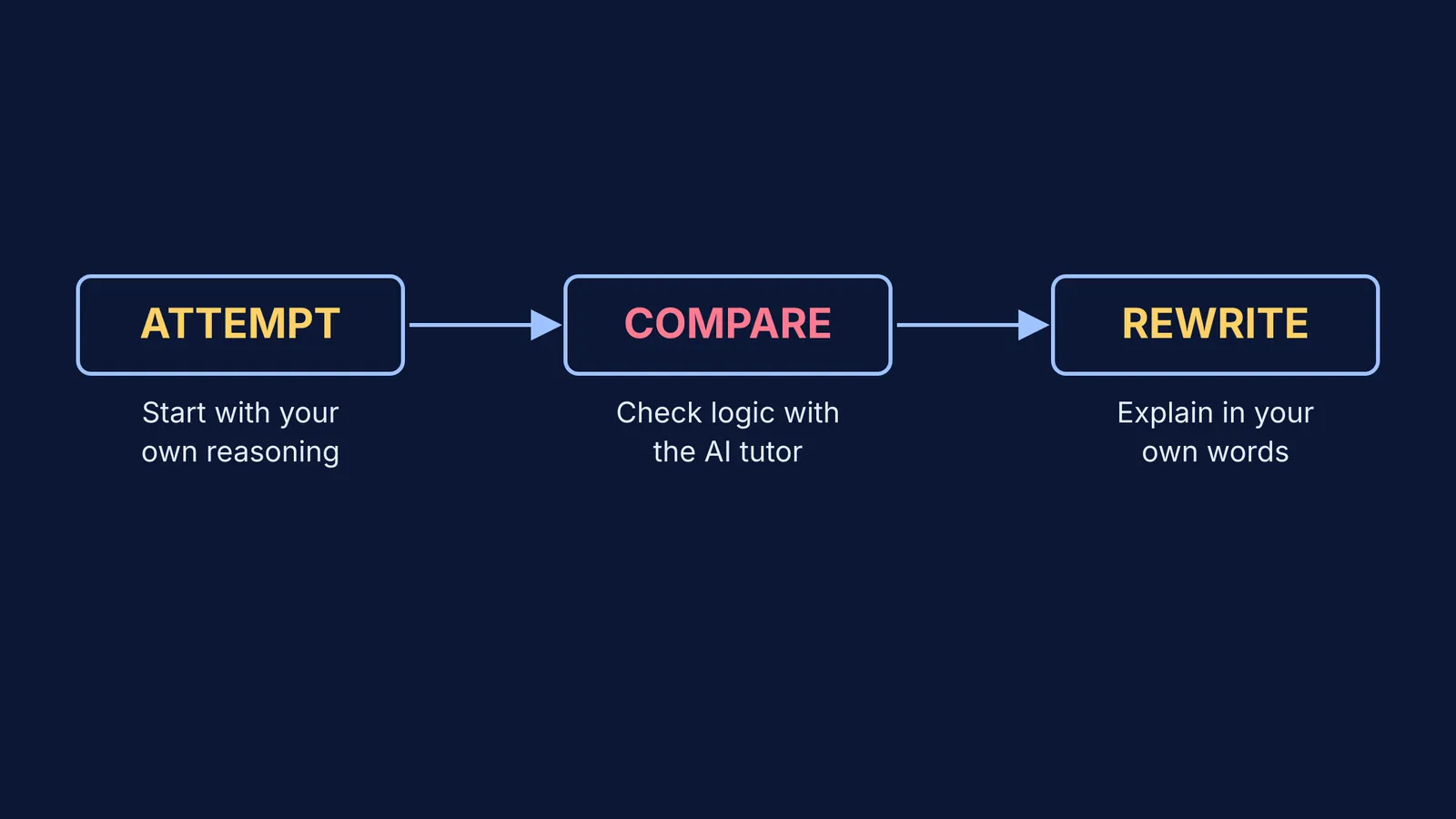
How does the attempt, compare, and rewrite method work?
To get the benefit of the AI tutor without losing the learning, use a three-step framework. Let's look at a worked example. Suppose you encounter this Class 10 science question: "Why should a magnesium ribbon be cleaned before burning in air?"
Attempt the question first. Do not open the AI tool yet. Read the NCERT question and write down what you know. You might remember that magnesium is a reactive metal and that it reacts with oxygen. Write that down. Even a partial attempt primes your brain to look for the missing piece.
Compare and check your logic. Now, ask the AI for a hint or to check your partial work. You might prompt the AI with: "I know magnesium reacts with oxygen. Is that why we clean it?"
The AI will explain that magnesium slowly reacts with oxygen at room temperature to form a protective layer of magnesium oxide, which must be removed by sanding so the metal can burn easily. Read the explanation carefully to spot where your own reasoning went wrong.
Rewrite in your own words. This is the most important step. Put the device away and write the final answer in your notebook. You must use your own words and sentence structure. Instead of transcribing the AI's exact sentence, you might write: "Magnesium forms a layer of magnesium oxide when left in air. We sand it off so the pure metal is exposed and can catch fire."
If you find yourself struggling to explain it, you have found a gap in your understanding. Go back and review the concept again. This is also a good time to review five quick ways to check you understood an AI explanation.


