

On this page
When you spot a full moon rising exactly at sunset, you might expect it to appear at the same time the next evening. Instead, the moon will rise nearly an hour later. This daily delay is not a quirk of your local time zone; it is the visible result of Earth's rotation racing against the moon's orbit.
To understand why the moonrise time shifts, we have to look at how Earth and its satellite move together. While we spin on our axis, the moon is steadily making its own way around us.
Why does the moon rise later each day?
Earth completes one full rotation each day. If the moon stayed perfectly still in space, it would rise at the same time every single day. But the moon is not standing still. It is travelling eastward in its orbit around Earth.
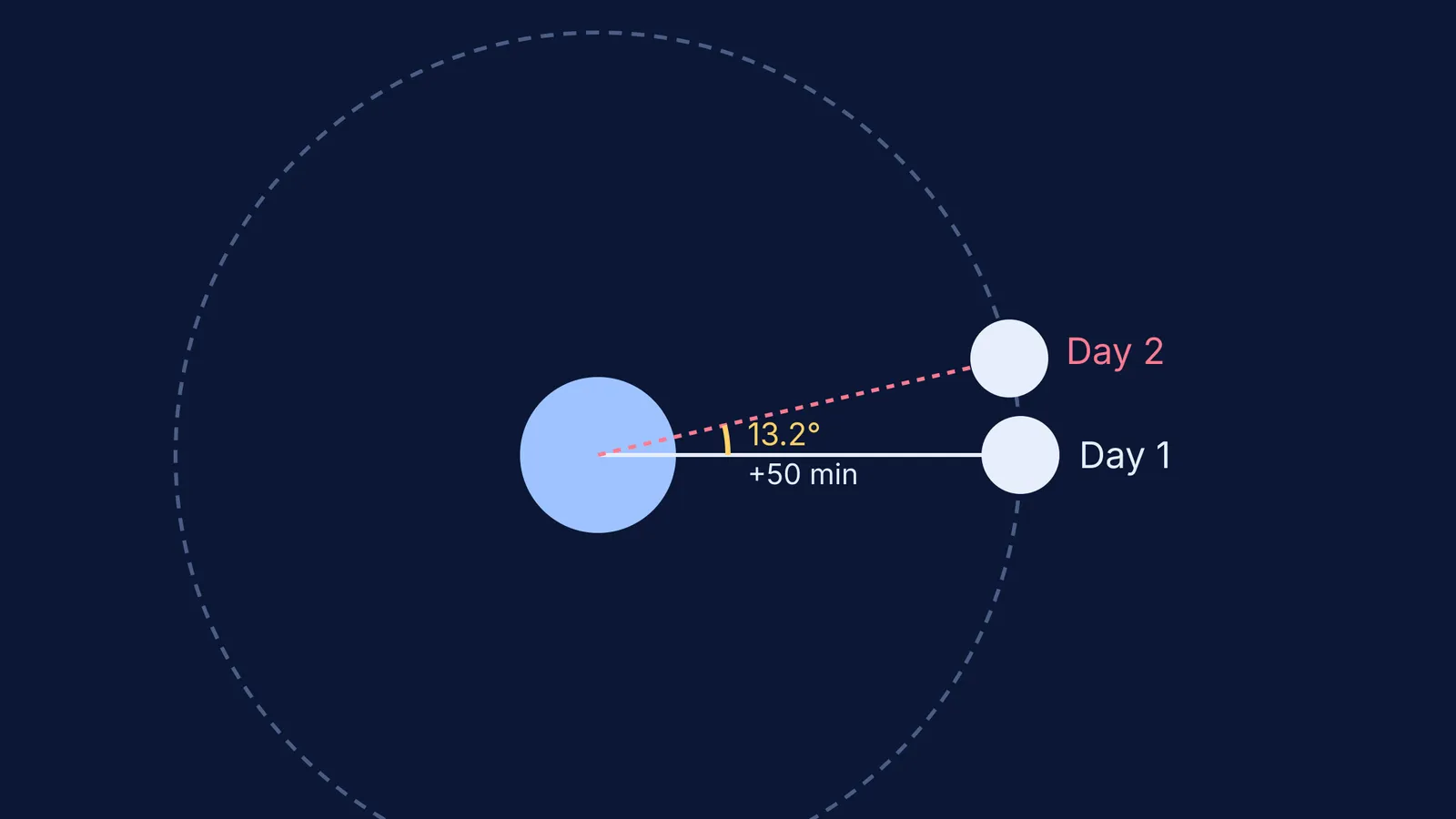
The moon completes a full 360-degree orbit around Earth in about 27.3 days, according to NASA. This means it moves about 13 degrees along its orbital path every 24 hours.
Because the moon has moved 13 degrees ahead, Earth's 24-hour spin is no longer enough to bring it back into view. Earth has to rotate a bit further to "catch up" to the moon's new position.
Since Earth rotates at 15 degrees per hour (or 1 degree every 4 minutes), it takes roughly 50 minutes to cover that extra distance. This extra turn is why you see the moonrise delayed by about 50 minutes each day.
How do you calculate the daily shift?
You can calculate this delay yourself using basic geometry and the rates of motion for both bodies.
Find the Moon's daily motion: Divide a full circle (360 degrees) by the Moon's orbital period (27.3 days, according to NASA). The result is 13.2 degrees per day.
Find Earth's rotation rate: Divide a full circle (360 degrees) by a 24-hour day. The result is 15 degrees per hour, or 1 degree every 4 minutes.
Calculate the catch-up time: Multiply the Moon's 13.2-degree shift by Earth's 4-minute-per-degree rotation rate. The result is 52.8 minutes.
This 52.8-minute average is usually rounded to 50 minutes for general stargazing.
Why is the delay not always the same?
While this average delay is a convenient rule of thumb, the actual time gap varies throughout the month. This variation is driven by two main factors: the shape of the moon's orbit and the angle of its path across the sky.
First, the moon's orbit is elliptical, not perfectly circular, according to NASA. When the moon is closest to Earth, it moves faster along its orbital path. When it is furthest away, it moves more slowly. This changing speed means the daily distance it travels is not always the same, causing the catch-up time to fluctuate.
Second, the angle at which the moon's orbital path intersects your local horizon changes depending on your latitude and the time of year. During certain seasons, the moon's path is very shallow relative to the horizon, so it rises only a short time later for several consecutive nights. At other times of the year, the steep angle of the orbit can push the delay to well over an hour.
How can you simulate the extra turn?
If you want to understand the exact mechanics, you can set up a model in the Fermi Simulation Lab. Running the orbit visually makes it much easier to see the extra turn Earth needs. Rather than just memorising the math, you can watch the angles change as the two bodies move.
This same orbital movement is also what causes the moon's phases. As the moon travels along its 27.3-day path, according to NASA, our view of its sunlit half changes. The daily 13-degree march across the sky is the clockwork behind both the shifting moonrise and the changing lunar phases.
Understanding orbital mechanics—from the moon to artificial satellites—requires a solid grasp of relative motion and gravitation. You can read more about how scientists calculate these paths in our guide on Gravitation and satellites: orbital speed, energy and escape speed or learn how pioneers like Katherine Johnson mapped the orbital maths behind early spaceflight. If you are stuck on a physics problem about orbits, Fermi's AI tutor can work out what you already know and build a plan for the session to help you solve it step by step.


