

On this page
Dilution is a chemistry idea you can fully test at your desk. Set a solute amount and a volume, add water, and say the new concentration out loud before the simulation shows it. If you are right three times in a row, you have the idea; if you are wrong, you have found exactly what to fix.
Here is a short session: five predictions with M1V1 = M2V2, then one experiment to find the saturation point.
What is molarity, and why does adding water lower it?
Molarity is moles of solute divided by litres of solution, M = mol/L, which is the basic equation in PhET's model notes for its Molarity simulation.
When you add water, the moles of solute stay the same and only the volume grows. Chemistry LibreTexts/13:_Solutions/13.07:_Solution_Dilution) puts it simply: in a dilution, "the number of moles of solute did not change". Since moles = M × V, the product before equals the product after, which gives M1V1 = M2V2. The same page notes that you do not need to convert to litres, as long as both volumes use the same unit.
How do you use a molarity simulation to predict dilution?
Open the free PhET Molarity simulation. It has a slider for solute amount in moles, a slider for solution volume in litres, a solute menu, a concentration meter, and a checkbox to show or hide the values for moles, litres and molarity, according to PhET's teacher tips. Hide the values while you predict.
A worked run (write each prediction down before you move anything):
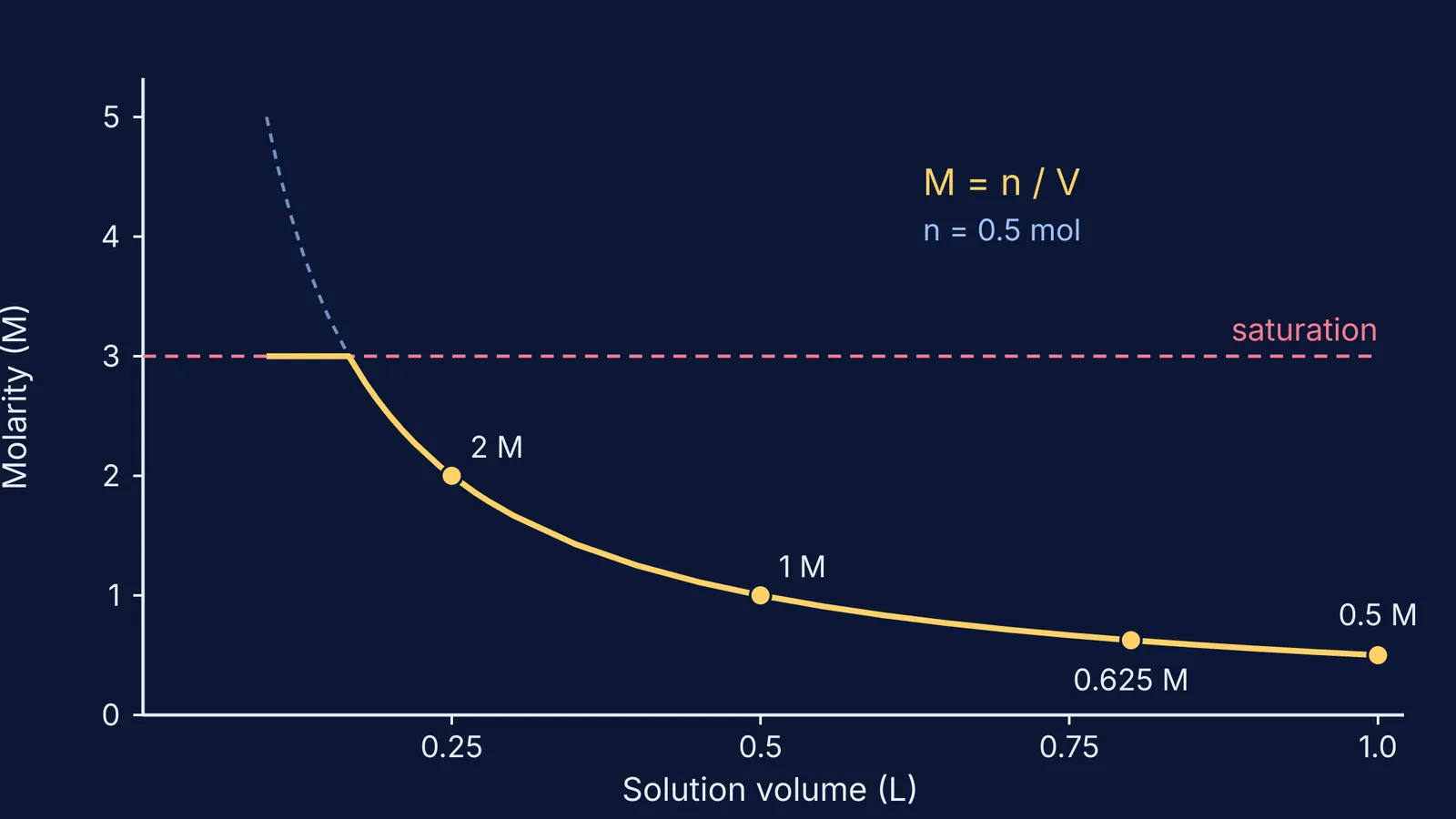
Set 0.50 mol of solute in 0.50 L. Predict: M = 0.50 / 0.50 = 1.00 M. Show the values and check.
Add water to 0.80 L. Predict with M1V1 = M2V2: M2 = (1.00 × 0.50) / 0.80 = 0.625 M.
Add water to 1.00 L. Predict: M2 = (0.625 × 0.80) / 1.00 = 0.50 M. Notice that doubling the volume from step 1 halved the concentration.
Now reverse it. Shrink the volume to 0.25 L. Predict: M2 = (0.50 × 1.00) / 0.25 = 2.00 M.
Twist: add 0.25 mol more solute at 0.25 L. M1V1 = M2V2 no longer applies, because it only covers changing the water. Start again from M = n/V: 0.75 / 0.25 = 3.00 M, unless the solution saturates first.
If solid appears in the beaker during these steps, that solute has saturated: switch to another solute, because a saturated solution no longer follows M1V1 = M2V2. If a prediction is off, check that you used the whole solution's volume. PhET's model takes solution volume as solute plus water, so read the volume slider, not "water added".
For more practice on paper, our guide to mixing and diluting solutions to find the final molarity covers the mixing case, where two solutions add their moles.
How do you find the saturation point in the simulation?
Saturation is where adding solute stops raising the concentration. PhET's model notes define the simulation's concentration as the smaller of the saturated concentration and moles divided by volume, so past that limit the meter stays flat and a precipitate forms. The teacher tips add that precipitate does not appear until the solute exceeds the saturation concentration, and that by design not every solute reaches saturation in the range the sliders allow.
Use this experiment for any solute in the menu:
Fix the volume, say 0.50 L.
Raise the solute in small steps, writing your n/V prediction and then the value shown.
While they match, the solution is unsaturated.
The first step where the display falls short of n/V, and solid appears, brackets the saturation concentration.
Now add water and predict whether the solid dissolves. It should, once n/V drops below the limit.
Plot concentration against moles: a straight line of slope 1/V that suddenly turns flat. The flat height is that solute's solubility in mol/L, at 25 °C for most solutes in the simulation, according to PhET.
How does this compare with real salt in water?
Real solutes have real limits. The CRC Handbook value listed on PubChem for sodium chloride is 36.0 g per 100 g of water at 25 °C. With PubChem's molar mass of 58.44 g/mol, that is about 360 / 58.44 = 6.16 mol per kilogram of water.
That figure is per kilogram of water, so it is a molality, not a molarity; converting needs the saturated solution's density. Our post on converting between molarity, molality and mole fraction works through it.
What should you do after the simulation?
PhET's teacher tips recommend building the qualitative relationships between molarity, moles and litres before quantitative problems. Our summary of what PhET research says interactive simulations are good for explains why interacting, and predicting first, beats just watching.
For more ideas that are easier to see than to read, try the Fermi Simulation Lab. When you move to written numericals, the Fermi Problem Library has worked problems with a step-by-step solver that explains the reasoning rather than printing an answer.
Tonight, try one run: three dilution predictions, then one saturation hunt, all written down before you check.


