

On this page
Have you ever stared at a dense biology or physics chapter and tried to memorise every sentence? It is a common strategy when exams loom, but it wastes time and effort. Not all knowledge needs the same treatment. In fact, education researchers separate learning into two distinct piles: isolated facts to remember, and underlying concepts to understand.
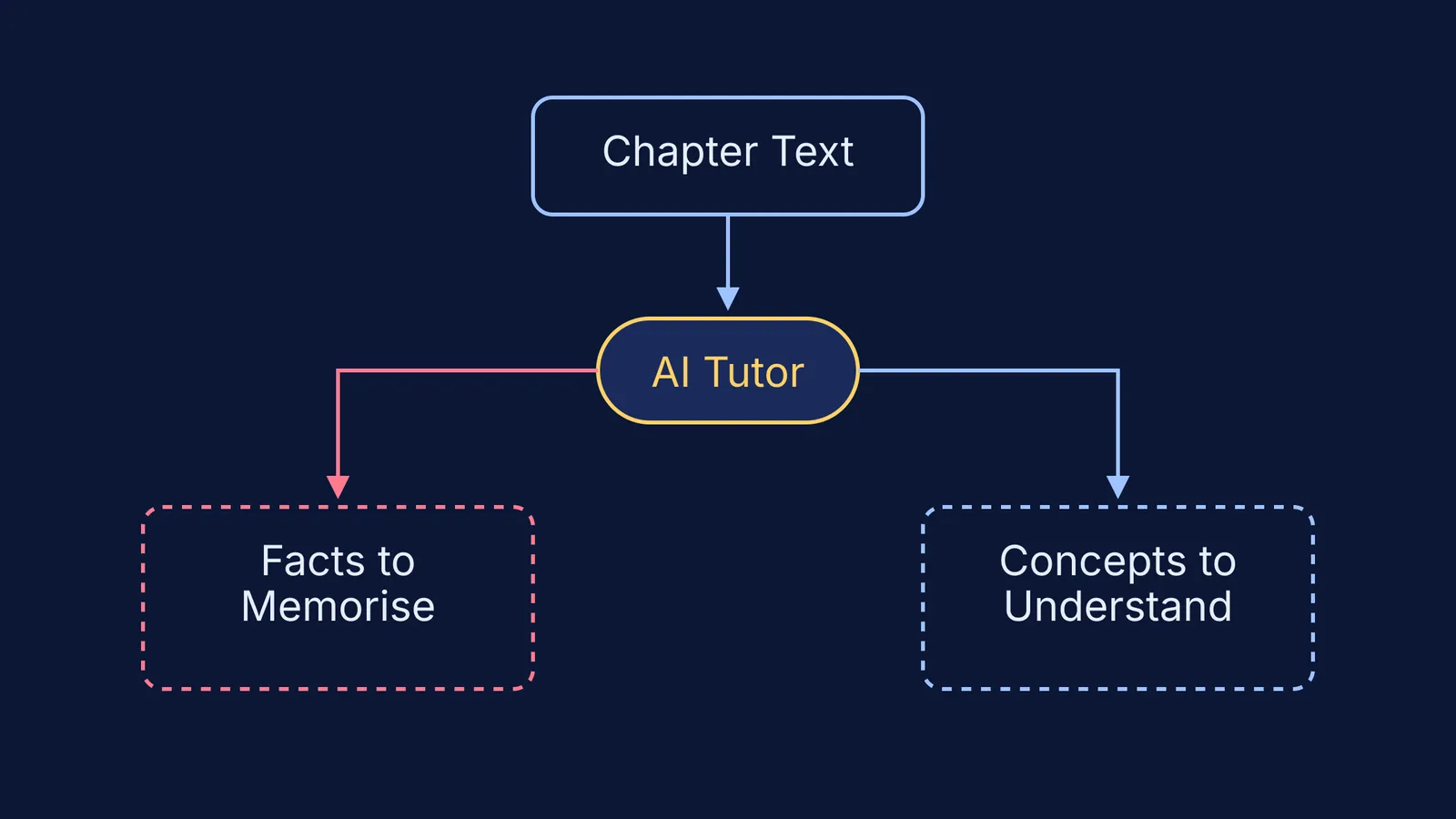
Today, you do not have to figure out that split alone. You can use an AI tutor to divide any topic into factual building blocks and conceptual frameworks, and then test yourself properly using past papers.
Factual versus conceptual knowledge: what does the research say?
In their 2001 revision of Bloom's Taxonomy, researchers Lorin Anderson and David Krathwohl formalised this split. They defined factual knowledge as the basic, isolated elements a student must know, such as technical terms, dates, and symbols. Conceptual knowledge, however, is about the interrelationships among those elements—the "why" and "how" things work together to form a larger structure.
Why does this matter for your exam preparation? A 2022 study of medical students evaluated how long these different types of knowledge stick in the brain. The researchers found that while students initially scored highly (82.0%) on questions requiring factual recall, that memory declined significantly over two years. By contrast, their performance on conceptual and inferential questions remained durable over the same period. Rote memorisation fades quickly; deep understanding lasts.
Furthermore, a 2019 study published in the *Journal of Educational Psychology* demonstrated that quizzing yourself on conceptual questions is much more effective at improving higher-order learning than simply drilling facts. Fact-based quizzes only improved short-term fact recall, whereas conceptual practice built flexible, adaptable knowledge.
How can you ask AI which topics to memorise and which to understand?
You can use an AI tutor to quickly sort your syllabus into these two categories. When you start a new chapter, paste the core text or syllabus objectives into the AI and ask it to separate the factual from the conceptual.
Once you have your two lists, you can approach them differently. Use flashcards and spaced repetition for the hard facts. For the concepts, ask your AI tutor to explain the "why" or draw connections. This is where Fermi comes in. Most learning tools just hand you an answer. Fermi's AI tutor teaches—it holds a line of reasoning across your session, notices where you are stuck, and checks your understanding as it works through a concept with you. If an idea is hard to picture, you can switch to the Fermi Simulation Lab to see how the variables interact.
How should you check your grasp with past papers?
After splitting the chapter and studying the concepts, the final step is to verify your learning against actual exam questions. Past papers from boards like CBSE or competitive exams like JEE and NEET are your best benchmark. Particularly in the week before an exam, working backwards from the test validates your preparation.
Identify the question type: Look at a past paper and ask yourself: is this asking for a fact or testing a concept?
Work through the reasoning: For conceptual questions, do not just check the answer key. Write out your step-by-step logic.
Get feedback on your process: If you get stuck on an application-based question, you can submit your working to the Fermi Problem Library. It offers worked problems with a step-by-step solver that explains the reasoning rather than just printing an answer. (Alternatively, you can get AI feedback on your physics solutions directly.)
When you know exactly what requires rote learning and what demands deep reasoning, your study time becomes much more efficient. Use AI to draw the line between facts and concepts, commit the basics to memory, and spend the bulk of your time mastering how those ideas fit together.


