

On this page
When you enter Class 11 mathematics in India, the syllabus shifts from concrete calculation to dense symbolic abstraction. Textbooks that once covered quadratic formulas and basic arithmetic progressions introduce expressions filled with capital sigmas (Σ), products (∏), inverse functions (f⁻¹), and Leibniz derivatives (dy/dx). For many students preparing for CBSE or JEE, the struggle is not the underlying mathematics—it is reading the symbols without feeling lost.
Why does Class 11 maths notation suddenly feel like a foreign language?
In cognitive science, this barrier has a clear name. In research on Cognitive Load Theory, John Sweller showed that human working memory can only handle a few novel items at once. When unfamiliar notation forces you to parse syntax while also trying to grasp a concept, cognitive overload follows.
Researchers Caroline Bardini and Robyn Pierce analysed this transition in their study on assumed mathematics knowledge. They identified "symbol load"—the barrier caused by symbol density, unfamiliar Greek letters, and shifting meanings. For instance, the superscript −1 means reciprocal in basic algebra (x⁻¹ = 1/x), but an inverse function when attached to f (f⁻¹).
In the Journal for Research in Mathematics Education, Eddie M. Gray and David O. Tall showed that mathematical symbols are "procepts"—both a computational process and a static object. Skilled mathematicians move fluidly between both, but beginners often see only an impenetrable static sign.
How can an AI tutor decode Σ, ∏, f⁻¹ and dy/dx into plain English?
Instead of using AI as an answer engine, you can use it as a notation interpreter. In his work on symbol sense, Abraham Arcavi emphasised that building mathematical intuition requires "reading through" symbols to find their informal meaning before calculating.
When an AI model explains Class 11 notation, ask it to reveal the action inside each symbol:
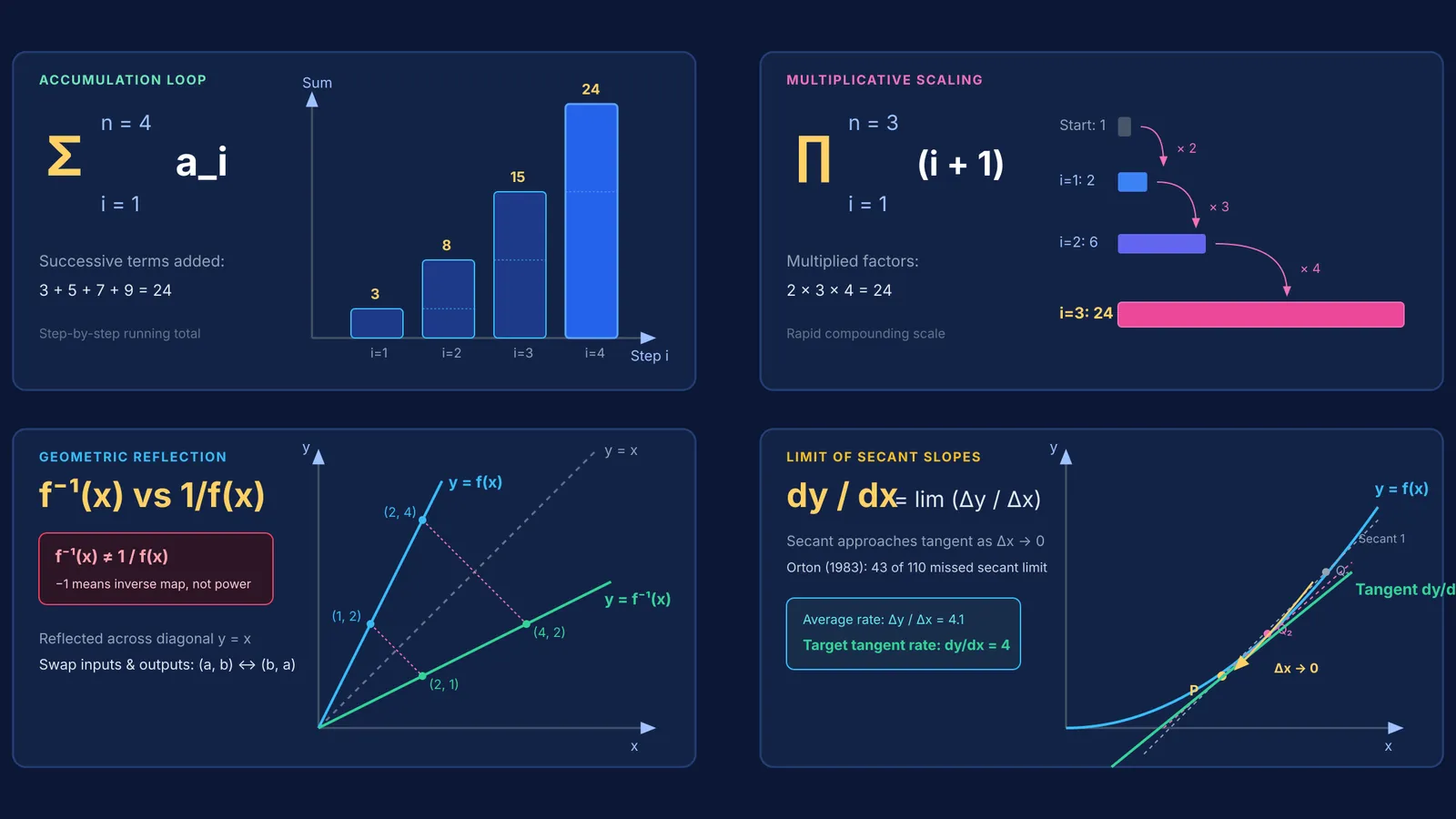
Capital Sigma (Σ): An instruction loop. The lower index (such as i = 1) gives the start, the top number (such as n) sets the stop, and the adjacent formula specifies what term to evaluate and add at each step.
Capital Pi (∏): The multiplicative partner of sigma. It uses the same index and bounds, but commands you to multiply each generated term rather than add them.
Inverse Function Notation (f⁻¹): The −1 is not an exponent. It denotes a reverse machine that takes an output and returns the initial input, equivalent to reflecting functions across the line y = x.
Leibniz Derivative (dy/dx): It looks like a fraction, but it represents an instantaneous rate of change. In Educational Studies in Mathematics, Anthony Orton found that 43 out of 110 students aged 16 to 22 could not deduce that a secant becomes a tangent as the distance between points approaches zero. Reviewing derivatives from first principles in Class 11 shows that dy/dx is the limit of Δy/Δx as Δx shrinks to zero.
Rather than outputting quick answers, Fermi's AI tutor teaches by noticing where a student is stuck, deciding whether to explain, ask or show, and writing on a board to check understanding as it goes.
How do you test each decoded symbol with a tiny example?
Never accept an explanation of notation until you verify it on numbers small enough to calculate in your head:
Test Σ with n = 3: For the sum of (2i + 1) from i = 1 to 3, calculate: (2(1) + 1) + (2(2) + 1) + (2(3) + 1) = 3 + 5 + 7 = 15.
Test ∏ with n = 3: For the product of (i + 1) from i = 1 to 3, calculate: (1 + 1) × (2 + 1) × (3 + 1) = 2 × 3 × 4 = 24.
Test f⁻¹ with a linear function: If f(x) = 2x + 4, then f(1) = 6. The inverse is f⁻¹(x) = (x − 4)/2, giving f⁻¹(6) = 1. Because 1 ≠ 1/6, checking f⁻¹(6) ≠ 1/f(6) instantly breaks the reciprocal confusion.
Test dy/dx on a curve: For y = x² at x = 2, the average rate over Δx = 0.1 is Δy/Δx = (2.1² − 2²)/0.1 = 4.1. The derivative dy/dx = 2x gives 4 at x = 2, confirming that the derivative is the target of shrinking intervals.
When navigating new chapters, the Fermi Concept Library offers dedicated lessons for every concept across mathematics and physics, placing each symbol in its proper curriculum context.
What prompt framework prevents you from passively copying the AI?
Asking an AI to "solve this problem" encourages passive reading. As shown in our guide on why AI chatbots get maths wrong and how to check them, models can also make algebraic slips when unguided.
To build genuine symbol sense, use this four-step prompt sequence whenever an expression looks intimidating:
Step 1 (Anatomy): "Break down this expression symbol by symbol. What is the operator, what is the index, and what are the boundaries?"
Step 2 (Translation): "Translate this expression into two plain English sentences describing what actions to take, without jargon."
Step 3 (Micro-example): "Create the simplest numerical example with two or three terms showing how this notation expands step by step."
Step 4 (Active check): "Give me one small practice question with different numbers so I can test whether I can expand it."
If you want structured practice on complete questions, the Fermi Problem Library offers worked problems with a step-by-step solver that explains the reasoning rather than printing an answer.


