

On this page
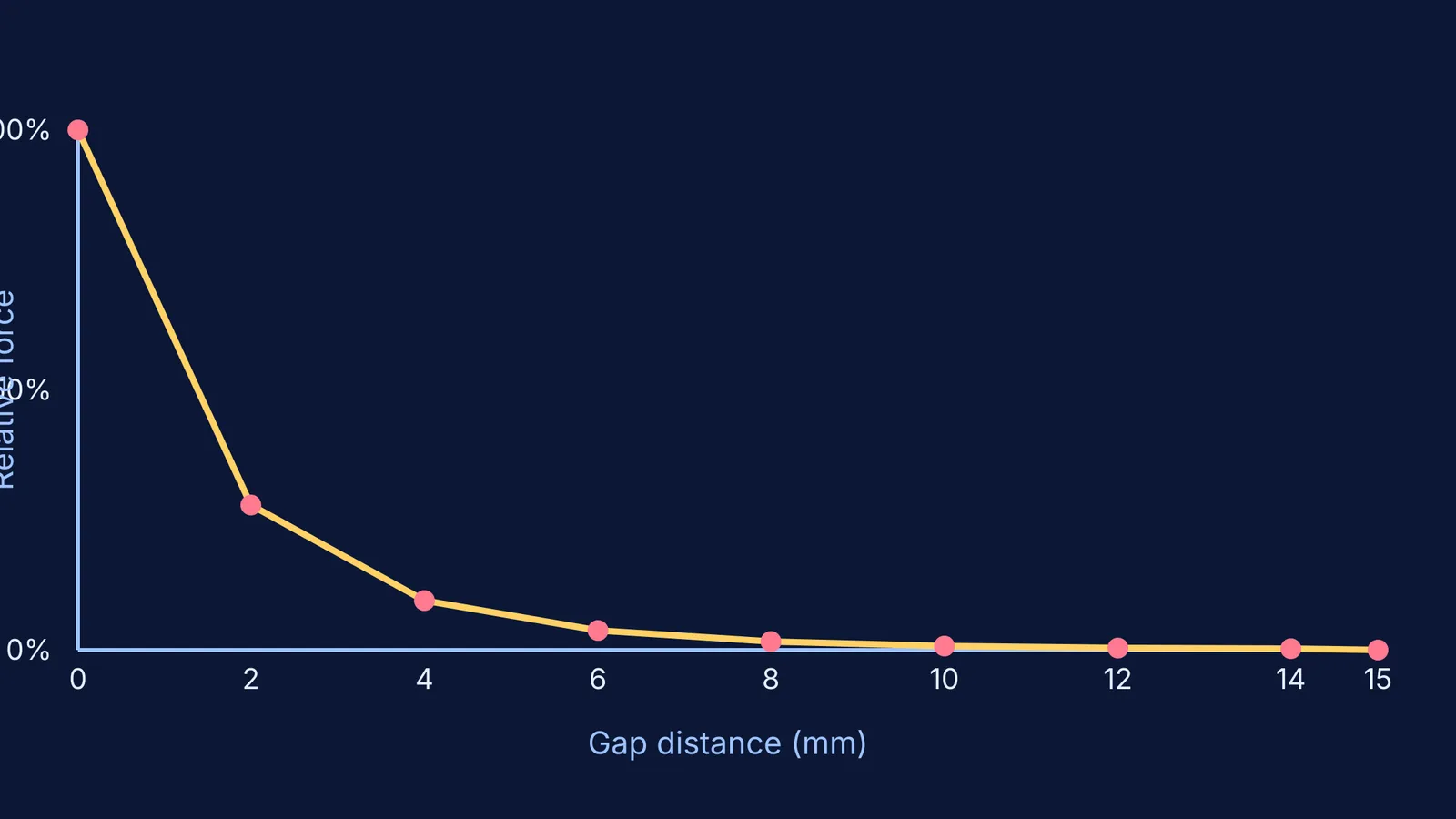
In short The force between a magnet and a paperclip drops extremely fast—following a steep inverse-seventh power curve—because the induced magnetism weakens with distance. In a classic classroom experiment, a magnet holding a chain of clips at a 0 mm gap drops them all as the gap increases by just a few millimetres.
Why does the magnetic pull drop so quickly?
If you double your distance from the Earth, gravity becomes four times weaker because it follows the famous inverse-square law. Magnetic fields behave differently, which is why a magnet that feels incredibly strong in your hand will fail to pull a paperclip from just a few centimetres away.
A standard bar or disc magnet has two opposite poles. Because these poles partially cancel each other out as you move away, the magnet's field strength falls off as the cube of the distance (1/r³). If this were the whole story, doubling the distance would make the magnetic field eight times weaker.
However, a steel paperclip is not a permanent magnet. To pull on the clip, the permanent magnet must first induce a temporary magnetic field inside the steel. This means the clip's own magnetism also weakens as it gets further from the magnet. Because the total pull depends on both the magnet's field and the clip's induced field multiplying together, the resulting force on the paperclip drops as the seventh power of distance (1/r⁷). This steep mathematics means the magnetic attraction practically vanishes over a tiny gap.
This same principle explains why magnetic mounts, latches, and fridge magnets require direct contact to work reliably. Even a thin layer of plastic or a few sheets of paper can push the magnet far enough down the curve that it fails to hold its target.
How fast does magnet force drop with distance for paperclips?
Because the force follows such a steep curve, it acts like a "cliff" rather than a gentle slope. Close up, the magnet is overwhelmingly strong, but just a few millimetres away, its pull is defeated by gravity.
When mapping this drop in a classroom experiment, the results show exactly how steep the cliff is. When touching the magnet directly, the magnetic field supports a long chain of paperclips. Adding a small gap—the thickness of a few index cards—drastically cuts the number of clips the magnet can support. By the time the gap reaches a centimetre, the force is often so weak it cannot overcome the weight of a single paperclip.
Understanding this rapid drop is crucial in electromagnetism. Whether you are calculating the helical path of a charge in a magnetic field or exploring the circulating E inside a solenoid, the distance from the source dominates the behaviour of the system.
How do you test the paperclip gap yourself?
You can plot this curve on your own desk with simple materials to see the inverse power law in action. Here is how to set up the test:
Set up the gap: Place a non-magnetic spacer, such as layers of index cards, masking tape, or a plastic ruler, against the pole of a strong magnet.
Build the chain: Hang standard steel paperclips end-to-end from the spacer. Keep adding clips carefully until the magnet can no longer hold the weight of the next clip.
Record the data: Note the gap distance in your table alongside the number of clips successfully held.
Increase the distance: Add more layers to your spacer to increase the gap by 2 mm increments, and repeat the test.
Make sure you use exactly the same size of paperclip for every trial. The mass of the clips acts as your force scale; if you mix large and small clips, your measurement of the magnetic pull will be distorted. Performing three trials for each distance and taking the average will give you a smoother, more accurate curve.
When you graph your results on paper, you will not see a straight line. Instead, the number of clips will plummet sharply and then flatten out as it approaches zero, perfectly mirroring the theoretical drop of an induced dipole.
Seeing the invisible forces
When you study electromagnetism for exams, picturing invisible forces can be difficult from textbook equations alone.
If you are struggling to visualise how fields interact or why they drop off so fast, the Fermi Simulation Lab lets you adjust variables and see the forces change in real time. Fermi's AI tutor can walk you through the mathematics of dipoles and induced fields, ensuring you understand exactly why the paperclips fall.


