

On this page
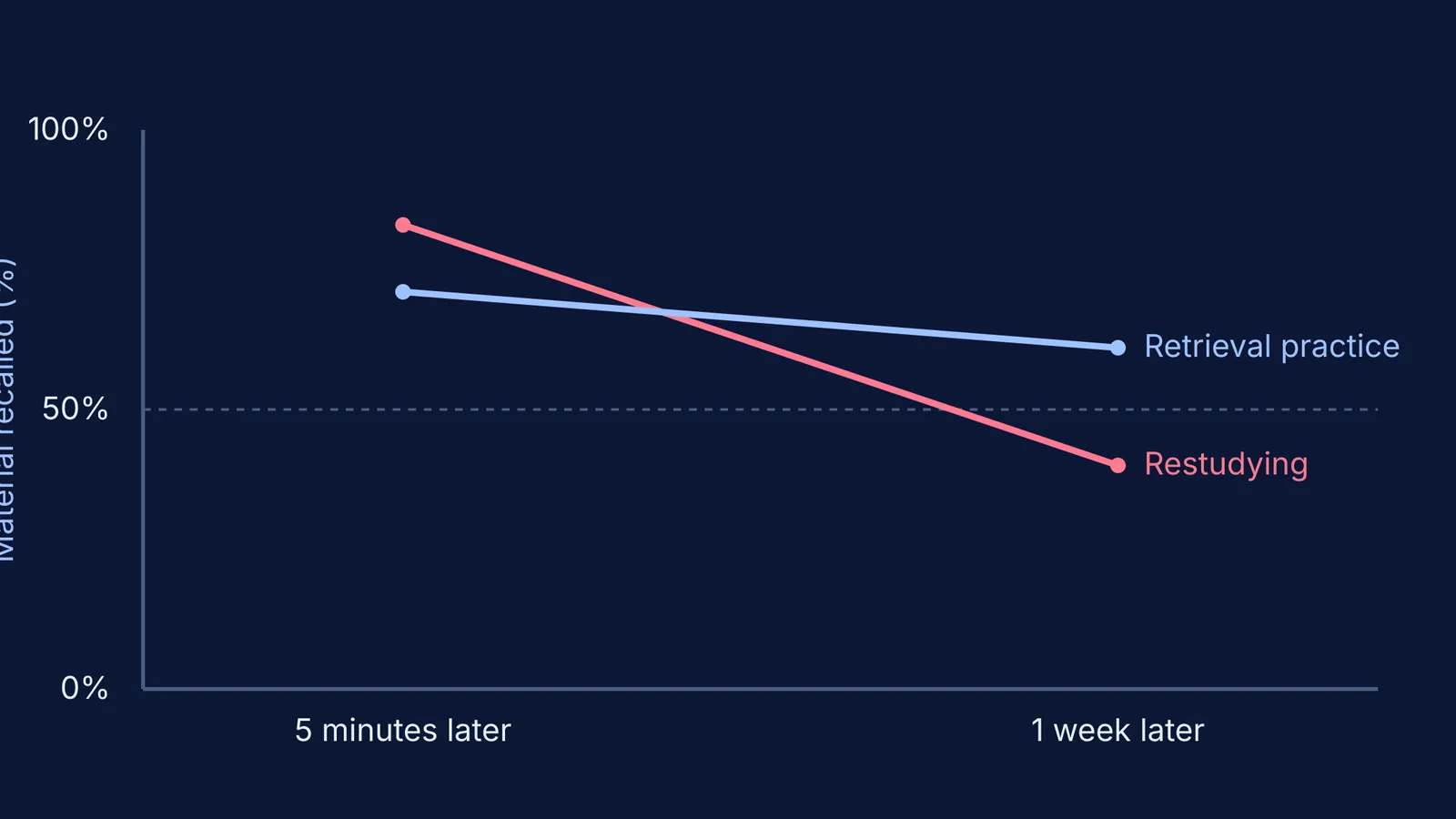
In short The most effective way to score full marks on 5-mark board answers is to write timed answers from memory and mark them strictly. Students who practice free recall remember 61% of the material a week later, compared to 40% for those who just reread. You can use an AI tutor to check your handwritten answer against the official value points and find the gaps.
If you are aiming for top marks in a board exam, reading your notes is not enough. You have likely experienced the "illusion of competence": the material feels familiar when you read it, but your mind goes blank the moment you face a 5-mark long answer question in the exam hall.
The solution is retrieval practice—pulling information from memory without cues. When you combine this with strict grading against a marking scheme, you close the gap between what you think you know and what the examiner actually wants to see.
Why is it hard to score full marks on long answers?
CBSE and ICSE examiners do not award marks just because an answer is long. They use a marking scheme that breaks down the required answer into value points. These are the specific facts, keywords, or logical steps that form the skeleton of a correct response.
For a 5-mark question, evaluators typically look for five distinct value points (CBSE Academic). If you write two pages but only hit three value points, you will score 3 out of 5. Practicing how to hit these points quickly is a skill you have to train.
Research shows that actively reconstructing an answer is far more effective for long-term memory than passively studying. In a foundational study, students who practiced free recall retained 61% of a passage one week later, while those who only reread the material retained just 40% (Roediger & Karpicke, 2006).
How much time should you spend on a 5-mark question?
In a board exam, time management is critical. If you spend too long writing an overly detailed answer, you will inevitably run out of time for the rest of the paper. This is why practicing your pacing is just as important as knowing the content.
How to practice 5 mark board answers with AI?
You can turn an AI tutor into a strict board examiner. Instead of asking the AI to write the answer for you, use it to check your own work.
Here is the three-step framework:
Write it out on paper: Pick a 5-mark question from a past paper. Set a timer for your target duration. Write the complete answer from memory, just as you would in the exam hall.
Find the value points: Open the official marking scheme for that past paper and find the value points for the question.
Ask the AI to grade you: Upload a photo of your handwritten answer to your AI tutor. Give it this exact prompt:
> "Act as a strict board examiner. Here is the question: [Insert question]. Here are the official value points: [Paste value points]. Read my handwritten answer and score it out of 5. Tell me exactly which value points I missed and how I can improve the structure."
Why does marking against value points matter?
Feedback is only useful if it tells you what to change. Educational researchers found that feedback is one of the most powerful influences on student achievement, with a massive average effect size of 0.79 (Hattie & Timperley, 2007). However, they noted that the *type* of feedback matters immensely.
General praise has very little impact. The most effective feedback operates at the "task level" and "process level"—it tells you exactly what is missing from your answer and what strategy you should use next time.
By feeding the marking scheme to the AI, you force it to give you task-level feedback. It stops the AI from being overly polite or evaluating your answer against its own general knowledge, tying the grade directly to the exam's standards.
If you don't know where to start or your concepts are weak, Fermi can work out what you already know and build a plan for the session, writing on a board and checking your understanding as it goes. For more on getting the most out of your practice sessions, you can read our guide on getting useful AI feedback on your step-by-step physics solutions. Or, to see the difference in how these tools operate, see how AI tutors vs answer chatbots compare when you get stuck.


