

On this page
If you are preparing for your Class 12 board chemistry examination, you already know the sinking feeling of getting a complex Nernst equation or first-order kinetics problem right on theory, only to lose marks on the final decimal. Under official CBSE senior secondary examination guidelines, calculators are strictly prohibited in the examination hall. Students must rely on printed four-figure logarithm tables or given log values to evaluate roots, exponential decay factors, and equilibrium constants.
When homework gets tedious, turning to an AI chatbot to generate the final numerical answer is tempting. However, relying on artificial intelligence to do your arithmetic undermines your preparation. A 2025 randomized controlled trial by Hamsa Bastani and colleagues published in the *Proceedings of the National Academy of Sciences* evaluated nearly 1,000 high school students solving mathematics problems. While access to standard generative AI boosted homework scores by 48%, those same students suffered a 17% decline in performance on subsequent unassisted examinations compared to peers who never used the tool. The students treated the software as a cognitive crutch rather than a learning tool. The smarter way to study is using AI as an auditor for your pencil-and-paper steps.
Why are log table skills essential for board chemistry?
Physical chemistry numericals carry substantial weight in the senior secondary chemistry theory examination under the CBSE Class 12 chemistry curriculum. Core syllabus chapters like Electrochemistry, Chemical Kinetics, and Solutions require multi-step numerical solutions where examiners award marks according to a step-wise rubric. A student who sets up the correct electrochemical cell reaction and substitutes values into the Nernst equation earns marks for the formula and substitution, but dropping the arithmetic at the antilog stage costs the final accuracy marks.
In the exam hall, nobody gives you an automated solver. You must determine the characteristic, look up the four-digit mantissa in printed logarithm tables, add the mean difference, and manage negative exponents. If you outsource this practice to an AI tool during your revision, your eye never trains to locate values rapidly across columns, and your fingers never develop the habit of writing down the sign transformations that prevent systematic errors.
How should you break down negative logs for antilog tables?
The single most frequent mistake in board chemistry occurs when reversing negative logarithmic quantities, particularly when calculating hydrogen ion concentration from pH or finding an equilibrium constant from standard electrode potentials.
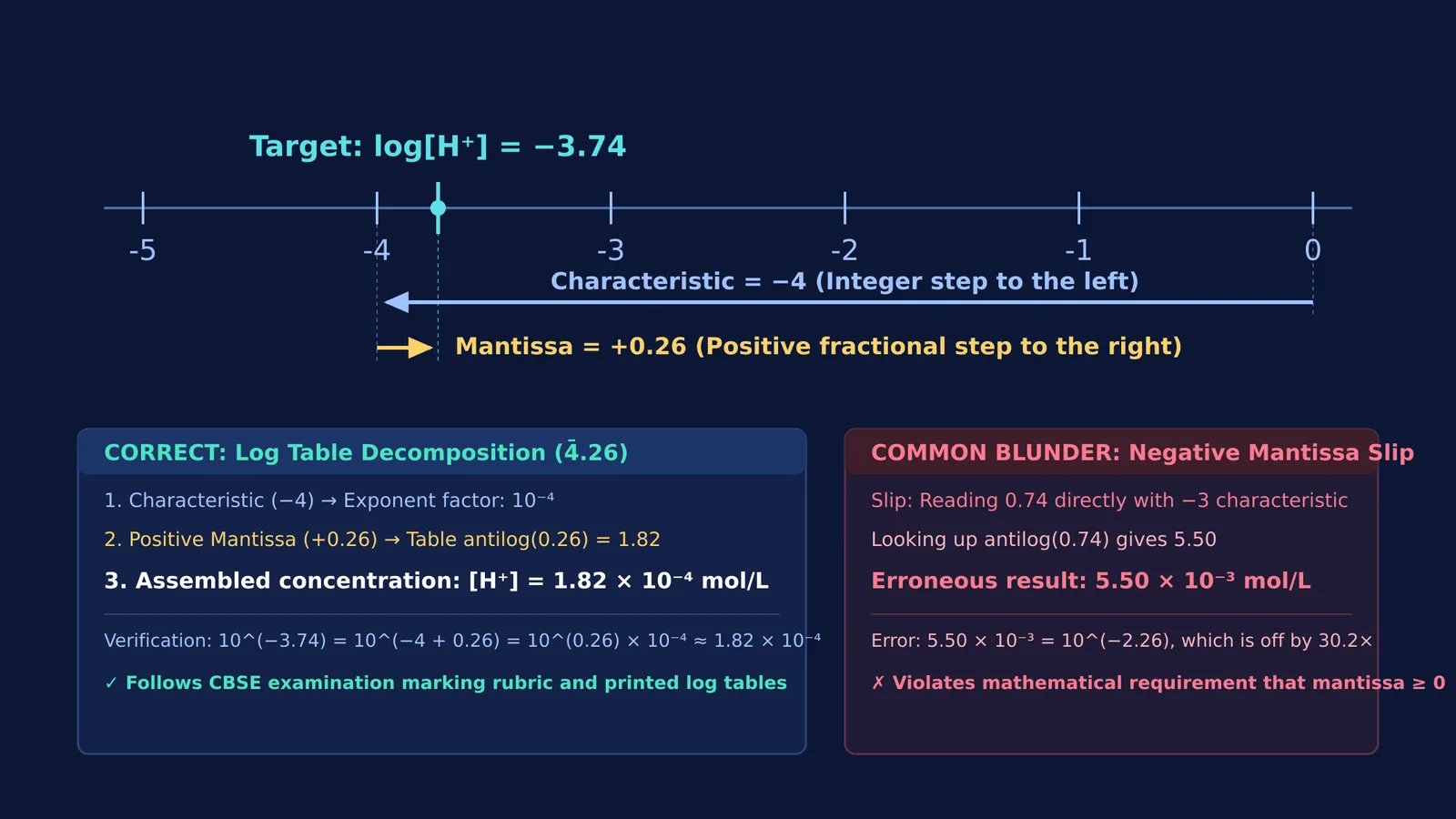
Consider finding the hydrogen ion concentration of a solution with a pH of 3.74. By definition, pH equals the negative common logarithm of hydrogen ion concentration. Therefore:
log[H⁺] = −3.74
A common blunder is to look up 0.74 in the antilog table and write 5.50 × 10⁻³, which is completely incorrect. Four-figure logarithm tables are constructed with the fundamental mathematical constraint that the mantissa—the decimal part—must always be positive or zero. To convert a negative logarithm into a form compatible with printed tables, you must split the number into a negative integer characteristic and a positive fractional mantissa:
−3.74 = −3 − 0.74 = (−3 − 1) + (1 − 0.74) = −4 + 0.26
In chemistry notation, this is written as 4̄.26 (with a bar over the four, read as "bar four point two six"). The bar over the four denotes that only the characteristic is negative, while the mantissa 0.26 remains positive.
Now you look up the antilog of 0.26 in your table, which yields 1.82. The negative characteristic of −4 becomes the power of ten:
[H⁺] = 1.82 × 10⁻⁴ mol/L
If your calculation involves buffers or weak acids, you can review our guides on solving ionic equilibrium and buffer calculations and calculating the pH of dilute acid solutions to ensure your equilibrium expressions are set up accurately before you reach the logarithm step.
How can AI check your log steps without replacing your thinking?
When you ask an AI model to solve a chemistry problem from scratch, it evaluates mathematical expressions using floating-point arithmetic. It will calculate 10 raised to the power of negative 3.74 directly as 0.00018197, skipping the characteristic and mantissa split entirely. That decimal output does not tell you whether your pencil-and-paper decomposition had an arithmetic slip, whether you misread the mean difference column, or whether your power of ten was off.
Educational research proves that the level of granularity in feedback determines learning outcomes. In a landmark meta-analysis published in *Educational Psychologist*, cognitive scientist Kurt VanLehn found that step-based intelligent tutoring systems—which assess a learner's intermediate reasoning steps—produced an effect size of d = 0.76 over classroom instruction, virtually matching human one-on-one tutoring (d = 0.79). In contrast, tutoring that only verified final answers proved far less effective.
Intelligent tutoring platforms apply this step-based principle. On Fermi's AI tutor, the AI tutor teaches rather than simply answers: it holds a line of reasoning across a session, notices where a student is stuck, and decides whether to explain, ask, or show while checking understanding as it goes. Similarly, the Fermi Problem Library provides worked problems with a step-by-step solver that explains the reasoning rather than printing an answer. To learn more about how targeted hints strengthen retention, read our analysis on why hints beat complete answers in tutoring.
What does an effective AI step-checking prompt look like?
To make AI an active revision partner rather than an answer key, do your calculation on paper first. Then, ask the AI to audit your intermediate lines.
Here is a structured prompt you can use when working through physical chemistry problems:
"I am solving a Class 12 physical chemistry numerical using pencil, paper, and printed log tables. Do not solve the problem from scratch. Check only my intermediate steps for mathematical validity:
Substituted formula: log Kc = (2 × 0.46) / 0.0591 = 15.5668
Rounding to four figures: 15.57
Characteristic and mantissa separation: Characteristic = 15, Mantissa = +0.57
Antilog table reading: antilog(0.57) = 3.715
Final value: Kc = 3.72 × 10¹⁵
Please identify if any line contains an arithmetic error, sign error, or incorrect mantissa split."
By forcing the model to evaluate your reasoning instead of generating it, you isolate precisely where a calculation failed while keeping the cognitive effort on your side of the desk. When exam day arrives and you open the printed log booklet, that deliberate practice translates directly into speed and confidence.


