

On this page
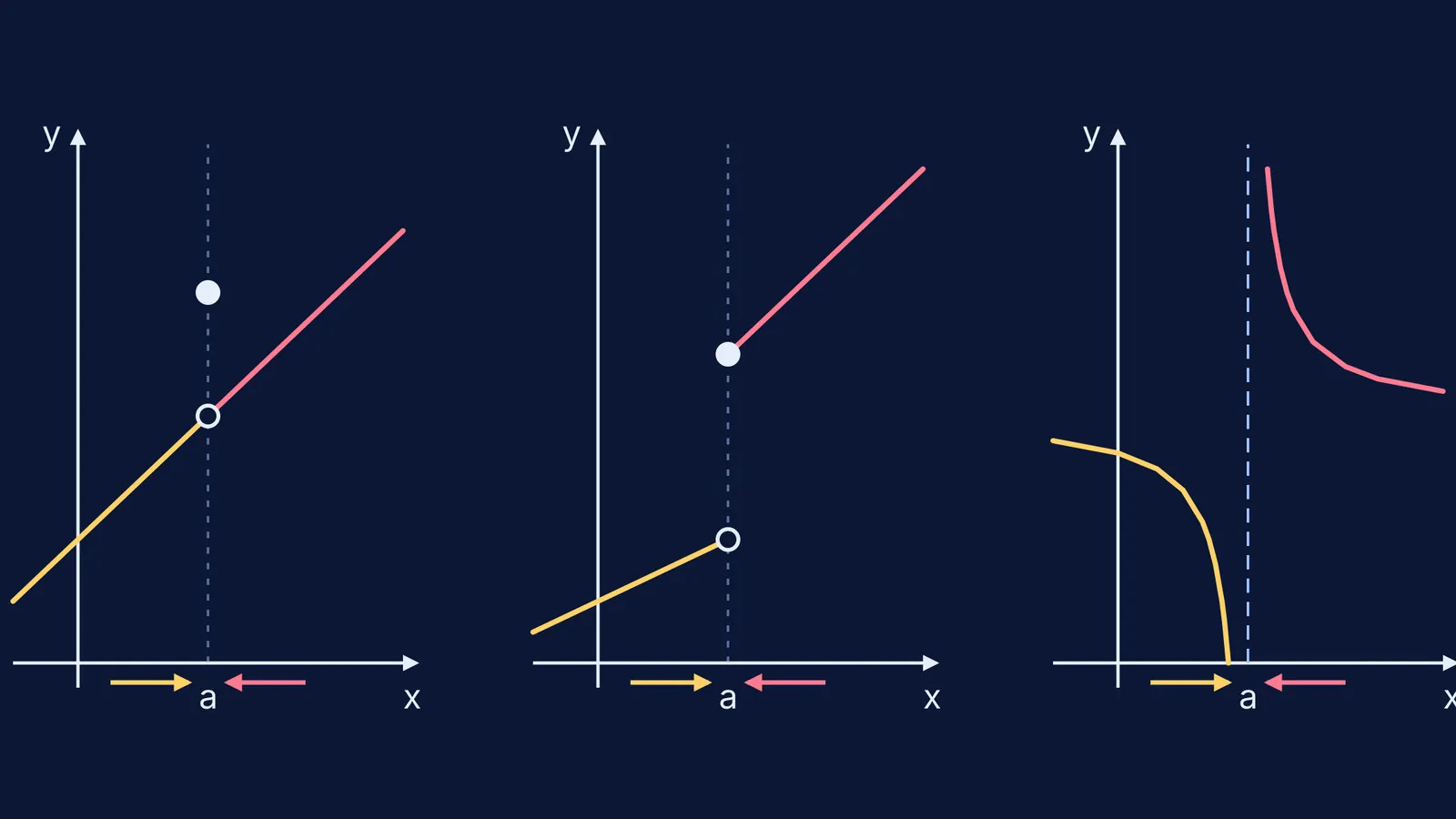
A common mistake with limits is reading the dot. The dot shows f(a), the value of the function. The limit asks what height the curve heads for as x gets close to a. Here is how to read that for three shapes that turn up in Class 11 and JEE questions: a hole, a jump and a vertical asymptote.
What is a left and right limit on a graph?
The left-hand limit is the value f(x) approaches as x comes towards a from values smaller than a, as defined in OpenStax Calculus Volume 1, section 2.2. The right-hand limit is the same idea, with x coming in from values larger than a.
On a graph, slide a finger along the curve towards x = a from the left, then from the right. The two heights you are heading for are the left and right limits.
The limit of f(x) as x approaches a equals L if and only if both one-sided limits equal L (OpenStax, section 2.2). The Lamar University Calculus I notes on one-sided limits agree: if the two sides differ, there is no two-sided limit, and the value at the point itself does not matter.
Why can the function value differ from the limit?
The definition of a limit only needs f to be defined on an open interval around a, "with the possible exception of a itself" (OpenStax, section 2.2). So f(a) can be missing, or some unrelated number, and the limit does not change. In OpenStax's Example 2.6, g(−1) = 4, yet the values of g(x) approach 3 as x approaches −1 from either side, so the limit there is 3.
A function is continuous at a when f(a) is defined, the limit exists, and the two are equal; these are the three conditions in OpenStax section 2.4 on continuity. Every hole, jump or asymptote breaks at least one of them.
How do you read limits at a hole, a jump and an asymptote?
Predict both sides first, then check. OpenStax names all three cases in section 2.4: removable, jump and infinite discontinuities.
First, a hole. Take f(x) = (x² − 4)/(x − 2), and say the question defines f(2) = 1. For every x except 2 the fraction cancels to x + 2, so the graph is a line with an open circle at (2, 4) and a filled dot at (2, 1).
Left: f(1.9) = 3.9, f(1.99) = 3.99, heading for 4.
Right: f(2.1) = 4.1, f(2.01) = 4.01, heading for 4.
Limit: 4. Value: f(2) = 1. They differ, and that is fine.
OpenStax calls this a removable discontinuity, because the limit exists. Redefine f(2) = 4 and the hole is filled.
Next, a jump. Take the greatest integer function, f(x) = ⌊x⌋, at x = 2.
Left: just below 2, say at 1.99, ⌊x⌋ = 1. Left limit: 1.
Right: just above 2, say at 2.01, ⌊x⌋ = 2. Right limit: 2.
Limit: does not exist, because 1 ≠ 2. Value: f(2) = 2.
Both one-sided limits exist but differ, which is OpenStax's definition of a jump discontinuity. Notice that f(2) matches the right side, so a student who reads only the filled dot will wrongly answer 2.
Last, an asymptote. Take f(x) = 1/(x − 3) at x = 3.
Left: x = 2.99 gives −100, x = 2.999 gives −1000. The curve falls towards −∞.
Right: x = 3.01 gives 100, x = 3.001 gives 1000. The curve climbs towards +∞.
Limit: does not exist as a number. Value: f(3) is undefined.
If either one-sided limit is +∞ or −∞, the line x = a is a vertical asymptote (OpenStax, section 2.2), and section 2.4 calls this an infinite discontinuity. When x grows large instead of approaching a number, you need a different tool, covered in our guide to limits at infinity of rational functions.
How do you check a limit on a graph step by step?
Use these four steps on every graph or piecewise question:
Cover x = a and predict the left-hand height.
Predict the right-hand height.
Compare. Equal and finite: the limit exists. Both finite but unequal: a jump. Infinite on either side: an asymptote.
Only now uncover the dot and read f(a). Write the limit and the value as two separate answers.
If holes and jumps still blur together, practise with our post on telling removable and jump discontinuities apart. The same left-and-right reading returns when you find derivatives from first principles, because a derivative is itself a limit.
For ideas that are easier to see than to read, the Fermi Simulation Lab has interactive simulations. If one-sided limits are the gap, the Fermi Concept Library gives each mathematics concept its own lesson and its place in the map.


