

On this page
Calculus students often treat indeterminate forms as algebraic dead ends. When evaluating a limit yields 0/0, the standard advice is to differentiate the top and bottom. But why does this work?
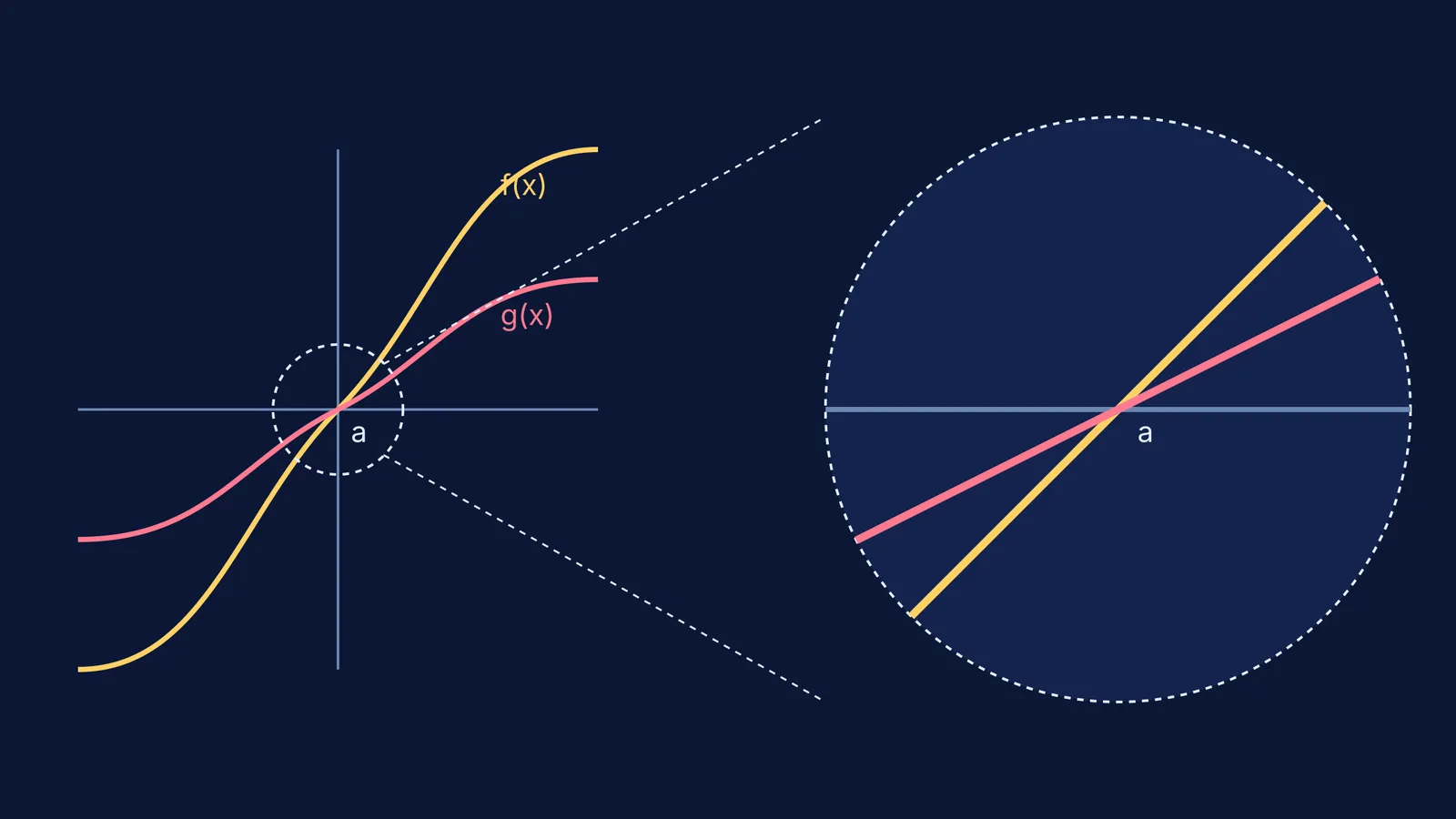
The secret lies not in algebra, but in geometry. If you take a differentiable curve and magnify it enough, it stops looking like a curve and starts looking like a straight line. By visualising what happens when we zoom into an intersection point, the mystery of the 0/0 limit disappears.
What does 0/0 actually mean?
Imagine you are trying to evaluate the limit of f(x)/g(x) as x approaches a point a. If both f(a) and g(a) equal zero, their graphs both cross the x-axis at exactly the same spot.
Because both values are shrinking to zero at the same time, the final value of their ratio depends entirely on a "race" to the bottom. If the numerator shrinks faster than the denominator, the ratio will settle at a different value than if they move at the same speed. To find the winner of this race, we need to compare their speeds.
How does zooming reveal the answer?
According to OpenStax, L'Hôpital's rule formally states that if the limit of a ratio yields an indeterminate form like 0/0, it is equal to the limit of their derivatives, f'(x)/g'(x).
The visual proof of this relies on a concept called local linearity. Every smooth curve, no matter how complex, behaves like a straight tangent line if you zoom in closely enough.
When you zoom into the point x = a where both functions hit zero:
The curves straighten out: Both f(x) and g(x) become visually indistinguishable from straight lines passing through the origin of your zoomed-in view.
The slopes take over: The steepness of these straight lines is given by their derivatives at that point, f'(a) and g'(a).
The ratio becomes simple: Because they are just straight lines intersecting at zero, comparing their values at any nearby point is the exact same as comparing their slopes.
By taking the derivatives, you are simply replacing complicated curves with the straight lines they resemble under a microscope.
Why do students get stuck on L'Hôpital's rule?
Despite its usefulness, this rule is a common source of lost marks in exams. Without a geometric understanding, students tend to apply the rule blindly as a mechanical "trick", leading to three classic mistakes:
Applying it when the limit is not 0/0 or ∞/∞: If a limit evaluates to 1/0, L'Hôpital's rule does not apply. If you picture this geometrically, the numerator curve is nowhere near the x-axis, so there is no shared "race to zero".
Confusing it with the quotient rule: Students frequently attempt to differentiate the entire fraction at once. Remember that you are looking for the independent slopes of two separate curves, not the derivative of their ratio.
Forgetting to check the new limit: Sometimes, differentiating once still leaves you with a 0/0 ratio (for example, when differentiating parametric functions: dy/dx and d²y/dx² creates nested fractions). In these cases, you simply zoom in again by taking the second derivative.
A practical framework for indeterminate limits
When you face a stubbornly indeterminate limit in your JEE or CBSE exam, avoid jumping blindly into differentiation. Follow these steps:
Verify the collision: Plug in x = a. You must confirm that both the numerator and denominator are actually zero (or infinity). If they are not, L'Hôpital's rule will give you the wrong answer.
Check the derivatives: Ask yourself if differentiating will actually make the expression simpler. If differentiating creates a worse mess, look for an algebraic shortcut or a Taylor series expansion instead.
Differentiate separately: Take the derivative of the top, and then the derivative of the bottom.
Evaluate again: Substitute x = a into your new fraction. If you get a real number, you have found the ratio of their slopes, and therefore your limit.
Seeing the math in motion
Static diagrams in textbooks often fail to capture this limiting process. For students who need to see the "straightening" happen to truly believe it, the Fermi Simulation Lab has interactive simulations for the ideas that are easier to see than to read. You can watch curves morph into straight lines as you zoom in on their intersection.
A deep grasp of limits requires geometric intuition—a skill that was crucial to Karl Weierstrass and the epsilon-delta definition of a limit. If you are struggling to move past the mechanical steps of calculus, Fermi's AI tutor can work out what you already know and build a plan for the session, writing on a board, drawing the figure, and checking understanding as it goes.


