

On this page
Temperature is the main driver of biological activity in the soil. Fungi, bacteria and soil invertebrates rely on heat to speed up the chemical reactions that break down tough leaf walls. In general, leaves break down much faster in warm conditions.
Biologists measure this sensitivity using a value called Q₁₀, which tells you how much the decay rate multiplies for every 10 °C rise in temperature. A study in Hawaiian tropical montane wet forests found a Q₁₀ of 2.17 for leaf litter decomposition. This means that for every 10 °C you add, the microbes break down organic matter more than twice as fast.
What happens at 10, 25 and 35 degrees?
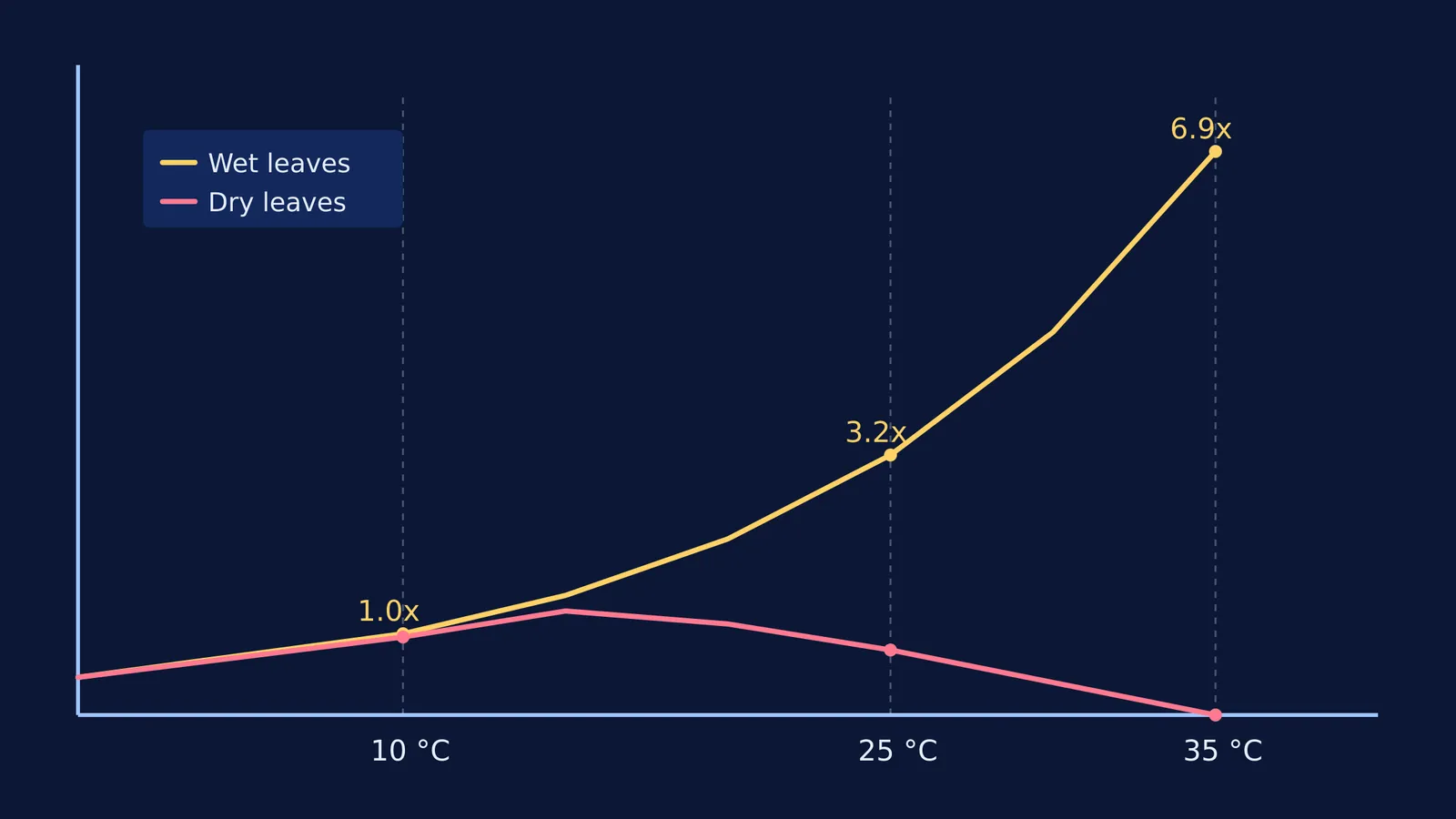
When you plot the breakdown of leaf litter across specific temperatures, you see an exponential curve—provided the leaves have plenty of water. Based on a Q₁₀ of 2.17 from the Hawaiian forest study, here is how the pace changes:
10 °C (Baseline decay): At this temperature, microbial metabolism is sluggish. Leaves on a cool forest floor take months or years to vanish. We can treat this cold state as our starting rate of 1.0.
25 °C (Rapid breakdown): This is the sweet spot for many decomposers. At 25 °C, the decay rate reaches 3.19 times the baseline. A leaf that takes a year to rot at 10 °C will disappear in less than four months here.
35 °C (Peak potential): Microbes work furiously at high heat. If you keep the leaves wet, the rate at 35 °C climbs to 6.93 times the baseline.
How does moisture change the temperature rule?
While heat dictates the maximum speed of decay, water acts as the gatekeeper. Microbes need a thin film of water to move around and secrete the enzymes that digest the leaves.
If the environment hits 35 °C but the soil dries out, the microbes encyst to survive, and decomposition crashes to a halt. A 2021 study on the Loess Plateau in China tested leaf decomposition at a steady 25 °C across different soil moisture gradients of 10%, 25% and 50%. The researchers found that the decomposition rate increased in direct step with available moisture. A warm environment is useless to a microbe if it is too dry to move.
Understanding how environmental factors like this stack together is central to ecology. You can read more about how populations respond to environmental limits in Organisms and populations: growth models and species interactions, or look at how cells extract energy in Respiration in plants: how to count ATP from glycolysis to ETS.
How can you test temperature and moisture?
If you want to test this biological principle yourself, you can build a simple decomposition experiment at home.
Gather identical material: Collect fallen leaves of the same species. Dry them out slightly, then weigh equal 10-gram batches into separate mesh bags or plastic containers with air holes.
Set the temperatures: Place one batch in a fridge (roughly 10 °C), one in a shaded room (roughly 25 °C), and one in a warm, sunny spot or incubator (roughly 35 °C).
Control the moisture: Add a measured amount of water (e.g. 10 ml) to half the bags to keep them damp, and leave the other half bone dry.
Weigh them over time: Check the bags every two weeks. Dry the leaves gently, weigh them to see how much mass has been lost to respiration, and re-wet the damp group.
You will likely see the damp 35 °C batch vanish first, while the dry 35 °C batch barely changes. If you are investigating the precise effects of variables like these, the Fermi Simulation Lab allows you to model changes in temperature and moisture and track the exponential effects over time. You can adjust the starting parameters to see exactly how quickly heat and water interact to turn fallen leaves back into soil.


