

On this page
When *Escherichia coli* bacteria encounter lactose, they do not waste energy producing the enzymes to digest it if a better food source like glucose is around. Instead, they use a tightly controlled genetic switch called an operon. Understanding this switch is a core part of the Class 12 biology syllabus and the NEET-UG exam.
What is the lac operon?
An operon is a group of genes that are transcribed together under the control of a single promoter. The *lac* operon controls three structural genes needed to transport and break down lactose:
*lacZ* codes for β-galactosidase, which splits the disaccharide lactose into the simple sugars glucose and galactose.
*lacY* codes for permease, a membrane channel that lets lactose into the cell.
*lacA* codes for a transacetylase whose exact physiological role is still debated among biologists.
In 1961, François Jacob and Jacques Monod published their model of this regulatory mechanism in the *Journal of Molecular Biology*80072-7). Their insight—that genes can be turned on and off by specific repressor proteins—won them the 1965 Nobel Prize in Physiology or Medicine.
How does the lac operon turn on and off?
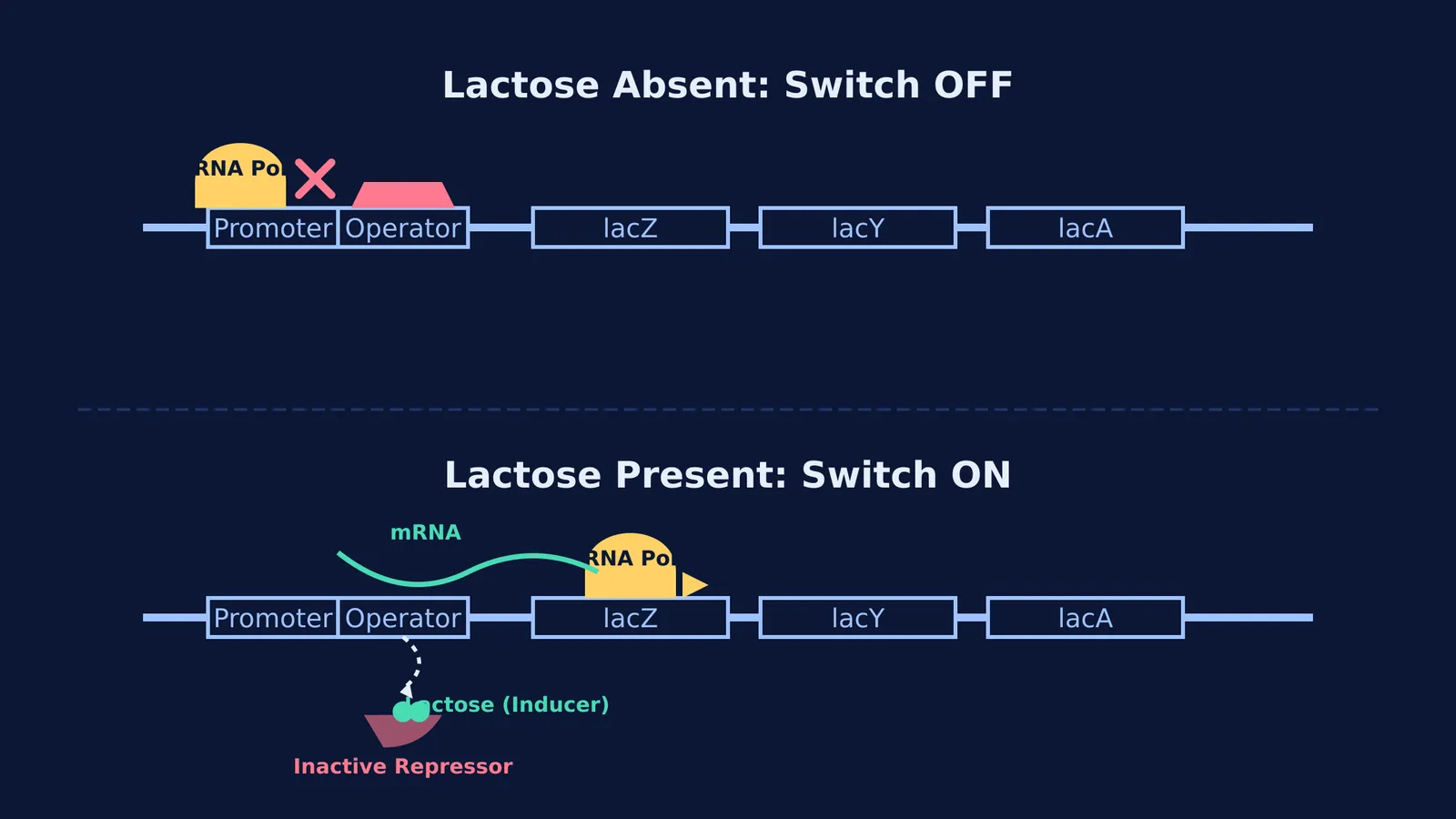
The operon has two main control regions: the promoter (where RNA polymerase binds to start transcription) and the operator (where a repressor protein binds to block it).
When lactose is absent: The repressor protein, which is constantly produced by a separate regulatory gene called *lacI*, sits tightly on the operator sequence. Because the operator overlaps the promoter, the repressor physically blocks RNA polymerase from moving forward. The switch is OFF. However, this block is not absolute. A minimal amount of background expression always occurs. This tiny leak is crucial: without it, there would be no permease channels to let the first few lactose molecules into the cell, and the operon could never be switched on. (Note that in eukaryotes, transcription involves different enzymes; see our guide to eukaryotic RNA polymerases).
When lactose is present: A small amount of lactose enters the cell through existing permease channels and acts as an inducer. It binds to the repressor protein and changes its three-dimensional shape. This conformational change means the altered repressor can no longer grip the operator DNA, and it falls away. RNA polymerase is now free to travel down the DNA and transcribe the genes into a single strand of messenger RNA. The switch is ON.
What happens when both glucose and lactose are present?
Bacteria strongly prefer glucose because it provides energy much faster than lactose. If you place *E. coli* in a broth containing both sugars, the bacteria will consume all the glucose first, pause briefly, and only then start digesting the lactose. This two-phase growth pattern is known as diauxie.
To achieve this, the *lac* operon has a second layer of control called catabolite repression. Even if lactose has removed the repressor from the operator, RNA polymerase struggles to bind to the promoter on its own. It needs help from an activator protein called the Catabolite Activator Protein (CAP). However, CAP only becomes active when glucose levels are extremely low. If glucose is abundant, CAP remains inactive, RNA polymerase ignores the promoter, and the *lac* operon stays practically silent, regardless of whether lactose is floating around.
Why do bacteria use a repressor?
It comes down to energy conservation. Building RNA transcripts and translating them into proteins costs a massive amount of ATP. If a bacterium made lactose-digesting enzymes all the time, it would waste precious cellular resources when there is no lactose to eat. By using a repressor, the default state is OFF, ensuring the genes are transcribed only when their products are actually needed for survival.
How do I use the simulation?
Reading about repressors, promoters and polymerases in a textbook is one thing, but seeing them move makes the mechanism click. In the Fermi Simulation Lab, you can interact with the DNA, the repressor and the inducer directly.
Try this routine to test your understanding:
Predict: Before you change anything, ask yourself whether the genes are currently ON or OFF. Look at where the repressor is sitting.
Add lactose: Drop lactose into the environment and watch what happens to the repressor's shape.
Trace the polymerase: See how the RNA polymerase can now clear the promoter and start reading the *lacZ*, *lacY* and *lacA* genes.
Remove lactose: Take the lactose away and predict how long it will take for the system to shut down again.
If you are stuck on a genetics problem set, Fermi's AI tutor works out what you already know, builds a plan for the session, and teaches through it—running the simulation and checking understanding as it goes.


