

On this page
When you study the kinetic theory of gases, you first memorise a set of rules for an "ideal" gas. These rules make it much easier to calculate how gases will behave under normal everyday conditions. But to truly understand thermodynamics and physical chemistry, you must also know when and why those rules break down in the real world.
Using an AI to test yourself is an active way to learn this difference. Instead of just reading the textbook and hoping you remember the details, you can ask the AI to list the assumptions, prompt it to explain why real gases fail to follow them, and check your formulas for molecular speeds. Practising with prompt-based questions helps you spot the exact conditions that cause a real gas to deviate from the ideal gas law.
What are the assumptions of the kinetic theory of gases?
The kinetic molecular theory simplifies the chaotic motion of billions of atoms into a neat mathematical model. To do this, it relies on several core assumptions that strip away the complex physics of real-world particles [[1]](http://hyperphysics.phy-astr.gsu.edu/hbase/Kinetic/idegas.html):
Negligible volume: Gas molecules are treated as point masses that take up no physical space themselves. This implies that the entire volume of the container is free for the molecules to move around in.
No intermolecular forces: Molecules do not attract or repel each other; they only interact when they collide. There is no long-range force pulling them together or pushing them apart.
Perfectly elastic collisions: When molecules hit each other or the container walls, no kinetic energy is lost. The molecules bounce off perfectly, meaning the total kinetic energy of the gas remains constant over time.
Kinetic energy depends on temperature: The average kinetic energy of the gas molecules is directly proportional to the absolute temperature. For any ideal gas at a given temperature, the average kinetic energy is exactly the same.
Because these rules describe an idealised state, they do not perfectly match reality. Real atoms and molecules are physical objects, not mathematical points.
Which assumptions fail for real gases?
Real gas molecules are physical objects with finite volume, and they do exert weak attractive forces (Van der Waals forces) on one another. The ideal gas assumptions fail most noticeably under two extreme conditions [[2]](https://chemed.chem.purdue.edu/genchem/topicreview/bp/ch4/deviation.php):
At high pressure: When you compress a gas, the molecules are forced closely together. The space the molecules themselves occupy becomes a significant fraction of the total volume. Because the molecules cannot overlap, the free space available for them to move is less than the volume of the container. The gas is less compressible than the ideal gas law (PV = nRT) predicts, and the assumption of negligible volume breaks down.
At low temperature: When a gas is cooled, its molecules slow down. Because they are moving past each other sluggishly, their weak intermolecular attractive forces have more time to pull them together. As a molecule approaches the container wall to strike it, the other molecules behind it pull it back slightly. It hits the wall with less force, meaning the measured pressure is lower than the ideal prediction. The assumption of no intermolecular forces breaks down.
To correct for these failures, scientists use the Van der Waals equation. It adds a term a to the pressure to account for intermolecular attraction, and subtracts a term b from the volume to account for the space the molecules physically take up [[2]](https://chemed.chem.purdue.edu/genchem/topicreview/bp/ch4/deviation.php).
If you are revising these deviations, Fermi's AI tutor teaches rather than answers: it holds a line of reasoning across a whole session, notices where a student is stuck, and decides whether to explain, ask, or show the difference between an ideal and a real gas.
How to check RMS, mean, and most probable speed?
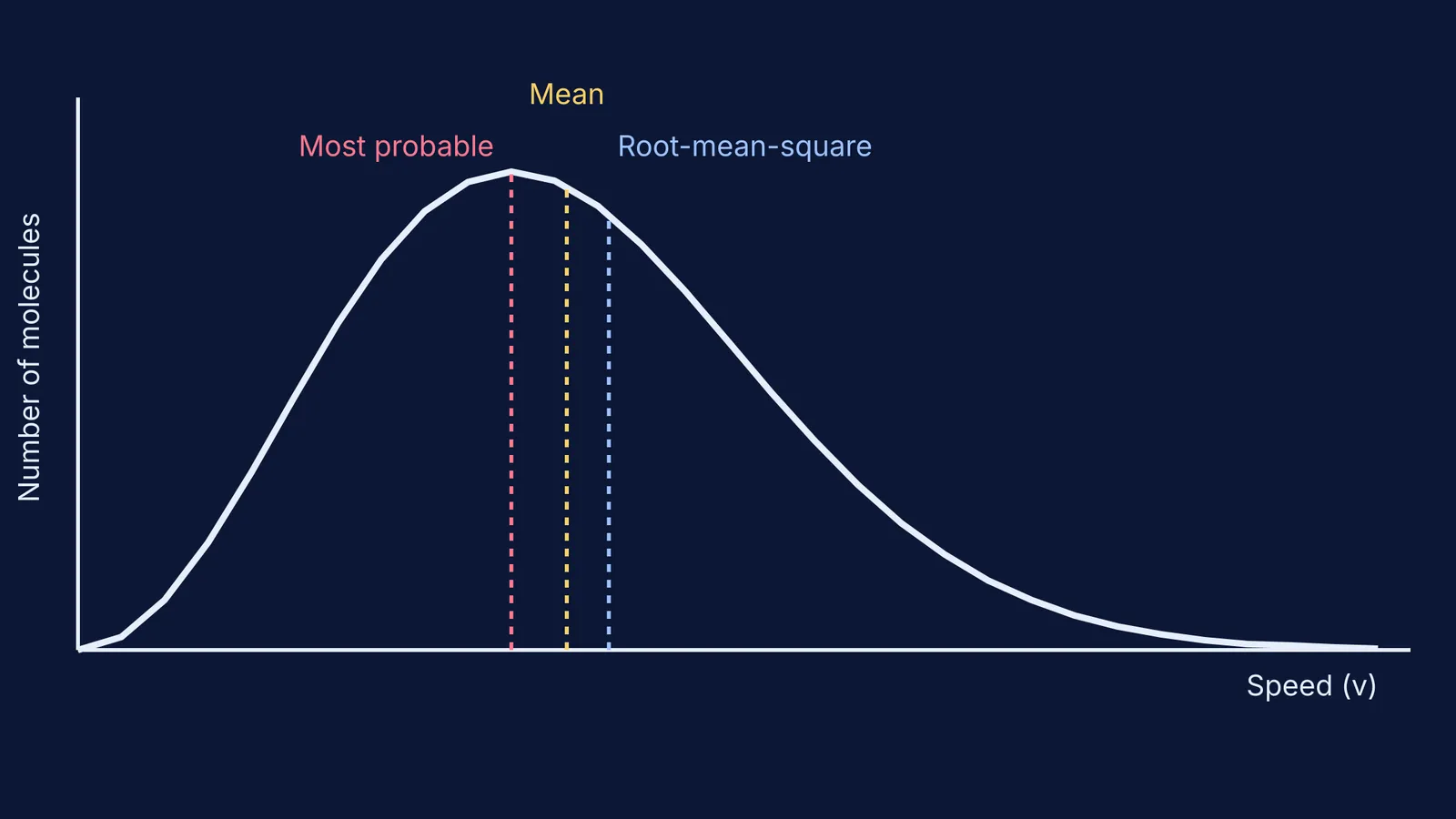
Even in an ideal gas at a steady temperature, not all molecules move at the same speed. Some move very fast, some move slowly, and most move at a speed somewhere in the middle. Their speeds follow the Maxwell-Boltzmann distribution, a curve that is skewed towards higher speeds. You are expected to know three specific speed values [[3]](http://hyperphysics.phy-astr.gsu.edu/hbase/Kinetic/kintem.html):
Most probable speed (v_p): The speed possessed by the largest number of molecules, representing the peak of the distribution curve. The formula is √(2kT/m) or √(2RT/M).
Mean speed (v_avg): The arithmetic average speed of all molecules in the gas. The formula is √(8kT/πm) or √(8RT/πM).
Root-mean-square speed (v_rms): The square root of the average of the squared speeds. This is the speed directly tied to the gas's average kinetic energy, making it crucial for thermodynamics. The formula is √(3kT/m) or √(3RT/M).
Because the distribution curve has a long "tail" on the high-speed side, the mean is pulled higher than the peak, and the rms is pulled higher still. The ratio is always v_p : v_avg : v_rms ≈ 1 : 1.128 : 1.225 [[3]](http://hyperphysics.phy-astr.gsu.edu/hbase/Kinetic/kintem.html).
If you get stuck remembering which formula is which or how to handle the constants, the Fermi Problem Library has worked problems with a step-by-step solver that explains the reasoning rather than printing an answer, helping you correctly substitute molar mass (M) and temperature (T) into the equations.


