

On this page
When you push a heavy crate up a ramp rather than lifting it vertically, the job feels much easier. Yet physical laws dictate that simple machines cannot generate free energy. An inclined plane trades force for distance: it lowers the muscular push needed to raise a load by extending the path over which that push is applied.
Understanding this trade-off requires separating force from work. Predicting and testing forces on ramps of varying slopes reveals why shallower angles require less push, why ideal work remains constant, and why friction penalises excessively long inclines.
Why does an inclined plane reduce the required force?
When an object of mass m rests on a ramp inclined at angle θ, gravity exerts a downward force mg. The ramp supports the perpendicular component mg cos θ through its normal force, leaving the parallel component pulling down the slope: F_parallel = mg sin θ.
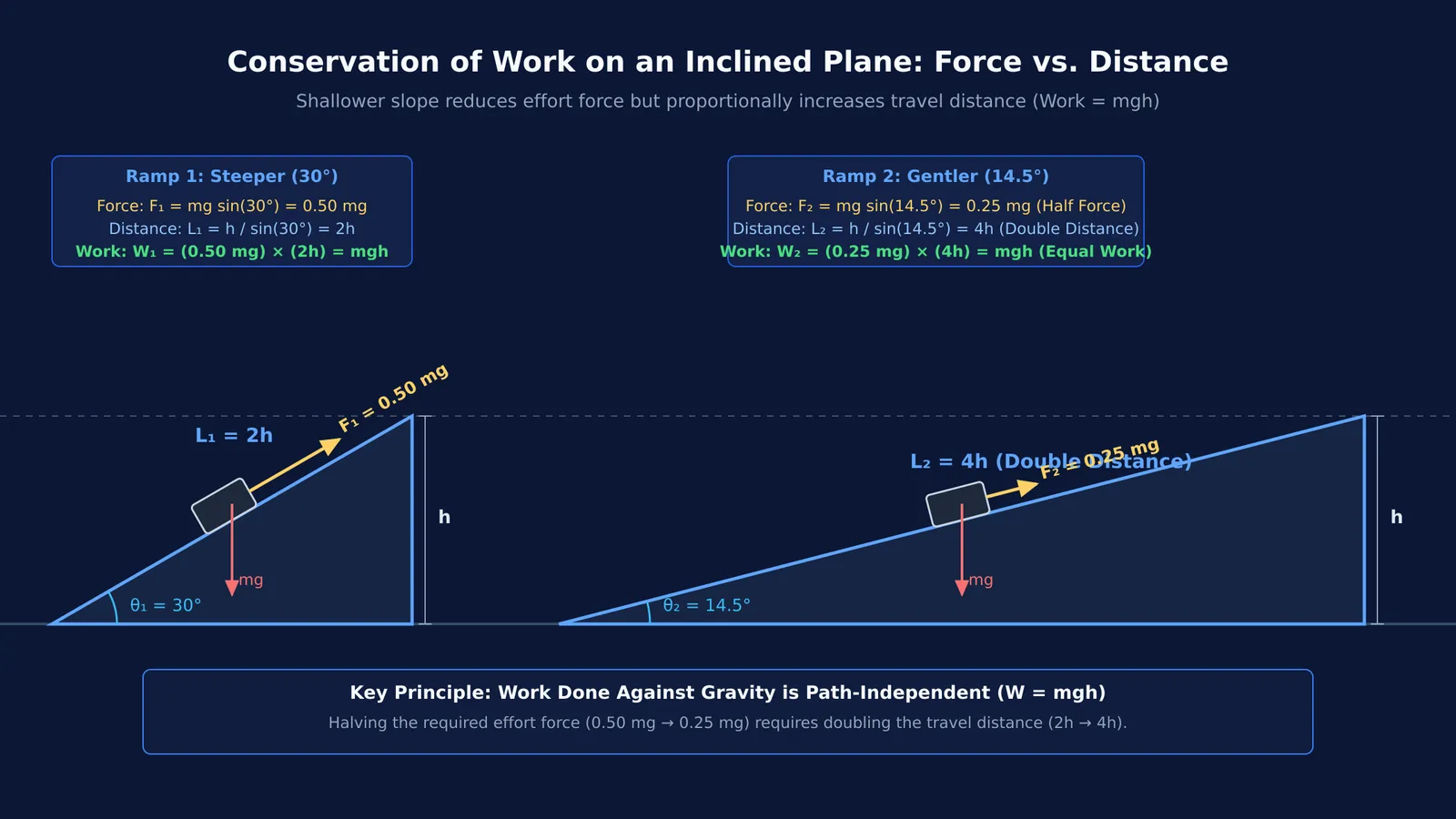
To move the load up the ramp at constant speed without friction, you must supply an upward push matching mg sin θ. As the inclination angle θ decreases, sin θ decreases, reducing the required push. However, reaching vertical height h requires traveling along the slope length L = h / sin θ.
In 1586, Simon Stevin demonstrated this equilibrium in *De Beghinselen der Weeghconst* using his "wreath of spheres" thought experiment, proving that the force supporting a weight along an incline of given height is inversely proportional to the length of the incline. As explained in OpenStax College Physics, simple machines multiply input force at the expense of the distance over which it is applied: by conservation of energy, the mechanical advantage of an ideal inclined plane equals the ratio of slope length to vertical height, L / h = 1 / sin θ. A 30° ramp has an ideal mechanical advantage of 2, cutting required push by 50% while doubling the path length.
How does the Predict-Observe-Explain method test ramp forces?
Students often assume that using a ramp reduces total work, confusing physical effort with mechanical energy. In science education research, Richard F. Gunstone and Richard T. White (1981) introduced the Predict-Observe-Explain (POE) sequence to address such misconceptions:
Predict: Students predict the required push force and total work for different ramp angles, recording written justifications.
Observe: Students pull a wheeled cart up 30° and 14.5° ramps using a spring balance or force sensor, measuring applied force and distance.
Explain: Students multiply force by distance, comparing results to their predictions to understand why force decreased while work remained unchanged.
A 2010 study in *The Physics Teacher* by Carl E. Wieman and colleagues demonstrated that interactive simulations provide dynamic feedback that lets students test variables without measurement error.
For learners exploring force vectors before lab experiments, the Fermi Simulation Lab offers interactive simulations for ideas that are easier to see than to read.
Does a gentler ramp actually save total work?
According to OpenStax College Physics, the work done against gravity depends solely on the vertical elevation gained (W = mgh) and is independent of the path taken. To test whether ramps reduce energy, consider lifting a crate of mass m = 20 kg to a height h = 1.0 m (taking g = 9.8 m/s², giving a weight of 196 N).
Compare three frictionless cases:
Direct vertical lift (θ = 90°): Force is 196 N over 1.0 m, giving work W = 196 N × 1.0 m = 196 J.
Moderate ramp (θ = 30°, sin 30° = 0.5): Length L = 2.0 m. Force is 196 N × 0.5 = 98 N. Work W = 98 N × 2.0 m = 196 J.
Gentle ramp (θ = 14.48°, sin θ = 0.25): Length L = 4.0 m. Force is 196 N × 0.25 = 49 N. Work W = 49 N × 4.0 m = 196 J.
Because gravity is a conservative force, halving the required push doubles the distance, leaving total work unchanged. For problems involving changing forces, see our guide to calculating work from a force-displacement graph.
How does friction change the force-distance trade-off?
In real-world tests, friction alters the balance. As detailed in OpenStax College Physics, the normal force N = mg cos θ generates a kinetic friction force f = μ mg cos θ that directly opposes motion up the slope. The push needed to maintain constant speed becomes F_push = mg sin θ + μ mg cos θ, making total input work W_total = mgh + μ mgh cot θ.
Assuming a kinetic friction coefficient μ = 0.10 for our 20 kg load:
On the 30° ramp (L = 2.0 m): Friction is 16.97 N, total push is 114.97 N, and total work is 114.97 N × 2.0 m = 229.94 J.
On the 14.48° ramp (L = 4.0 m): Friction is 18.98 N, total push is 67.98 N, and total work is 67.98 N × 4.0 m = 271.92 J.
On the gentler ramp, the push drops from 114.97 N to 67.98 N (41% less force), but total work increases by 41.98 J due to friction.
For sliding dynamics down slopes, consult our article on calculating motion for a block sliding down an incline. For static friction limits, see our review of the angle of repose and friction.
When practicing mechanics problems with multiple forces, the Fermi Problem Library provides worked problems with a step-by-step solver that explains the reasoning rather than printing an answer.


