

On this page
A mechanic can lift a two-tonne car with a simple push of a handle. This everyday feat relies on an application of fluid mechanics that acts like a liquid lever, trading a long, easy push for a short, powerful lift. The secret behind this mechanical advantage lies in the behaviour of fluids under pressure.
How does Pascal's principle multiply force?
According to the OpenStax College Physics textbook, Pascal's principle states that a change in pressure applied to an enclosed fluid is transmitted undiminished to all portions of the fluid and to the walls of its container.
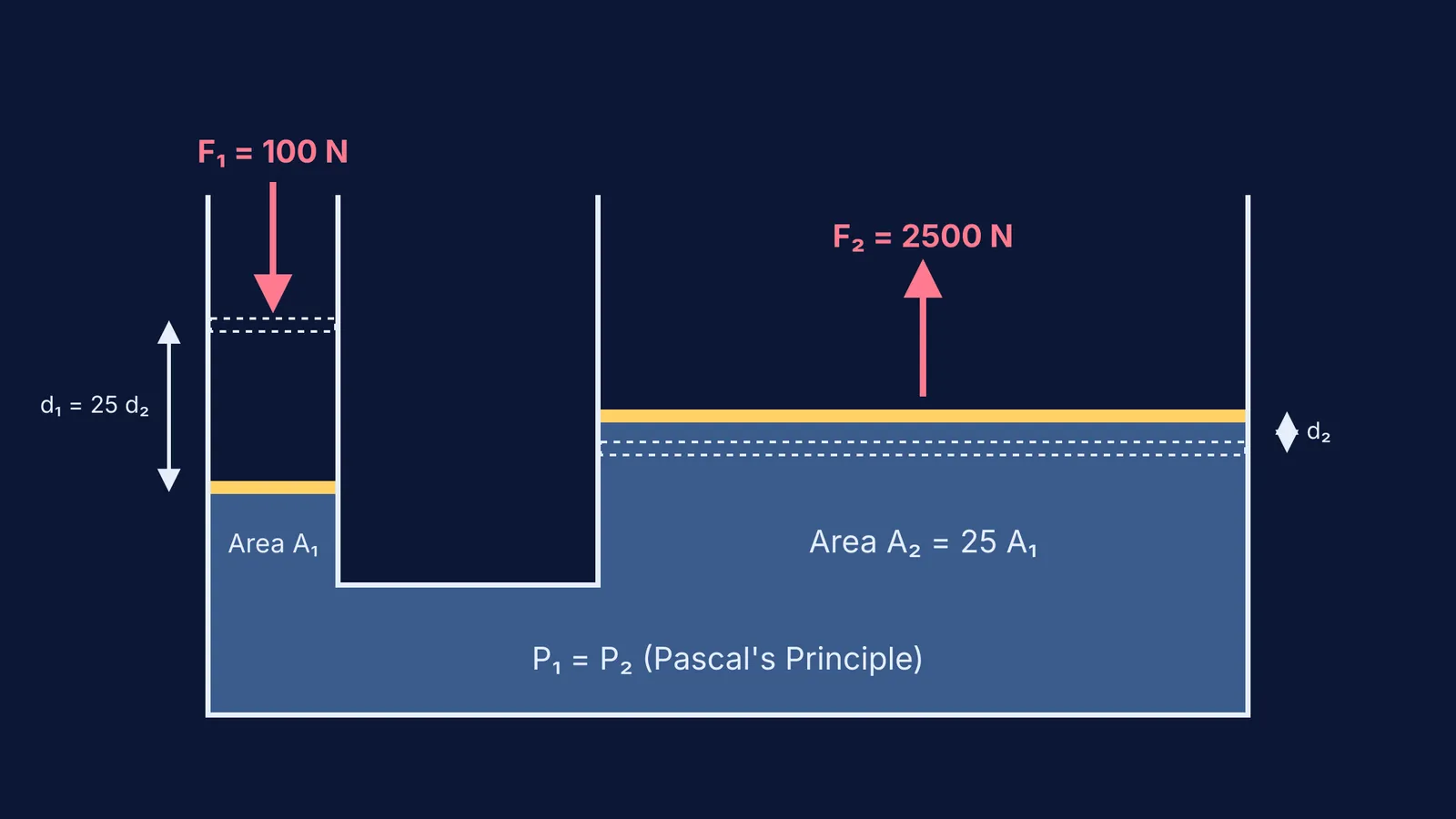
Because pressure (P) is defined as force (F) divided by area (A), maintaining the same pressure across a system of varying sizes produces a mechanical advantage. You apply a small input force (F₁) to a small piston with area A₁. The fluid transmits this pressure to a larger piston with area A₂. Because the output area is larger, the output force (F₂) must scale up to keep the ratio identical (P = F₁ / A₁ = F₂ / A₂). This simple relationship is why hydraulic lifts are often called force multipliers. They allow us to bypass human physical limitations by shifting the mechanical burden onto the fluid system.
For example, if the large piston has an area 25 times that of the small piston, your input force is multiplied by that same ratio of 25. A 100 N push can successfully balance a 2,500 N load. You can see more examples of these calculations in our guide to Pascal's law in hydraulic machines.
Where else is this mechanical advantage used?
This multiplication of force is not limited to lifting cars in garages. It forms the basis of many systems where large forces are required from human-scale inputs or small pumps.
Automotive brakes use the exact same physics. When a driver presses the brake pedal, they exert a force on a small pedal cylinder. The enclosed brake fluid transmits this pressure to wider wheel cylinders at each wheel. Because the wheel cylinders have a larger cross-sectional area, they multiply the driver's braking force to safely halt a fast-moving vehicle without requiring immense leg strength.
Nature also takes advantage of hydraulics. According to the OpenStax text, jumping spiders rely on pressurized fluid in their legs rather than muscles alone, generating enough hydraulic force to propel themselves 25 times their own body length. Similarly, bulldozers and heavy earth-moving equipment use engine-driven pumps to pressurize fluid, distributing massive forces across heavy steel arms to crush rock and move soil.
Why do you pay in distance for a big load?
While a hydraulic system multiplies force, it cannot multiply energy. The work you put into the system must equal the work you get out, in accordance with the strict conservation of energy. Crucially, this assumes the fluid is completely incompressible, meaning its volume does not change when squeezed.
Work is calculated as force multiplied by distance (W = F × d). To lift a heavy load a small distance (d₂), the much smaller input force must be applied over a proportionally larger distance (d₁). The volume of fluid displaced by the small piston exactly matches the volume that fills the wide cylinder. Pushing one litre of fluid through a narrow pipe requires a long stroke, but that same litre barely raises the fluid level in a wide barrel.
If you are struggling to picture this volume exchange in action, the Simulation Lab provides interactive simulations where you can drag the small piston and watch how the large one responds. Experimenting directly helps build an intuitive feel for the distance trade-off before you tackle exam numericals.
How do you set up a hydraulic lift calculation?
Whether you are programming a simulation or solving a physics problem on an exam, predicting the forces and distances follows a reliable framework.
Find the mechanical advantage: Divide the area of the large piston by the area of the small piston (A₂ / A₁). If you are given diameters or radii instead of areas, remember that area scales with the square of the radius (r²). For instance, doubling the radius quadruples the area and the mechanical advantage.
Predict the required force: Divide the weight of your heavy load by the mechanical advantage to find your required input force. Many students mistakenly swap the areas in the first step, resulting in a calculated force that is larger rather than smaller. Always check that your mechanical advantage is greater than one when you are lifting a heavy object with a small effort.
Calculate the distance penalty: Multiply your target lifting distance by the mechanical advantage. This tells you how far the small piston must be depressed to displace enough fluid.
When solving complex mechanics problems, this step-by-step approach ensures you check both the force and the distance before writing your final answer. Mastering these fundamentals is critical for scoring well on physics papers. For similar mechanics frameworks, see our walkthrough on calculating minimum pull forces.


