

On this page
You tap Pay, and in a fraction of a second software decides whether the payment looks like you. Usually the money moves; sometimes an honest payment, like a train ticket at midnight, gets stopped. Both come from the same machine-learning systems.
How does AI detect fraud in UPI payments?
A fraud model is a program trained on past payments, some later confirmed as fraud, so it learns which patterns tend to come before a loss. For each new payment it produces a risk score: how unusual the payment looks compared with your normal behaviour and with known fraud. Above a threshold, the payment is flagged for a block or an extra check.
In a March 2026 Rajya Sabha reply, the government said banks have been advised to use real-time transaction monitoring, AI and machine-learning tools, and network analytics to identify mule networks. The same reply says the RBI's MuleHunter.AI, a machine-learning system for spotting mule accounts, is live in 26 banks and is being scaled up.
A money mule is an innocent person duped into laundering stolen money through their own bank account, as the RBI's BE(A)WARE booklet puts it. The booklet describes money passing along a chain of mule accounts, a pattern that shows across accounts rather than in one. In May 2026 the government's cybercrime centre, I4C, agreed to share its Suspect Registry with the RBI's innovation hub to train fraud-risk models including MuleHunter.ai.
Why do genuine payments get blocked?
The short answer is rarity: to catch a few bad payments, a model has to be suspicious of many normal ones.
A widely used research dataset of European card payments shows how rare: 492 frauds among 284,807 transactions, or 0.172%, described in a 2015 study by Andrea Dal Pozzolo and colleagues. UPI's own fraud rate is not in that dataset, but the lesson carries over: when what you are hunting is rare, false alarms can easily outnumber true ones unless the model is close to perfect.
A large amount, a first payment to a stranger, a new phone or several payments in a few minutes can all look unusual for you. None proves fraud, but each can push the score up.
What does a fraud flag mean in numbers?
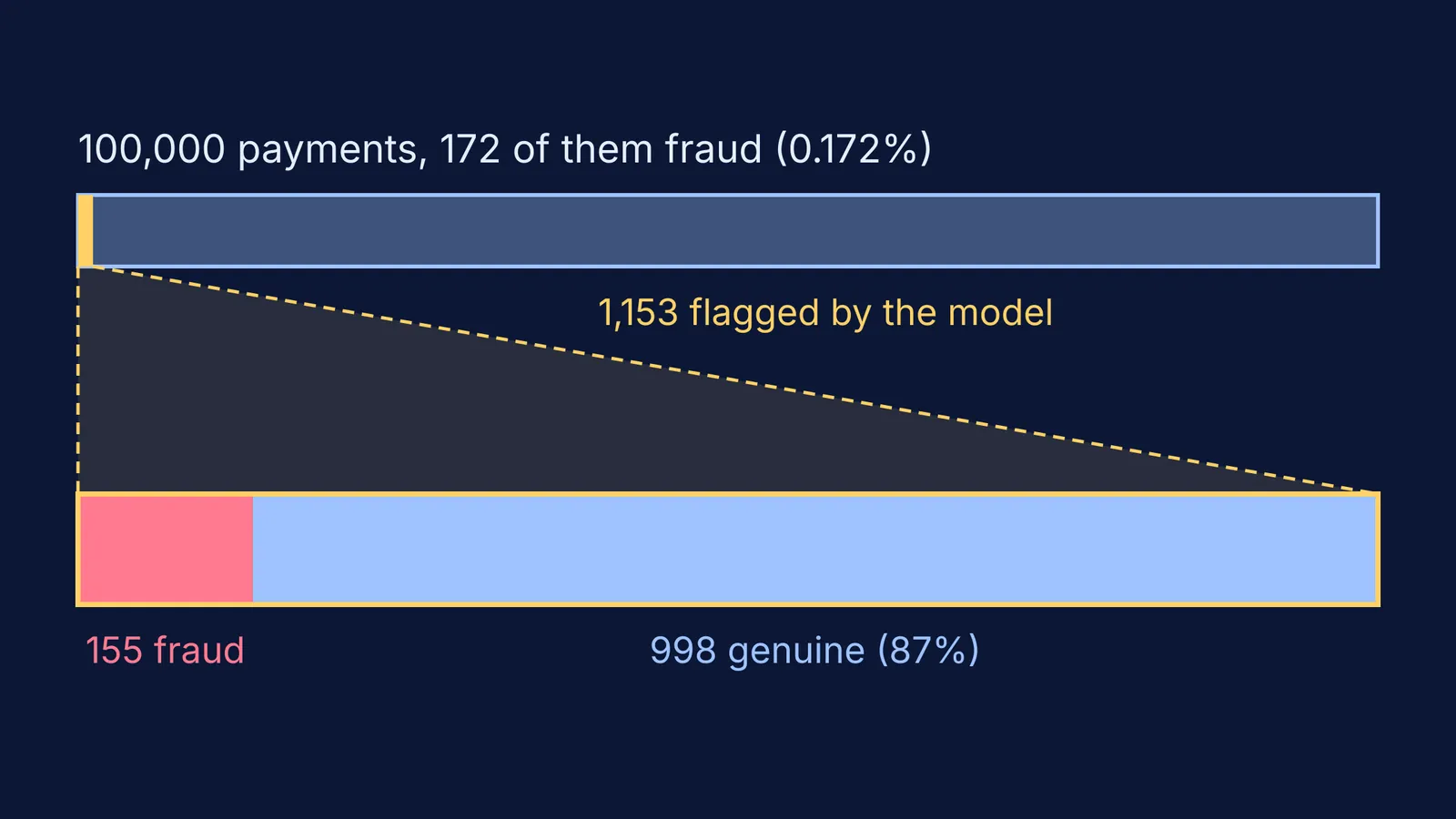
Take 100,000 payments at that dataset's 0.172% fraud rate, and imagine a model (our illustration, not any real bank's) that catches 90% of fraud and wrongly flags 1% of genuine payments.
Fraudulent payments: 0.172% of 100,000 is 172.
Caught: 90% of 172 is about 155, so 17 slip through.
Genuine payments: 100,000 minus 172 is 99,828.
Wrongly flagged: 1% of 99,828 is about 998.
Total flagged: 155 plus 998 is 1,153.
So about 87 in every 100 flagged payments are genuine: roughly six honest payments blocked for every fraud stopped. This is Bayes' theorem at work; practise it with our guide to conditional probability and Bayes' theorem. The same trap explains why AI-writing detectors misfire on honest students.
If those steps felt shaky, the Fermi Concept Library has a lesson for every concept in mathematics, including probability.
How can students stay safe from UPI scams?
The bank's model is a safety net, not a guarantee. Many scams talk you into approving the payment yourself, which can look normal to a model because it really is you. This checklist comes from the RBI's BE(A)WARE booklet.
You never need to enter your UPI PIN to receive money. If an app asks for your PIN, you are sending money.
Never scan a QR code to receive money.
Banks, the RBI and genuine companies never ask for your password, card details, CVV or OTP. Don't share them, even with friends or family.
Never let anyone use your account to receive or pass on money for a fee. That makes you the money mule, and the RBI warns this can land you in serious trouble with the police.
Install apps only from sources you have checked, never from a link a stranger sends.
For the syllabus side, see our note on cyber safety in CBSE computer science.
What should you do if you have been scammed?
Act fast, and don't let embarrassment slow you down.
Call 1930, the toll-free helpline for cyber complaints listed in a Ministry of Home Affairs update, or report at cybercrime.gov.in, the National Cyber Crime Reporting Portal.
Call your bank using the number in its official app or on your card.
Save screenshots of the chat, the UPI ID and the transaction reference.
Speed matters because the government's fraud reporting system, CFCFRMS, exists to stop fraudsters moving money on. Up to 30 June 2026, it had saved more than Rs 11,158 crore across more than 32.80 lakh complaints, according to the same ministry update.
Want to see the maths behind models like these? Fermi's AI tutor works out what you already know and builds a plan for the session, so you can work through the probability above one step at a time.


