

On this page
Automated essay scoring is software that predicts the mark a trained human would give a piece of writing, by measuring features of the text. ETS, which runs the GRE, describes how its e-rater engine learns in a 2005 research note by William Monaghan and Brent Bridgeman: it is fed thousands of essays that human raters have already scored and looks for the patterns found in better ones.
So the machine copies human judgements; it does not read for meaning. Newer deep-learning scorers work differently inside, but as you will see below, they share some of the same blind spots.
What features does automated essay scoring look at?
ETS researchers Yigal Attali and Jill Burstein listed the features of e-rater version 2.0 in a 2004 conference paper:
Errors: rates of grammar, usage, mechanics and style problems, each divided by the number of words.
Organisation: whether the software finds a thesis, main points, supporting ideas and a conclusion.
Vocabulary: the share of different words, how rare the words are, and average word length.
Topic words: how closely your words match those in essays at each score level on the same question.
Length: the number of words.
The same paper calls essay length "the single most important objectively calculated variable in predicting human holistic scores".
What does a scorer see in a sample answer?
Question: why does a ball rolling on grass slow down and stop? We counted two answers by hand. This illustrates the features above; it is not output from a real engine.
Answer A: "Friction from the grass acts opposite to the motion and removes kinetic energy." 13 words, average word length 5.1 letters, no grammar errors. Correct.
Answer B: "In the fascinating world of physics, motion is a phenomenon of considerable significance, and the ball, consequently, demonstrates that energy is fundamentally transformed by gravity pulling it forward." 28 words, average word length 6.1 letters, no grammar errors. Wrong: gravity does not pull a ball forward on flat ground.
On length and vocabulary, B wins. Neither feature knows any physics. A human examiner gives A the mark in seconds.
How can automated essay scoring be gamed?
Because the features are proxies, you can push them up without writing anything true. Les Perelman, a former director of undergraduate writing at MIT, built the BABEL generator with MIT and Harvard students; it turns a few keywords into fluent nonsense, and in 2014 one of its essays scored 5.4 out of 6 on an online writing product.
Newer models share the weakness. A 2020 study by Anubha Kabra and colleagues tested five recent scoring models, from feature-based ones to deep learning, and found that modifying as much as 25% of an essay with off-topic content did not lower the score, while irrelevant content on average raised it.
ETS has said as much itself. The 2005 note agrees with critics that such systems "can be fooled by clever nonsense", and points out that a human reader in the scoring model would detect such cases.
Why do exams still use human markers?
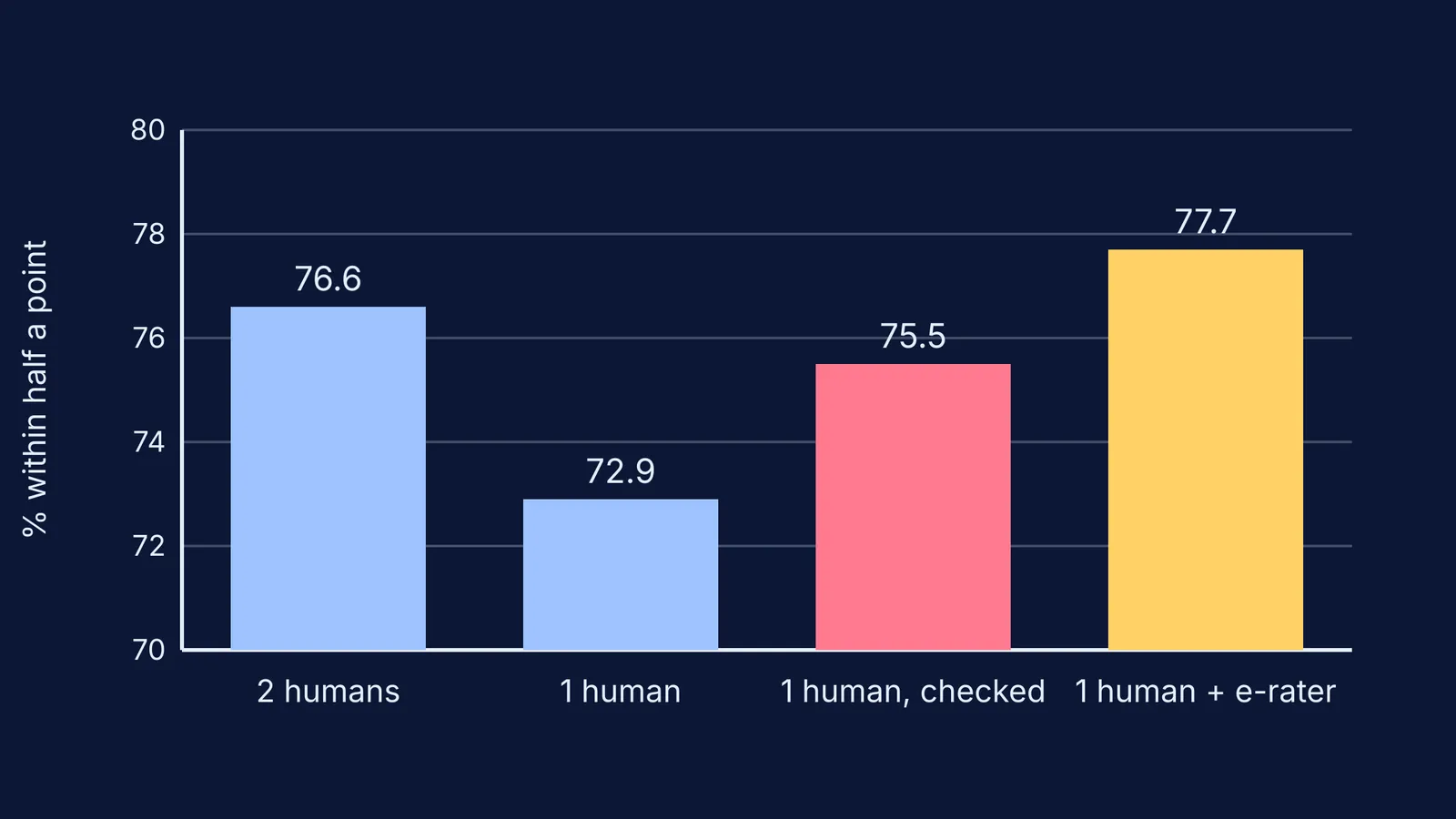
In the Monaghan and Bridgeman note, an ETS study tested e-rater as a check on GRE essays: if the machine and one human reader disagreed, a second human read it, so the score always rested on human raters. In that study the check sent about 15% of essays to a second reader. On argument prompts, two humans' scores correlated at 0.81, and a human's and e-rater's at 0.76.
The GRE still pairs the two: the 2026-27 GRE score guide says Analytical Writing responses are evaluated on a 6-point holistic scale that includes a score from e-rater.
In India, board answers are still read by people. When CBSE moved Class 12 evaluation to on-screen marking in 2026, teachers began assessing answer books on screen while the system takes over totalling marks; the judging stayed human.
How should you use AI feedback on your answers?
AI feedback is quick at surface errors. Use it for that, and keep the judgement about content for yourself and your teacher.
Fix what it does well: spelling, grammar, overlong sentences, repeated words.
Distrust a score that rose because you added words. Ask whether each new sentence answers the question.
Check content against the official marking scheme; our guide to using CBSE marking schemes shows how examiners award marks.
Ask a teacher to read one answer a week. Our piece on how teachers use AI for feedback covers what studies show so far.
If a tool flags your work as AI-written, read why AI-writing detectors misfire before you worry.
For science answers, the question a scoring engine cannot ask is whether your reasoning is right. The Fermi Problem Library has worked problems with a step-by-step solver that explains the reasoning rather than printing an answer, and Fermi's AI tutor checks understanding as it goes, so you find the gap in your physics before an examiner does.


