

On this page
A formula you know as the answer to someone's real problem is easier to rebuild than a string of letters. An AI chatbot is a quick way to get that story, as long as you treat its answer as a lead to check, not a fact.
Why ask what problem a formula was invented to solve?
Asking "why is this true?" is a study technique with a name. In a 2013 review of ten learning techniques, Dunlosky and colleagues looked at elaborative interrogation, where learners explain why a stated fact is true. It rated the technique of moderate utility, noting that it had not yet been adequately evaluated in real educational settings (Dunlosky et al., 2013). So it is a sensible habit, not a magic one.
What problem was Ohm's law invented to solve?
Georg Simon Ohm did his work on resistance in 1825 and 1826 and published it in 1827 as the book Die galvanische Kette, mathematisch bearbeitet (Wikipedia: Ohm's law). His question was practical: how well do different metal wires conduct, and how does the current change when you swap in a longer or shorter wire?
The story has a wrong turn in it. From his first experiments in 1825, Ohm concluded that a wire's conductivity and the deflection of his measuring needle were linked by a logarithmic law, and he revised this a year later using a thermocouple as the voltage source (University of Flensburg, history of physics collection). A 2022 Cambridge PhD thesis that reconstructed his 1826 apparatus describes the same move from a voltaic pile to a thermocouple (Connelly, 2022).
Ohm's data fitted x = a/(b + l), where x was the galvanometer reading and l the length of the test wire (Wikipedia: Ohm's law). In modern terms, a and b work out as E/ρ and r/ρ, with E the thermocouple's emf, r its internal resistance and ρ the wire's resistance per unit length. Put those back in and you get I = E/(r + R), where R = ρl is the wire's resistance (Wikipedia: Ohm's law). The internal resistance was in the law from the start, in the same cell-with-internal-resistance form that board and JEE Main circuit questions use.
What problem did the ideal gas law solve?
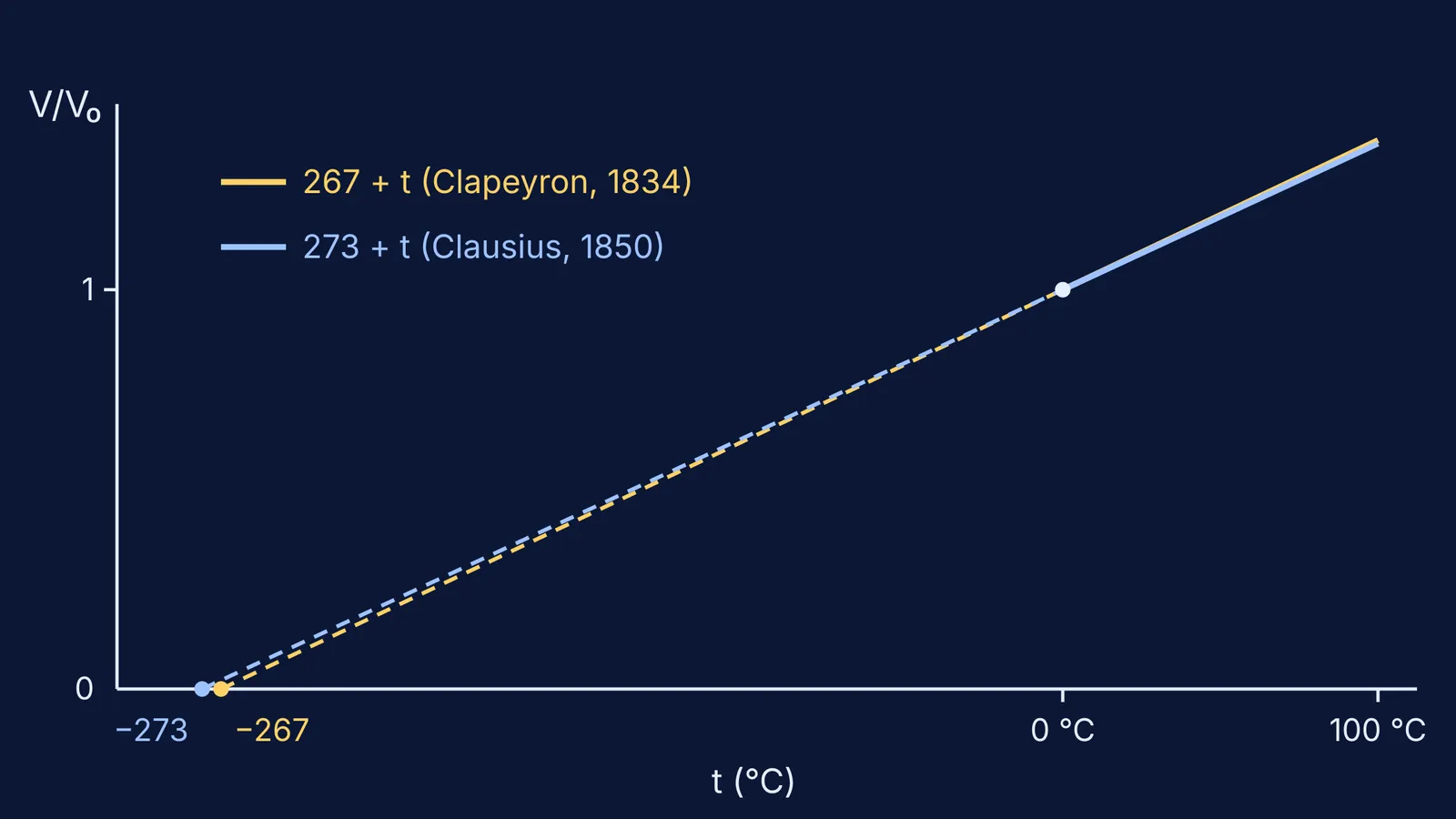
The ideal gas law grew out of the study of heat engines. In his 1834 memoir on the motive power of heat, the French engineer Émile Clapeyron appears to have been one of the first to combine Boyle's law (1662) and Gay-Lussac's law (1802) into one equation, pv = R(267 + t), with t in degrees Celsius (Jensen, Journal of Chemical Education, 2003).
Three details from that history make PV = nRT easier to remember:
In 1850 Rudolf Clausius used Henri Regnault's data to correct 267 to 273, and in 1864 wrote it as pv = RT (Jensen, 2003).
Clapeyron's and Clausius's R was per unit mass, so it changed from gas to gas; Clausius's student August Horstmann wrote it per mole, as a universal constant, in 1873 (Jensen, 2003).
Clausius introduced the term "ideal gas" in 1864 for gases far from condensing, where the law works best (Jensen, 2003).
Now the n in PV = nRT has a reason to be there, and "ideal" tells you when to distrust the law.
How do you ask AI about a formula's history and check it?
Use this prompt, filling in the formula:
"What practical problem was [formula] first written to solve, and by whom?"
"What did the first published version look like, and what did each symbol mean then?"
"What did the inventor get wrong or change before the final version?"
"Give the original publication's title and year so I can check it."
Then check the answer:
Find each name, date and original equation in one source you can open: a history-of-science article, a museum or university page, or the original paper.
Be suspicious of tidy stories. If the AI says Ohm "measured voltage and current", note that what he actually recorded was a galvanometer reading against the length of the test wire.
If a reference looks invented, test it the way our guide to checking AI-made-up sources and citations shows.
Keep only what you verified, in two lines: the problem, and the first form of the formula.
For checking physics working too, see when AI gets physics wrong and how to check its solution, and these ChatGPT prompts for physics that make you think.
What should you do after the history?
Solve one problem with the formula straight away, using your two-line card instead of the formula sheet: a cell with internal resistance, or R per gram for one gas.
The Fermi Concept Library gives every concept in physics, chemistry, biology, mathematics and computing its own lesson and its place in the map, so you can see what a formula grew out of. And Fermi's AI tutor can work out what you already know and build a plan for the session, then check your understanding as you go.
Pick one formula from this week's chapter tonight and write its two-line card.


