

On this page
When a colloidal solution—or sol—refuses to settle, the particles are usually bouncing off each other because they carry the same electrical charge. To force them to clump together (coagulate), you must add an electrolyte containing ions of the opposite charge.
But not all electrolytes are equally effective. If you have a negatively charged sol, how do you decide whether to use a sodium (Na⁺), barium (Ba²⁺), or aluminium (Al³⁺) salt? The answer lies in the valency of the added ion.
What is the Hardy-Schulze rule?
The Hardy-Schulze rule is a fundamental principle in surface chemistry stating that an ion's coagulating power depends on its valency. Specifically, the greater the valency of the counter-ion (the ion with a charge opposite to that of the colloidal particles), the greater its ability to cause coagulation.
For a negative sol, the active coagulating ions are cations. According to the rule, their coagulating power follows the order of their positive charge: Al³⁺ > Ba²⁺ > Na⁺ (Unacademy).
When you understand this, predicting coagulation becomes straightforward. You do not just look at the chemical; you look at the charge of the active ion it releases into solution.
How do you calculate flocculation value?
To measure this coagulating power in the laboratory, chemists use the flocculation value. This is defined as the minimum concentration of an electrolyte, expressed in millimoles per liter (mmol/L), required to cause complete coagulation of a sol within two hours (Sarthaks).
The test involves taking a fixed volume of the colloidal solution in a test tube, adding varying known concentrations of the electrolyte, and observing the mixture. If the colloid precipitates and settles at the bottom within the two-hour window, that concentration is marked as effective.
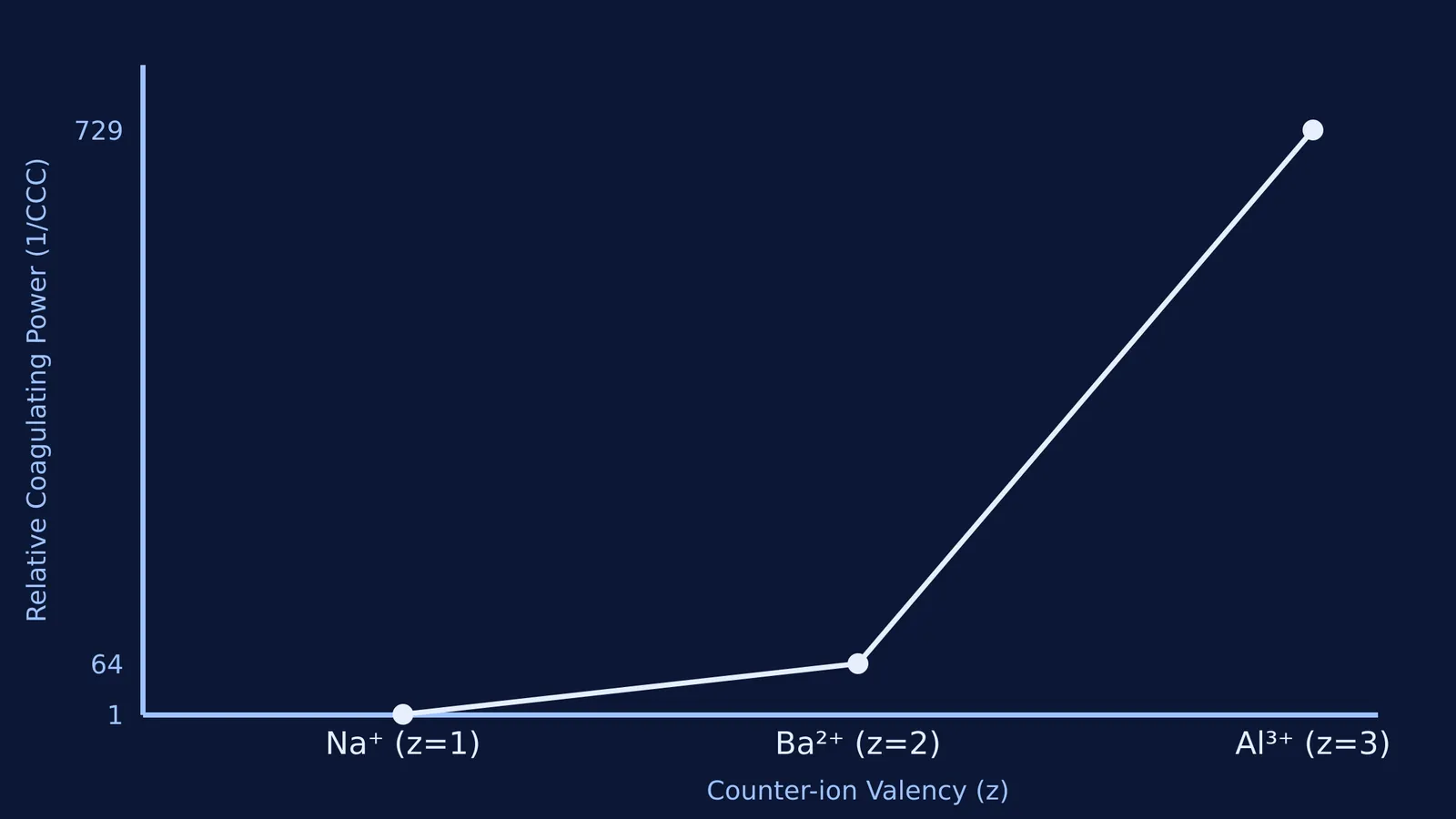
The flocculation value is inversely proportional to coagulating power. Because Al³⁺ is an extremely powerful coagulant, it takes a very small concentration to destabilize the colloid. Conversely, Na⁺ has a weak coagulating power, so you need a much higher concentration to achieve the same effect.
Which ion coagulates a negative sol fastest?
If you are running a simulation to test which ion works fastest on a negative sol like arsenic sulphide (As₂S₃), Al³⁺ will always win.
The physics behind this gap is well understood. The interaction is described by DLVO theory—named after Derjaguin, Landau, Verwey, and Overbeek—which models the balance between attractive and repulsive forces in a liquid. Under this theory, the minimum concentration required to coagulate a sol scales inversely with the sixth power of the counter-ion's valency, or 1/z⁶ (Wikipedia: DLVO theory).
In practice, this means Al³⁺ causes rapid coagulation almost instantly, while a dilute Na⁺ solution might take hours or fail entirely. If you want to visualize how different ions compress the electrical double layer around a colloid, the Fermi Simulation Lab lets you run a virtual sol, swap the electrolyte valency in real time, and watch the particles aggregate as you cross the flocculation threshold.
A checklist for predicting coagulation
You can predict the most effective coagulant for any sol by following these four steps:
Identify the sol's charge: is it a positive sol (like Fe(OH)₃) or a negative sol (like As₂S₃ or clay particles in water)?
Find the counter-ion: look at the electrolytes you can add. The active ion is the one with the opposite charge to your sol.
Compare valencies: write down the charge of each counter-ion. For a negative sol, compare the cations (e.g. Na⁺, Ca²⁺, Al³⁺).
Rank the power: the ion with the highest numerical valency will have the lowest flocculation value and act as the strongest coagulant.
Just as understanding micelles and hard water explains why soap fails in the presence of Ca²⁺, knowing the Hardy-Schulze rule explains how we purify drinking water and treat industrial wastewater on a massive scale. Richard Zsigmondy first observed these colloidal particles directly using the ultramicroscope; today, knowing the electrostatic rules that govern them allows us to manipulate their behaviour predictably. If you are preparing for chemistry exams, predicting these flocculation orders from basic valency is one of the most reliable ways to secure marks.


