

On this page
When you mix gases in a chemical reaction, their volumes follow a remarkably simple pattern. Before we understood atoms, molecules or the mole concept, chemists noticed that reacting gases always combine in neat, whole-number volume ratios.
This observation is the heart of Gay-Lussac's law of combining volumes. If you are learning stoichiometry or preparing for exams, mastering this law gives you a quick and reliable way to predict the amount of product a gas reaction will yield without converting to masses first.
What is Gay-Lussac's law of gaseous volumes?
The law states that when gases react together to form other gases, the ratio between the volumes of the reactant gases and the products can be expressed in simple whole numbers, provided all volumes are measured at the same temperature and pressure.
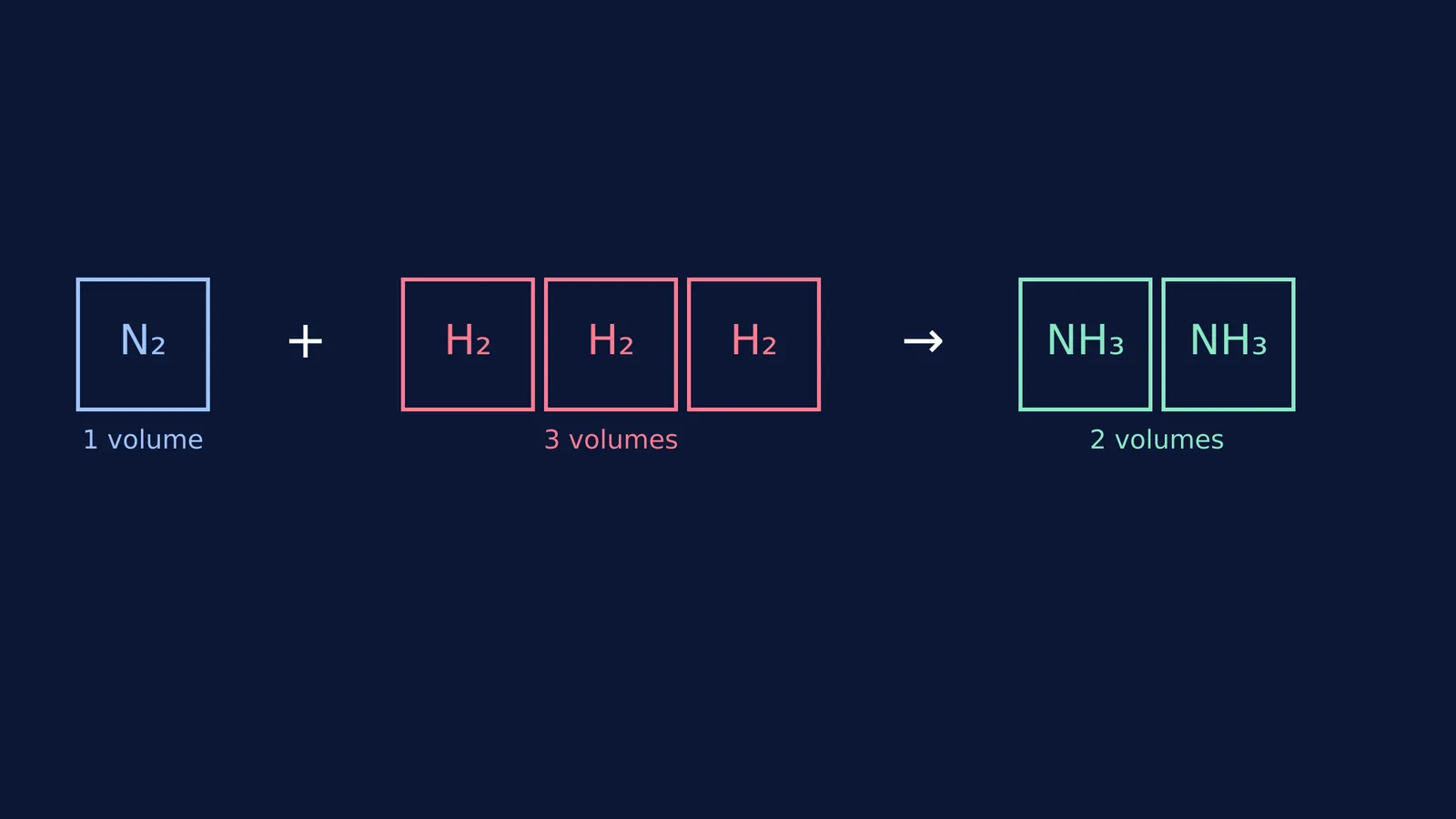
The classic example is the industrial synthesis of ammonia, known as the Haber process. This is a crucial reaction in modern chemistry. The balanced chemical equation is: N₂ (g) + 3 H₂ (g) → 2 NH₃ (g)
Because of Gay-Lussac's law, you can read the stoichiometric coefficients directly as volumes. This means exactly 1 volume of nitrogen reacts with 3 volumes of hydrogen to form 2 volumes of ammonia. There are no fractions or messy decimals to deal with. If you double the amount of nitrogen, you simply double the required hydrogen and the resulting ammonia.
How do you calculate gas volume ratios?
To predict gas volumes, start with a balanced equation. Since the coefficients match the volume ratios according to Gay-Lussac's law, you can scale the amounts up or down linearly. This saves time, especially in multiple-choice exams where you might otherwise be tempted to convert volumes to moles using the ideal gas law.
Worked example: Predicting ammonia volume Suppose you have 50 mL of nitrogen gas and an excess of hydrogen gas at the same temperature and pressure. How much ammonia will be produced?
Write the ratio: From the balanced equation, the ratio of N₂ to NH₃ is 1 : 2.
Set up the proportion: 1 volume of N₂ yields 2 volumes of NH₃.
Calculate: 50 mL of N₂ × 2 = 100 mL of NH₃.
If you are limiting both reactants, you must find the limiting reagent first. For example, if you have 30 mL of N₂ and 60 mL of H₂, the hydrogen will run out first. Here is why: 30 mL of N₂ would need 90 mL of H₂ (a 1:3 ratio), which you do not have. Therefore, the reaction will use all 60 mL of H₂, react with 20 mL of N₂, and produce 40 mL of NH₃. You will be left with 10 mL of unreacted nitrogen.
You can explore similar gas properties in our guide to the average molar mass of a gas mixture or see how volumes change during the free expansion of an ideal gas.
Why is it important that temperature and pressure stay constant?
Gay-Lussac's law only works if the temperature and pressure are the same for all gases involved. Gases expand when heated and compress when put under pressure. If the conditions change during the reaction, a specific volume of nitrogen might hold a completely different number of molecules than an identical volume of hydrogen.
In a laboratory or industrial setting like the Haber process, reactions often happen at very high temperatures and pressures. As long as you measure the initial reactants and the final products under identical conditions, the 1:3:2 volume ratio remains perfectly intact. If conditions change, you would need to use the combined gas law to correct the volumes before comparing them. If you are exploring how conditions shift equilibrium, our notes on adding an inert gas to an equilibrium explain constant volume versus constant pressure scenarios.
How does a simulation help?
Reading about volume ratios is one thing, but picturing them helps the concept stick. When students struggle to see why three volumes of hydrogen shrink down into two volumes of ammonia, setting up a gay lussac law of gaseous volumes simulation makes the math concrete.
The Fermi Simulation Lab offers interactive simulations for the ideas that are easier to see than to read.
Fermi's AI tutor can also guide you through the calculation. Instead of simply giving you the final volume, it holds a line of reasoning, asking you to identify the limiting reagent first and writing on a board until the process makes sense.
Next time you face a stoichiometry problem involving gases, remember that the balanced equation gives you the exact volume ratio. Balance the equation, find your limiting gas, and scale the volumes accordingly.


