

On this page
Most learning apps now count something: points for answers, badges for milestones, a flame for every day you show up, and a leaderboard to show where you rank. The research says these features can help you practise more, but only when what they count is the thing that makes you learn. When they count something easier, you end up chasing the counter.
Does gamification actually improve learning?
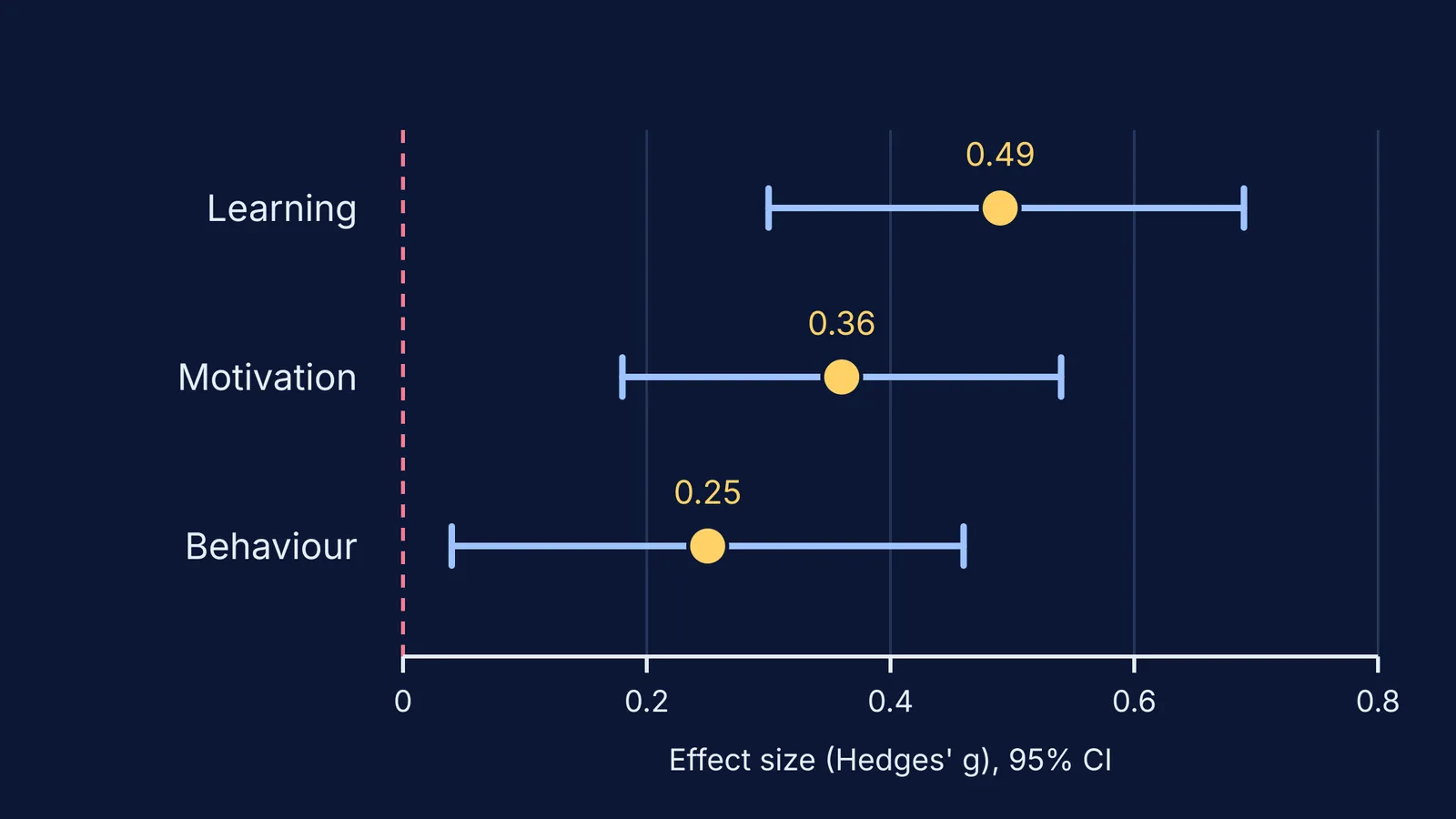
On average, a little. A widely cited summary is a 2020 meta-analysis in Educational Psychology Review by Michael Sailer and Lisa Homner, which pooled experiments comparing gamified and non-gamified teaching.
Learning (knowledge): effect size g = 0.49, from 19 comparisons with 1,686 learners.
Motivation (interest, engagement, confidence): g = 0.36, from 16 comparisons with 2,246 learners.
Behaviour (skills, such as doing a task well): g = 0.25, from 9 comparisons with 951 learners.
The authors call these small effects. Only the learning effect held up in the most rigorous studies, and mixing competition with collaboration worked especially well for behaviour. An earlier review by Hamari, Koivisto and Sarsa agreed: the effects are positive but depend heavily on context and on the users.
When do points, badges and leaderboards backfire?
A well-known warning comes from a 16-week classroom study by Michael Hanus and Jesse Fox. Two university classes had the same curriculum, but one added a leaderboard and badges. Over the semester, the gamified class reported less motivation, satisfaction and empowerment, and scored lower on the final exam, a drop the analysis linked to lower intrinsic motivation (enjoying the work for its own sake).
That fits an older result. A meta-analysis of 128 studies by Deci, Koestner and Ryan found that expected rewards for doing, finishing or doing well at a task reduced how often people chose it later, while positive feedback raised interest. Tangible rewards tended to do more harm to children than to college students. More in our piece on how rewards change motivation.
Leaderboards are not always bad. In a goal-setting experiment by Landers, Bauer and Callan, a leaderboard pushed people on a brainstorming task to perform about as well as difficult or even impossible goals did, as if they quietly aimed at or near the top. That helps when the top is within reach; it is worth asking what it does to the student ranked 40th.
Are streaks good for studying?
Streaks clearly change behaviour. Across seven studies, Silverman and Barasch in the Journal of Consumer Research found that showing people an unbroken streak made them more likely to do the activity again than showing them a broken one. The effect was stronger when people blamed themselves for the break and weaker when they could "repair" a streak.
Those studies measured whether people came back, not whether they learned. A streak counts days, not understanding, so it is easy to protect it with the shortest, easiest lesson. That is how gamification rewards the wrong behaviour: the counter rises while the hard practice gets skipped.
How do you tell if an app's game features are helping you?
Run this check on any app you use for revision:
What earns the points? Correct answers at your level: useful. Opening the app or watching a video: not.
Do hard questions pay more than easy ones? If not, the app pays you to avoid difficulty.
Does it bring old topics back? Spaced review beats new-topic badges; see our guide to spaced repetition apps.
Can you see your mistakes, not just your rank? A rank tells you where you stand; your mistakes tell you what to fix.
How does losing feel? If a broken streak makes you want to quit, use a weekly target instead.
A worked example: a Class 11 student's physics app gives the same points for every question. By week three they do dozens of easy kinematics questions a day and skip rotational motion. The fix is to change what they count: five rotational-motion problems a day that they can explain step by step, and the streak only counts those days.
If the score has become the goal, swap it for a better unit of work. The Fermi Problem Library has worked problems with a step-by-step solver that explains the reasoning rather than printing an answer, and Fermi's AI tutor works out what you already know and builds a plan for the session, so the next step comes from what you need rather than what scores points.
What should parents say about streaks and leaderboards?
Praise the process, not the number. Try: "Nice streak. Which question tripped you up today, and what will you try next time?" If your child is low on a class leaderboard, compare them with their own last week, not with the top ranker. See praising effort rather than ability for more.
If worry about rankings or streaks starts to affect sleep or mood, talk to a teacher or counsellor; in India, Tele MANAS offers free support on 14416.
Let game features remind you to show up, then judge each session by what you can now solve.


