

On this page
When you slide a textbook across your desk, you are doing work against friction. But if you take a longer, winding route to get the book to the same spot, does the friction cost you more energy?
The answer is yes. Friction is a non-conservative force, which means the work it does depends entirely on the path you take.
In physics, predicting the work done by friction along different paths is a standard test of whether you understand the difference between conservative and non-conservative forces.
Does the work done by friction depend on the path?
Yes. According to Wikipedia's entry on conservative forces, friction is the classic example of a non-conservative force because the work it performs depends on the specific path taken between two points.
If you push an object from point A to point B, friction constantly opposes the direction of motion. Because it never pushes the object forward, the work done by friction is always negative. Every extra centimetre you travel adds to the total negative work. This means a straight line costs the least work against friction, while a curved or winding path costs more.
This is fundamentally different from a conservative force like gravity. If you lift a mass from the floor to a shelf, the work done by gravity is exactly the same whether you lift it straight up or take it up a staircase. Gravity only cares about the start and end heights. Friction cares about every step of the journey.
Why is friction a non-conservative force?
A force is conservative if the work it does on an object moving around a closed loop—returning exactly to where it started—is zero.
Friction fails this closed-loop test. When you slide a box out and pull it back to the exact spot you started from, the work done by friction does not cancel out. Instead, the friction force flipped direction when you pulled the box back, so it did negative work on both legs of the trip. The total work done over the round trip is exactly the sum of the negative work from both legs, not zero.
This failure has a physical meaning: friction dissipates mechanical energy. It converts the kinetic energy of the sliding object into heat (and sometimes sound), which radiates away and cannot be perfectly recovered.
How do you compare work on straight and curved paths?
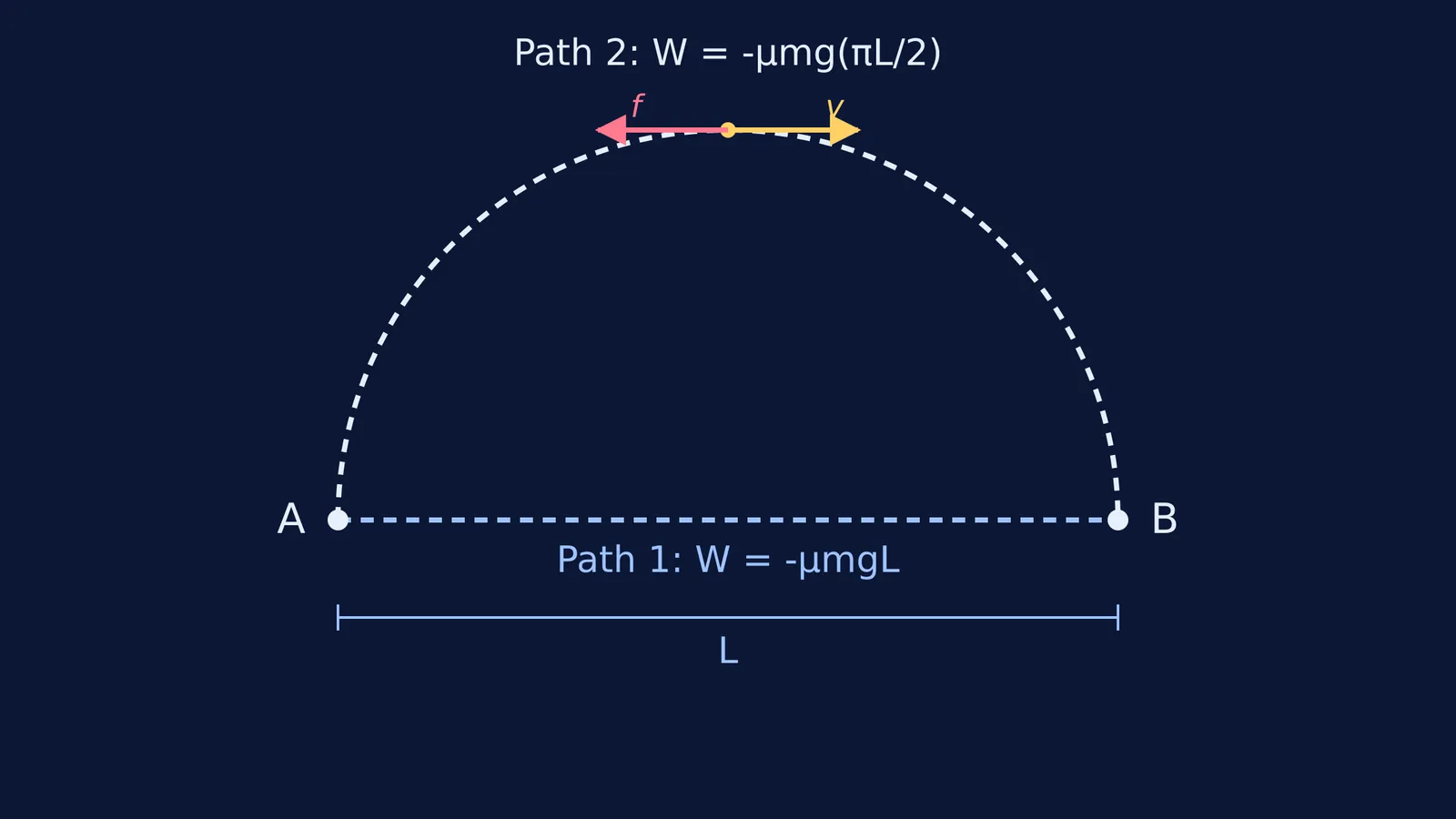
To see the path dependence clearly, let us compare the work done by friction when an object moves between two points, A and B, along two different routes.
The setup:
A block of mass m slides on a horizontal floor.
The coefficient of kinetic friction is μ.
The friction force magnitude is a constant F = μmg.
The straight-line distance between A and B is L.
Path 1: The straight line If you slide the block directly from A to B, the distance travelled is simply L. Work is force multiplied by distance. Since friction opposes motion, the work done is negative: Work = −μmgL
Path 2: The semicircular curve Now imagine sliding the block from A to B along a semicircular path. The radius of this semicircle is L/2. The distance travelled is the arc length of the semicircle, which is π × radius, or πL/2. The work done by friction is: Work = −μmg(πL/2)
Because the arc length is longer than the straight line, friction does more negative work. The start and end points are identical, but the work done is different.
If you are calculating the angle of repose and angle of friction for an inclined plane, the same path-dependence logic applies: the total work done by friction as a block slides down depends on the exact length of the incline it scrapes against.
How can you simulate the work done by friction along a path?
Visualising how a force constantly changes direction to oppose motion along a curved path can be tricky. On paper, it is easy to accidentally substitute the straight-line displacement for the total distance travelled.
If you find it hard to picture how forces act continuously along a curve, the Fermi Simulation Lab has interactive simulations for the ideas that are easier to see than to read. You can draw custom paths for an object to follow and watch how the total work done by friction accumulates in real time, compared to conservative forces where the net work in a cycle on an indicator diagram might be zero.
When you solve mechanics problems, always stop and ask whether the force you are dealing with is conservative. If it is friction or air drag, put away the displacement vector and start measuring the total distance.


