

On this page
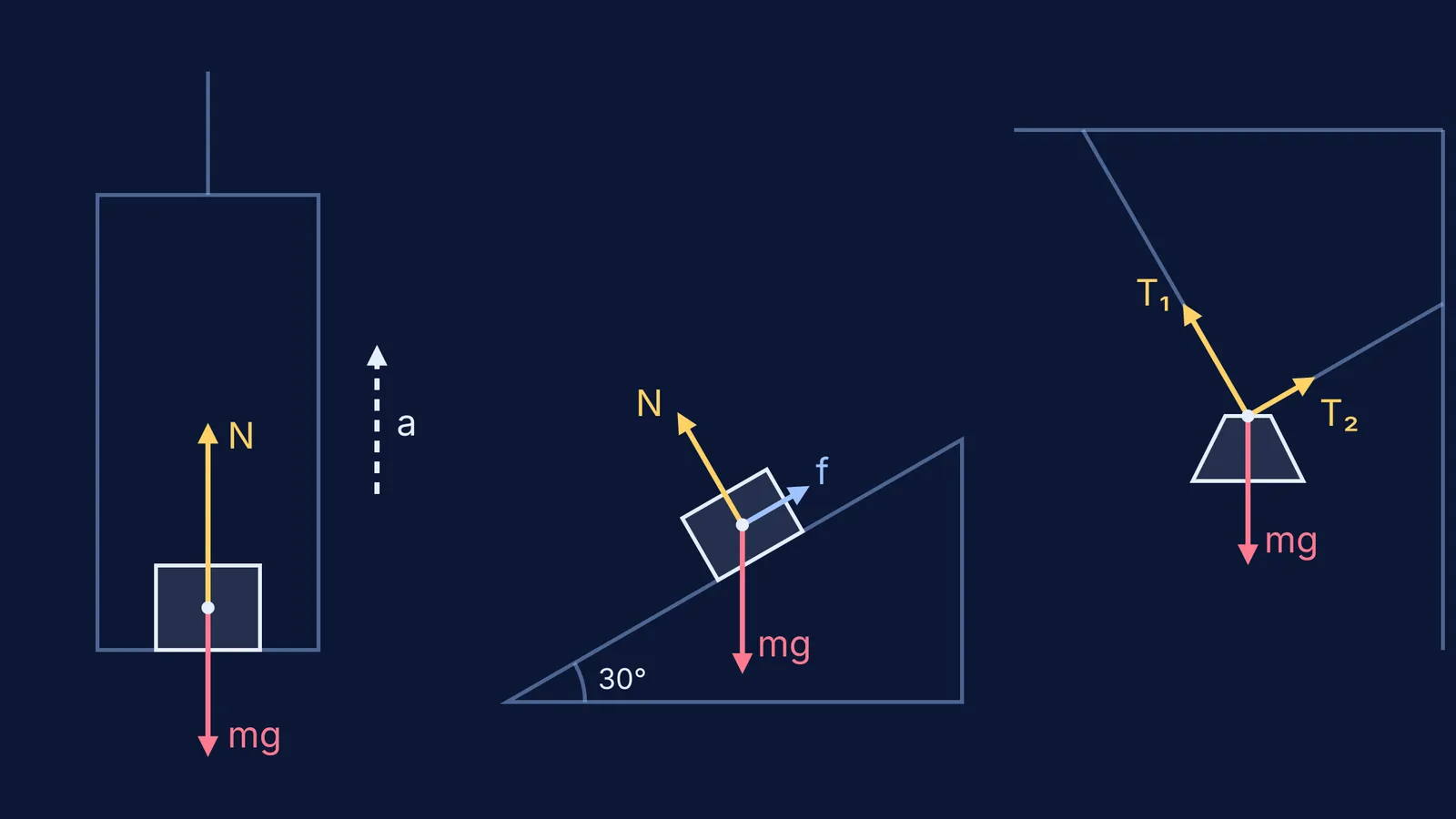
Getting the free-body diagram right comes before any algebra in a mechanics problem. Below are three to practise: a box in a lift, a block resting on a ramp and a lamp hung from two cables. For each one, cover the reveal, write down every force and the direction it points, and only then read on.
What is a free-body diagram?
A free-body diagram shows one object on its own, with every external force acting on it drawn as an arrow, according to the OpenStax University Physics guide to drawing free-body diagrams.
The same guide sets out rules worth keeping: do not include the net force as an extra arrow, draw a separate diagram for each body, and show any acceleration beside the diagram rather than on it. When you split a force into components, OpenStax puts a squiggly line through the original arrow so nothing is counted twice.
Why predict the forces before you see the answer?
In a study of classroom demonstrations, Catherine Crouch, Eric Mazur and colleagues found that students who only watched understood the concepts no better than students who never saw the demonstration, while students who predicted the outcome first showed significantly greater understanding.
The diagrams themselves pay off too. In a two-year study, David Rosengrant, Alan Van Heuvelen and Eugenia Etkina found that students who drew correct free-body diagrams were significantly more successful at getting the right answer, and that high-achieving students also used their diagrams to evaluate their work.
If you would rather see forces than read about them, the Fermi Simulation Lab has interactive simulations for ideas that are easier to see than to read, including a classical mechanics section on forces. For what simulations are good for, and where they fall short, see what PhET research says about interactive physics simulations.
How do you draw the free-body diagram for a box in a lift?
Predict. A box of mass m sits on the floor of a lift that is speeding up on its way up, with acceleration a = g/4. How many forces act on the box? Which way does each point? Is the floor's push bigger or smaller than mg?
Reveal. Two forces only: the weight mg straight down and the normal force N from the floor straight up. The acceleration is drawn beside the diagram, not as a force. Newton's second law, taking up as positive, gives N − mg = ma, so N = m(g + a) = 1.25mg. That is why a weighing machine reads more as a lift starts upward; our post on weighing machine readings in a lift works through the other cases.
The common slip is an extra arrow labelled “ma” or “force of the lift”; nothing exerts either on the box.
How do you draw forces on a block on a ramp?
Predict. A block rests, not sliding, on a rough ramp inclined at 30° to the horizontal. Name each force and its exact direction.
Reveal. Three forces. The weight mg points vertically down. The normal force N points perpendicular to the ramp surface, not straight up. Static friction f points along the slope, up the slope, because without it the block would slide down. Taking axes along and perpendicular to the slope, balance gives N = mg cos 30° ≈ 0.87mg and f = mg sin 30° = 0.5mg.
The common slips are drawing N vertical, writing N = mg, or adding “mg sin θ” as a fourth force. Those components replace the weight arrow; they are not new forces.
What forces act on a hanging lamp?
Predict. A lamp hangs from a knot. One cable runs up to the ceiling at 60° above the horizontal; the other runs to a wall at 30° above the horizontal. Which cable pulls harder?
Reveal. Three forces act on the lamp and knot: the weight mg down, tension T₁ along the steep cable and tension T₂ along the shallow one, each pulling away from the lamp. Horizontal balance gives T₁ cos 60° = T₂ cos 30°, and vertical balance gives T₁ sin 60° + T₂ sin 30° = mg. Solving, T₁ ≈ 0.87mg and T₂ = 0.5mg: the steeper cable carries more of the weight. A rope can only pull, so a tension arrow pointing into the rope is always wrong.
A 60-second check for any free-body diagram
Name the one body you are isolating.
List everything touching it: each contact gives a normal force, friction or a tension.
Add forces that act without contact; in these three problems, only gravity.
Point each arrow: normal force perpendicular to the surface, friction along it, tension along the rope and away from the body.
Cross out anything nothing exerts: “ma”, “net force”, or a force “of motion”.
Only now choose axes and resolve into components.
Once the diagram is right, the equations follow; Newton's second law with free-body diagrams: a five-step method takes you from arrows to answers. Then explore forces in the Fermi Simulation Lab, predicting each arrow before you look.


